
The short answer
Both surfaces lift a passage out of a page and show it above the results, so both reward the same thing: a self-contained answer stated plainly, near a heading that matches the question. They differ in what they do next — a snippet quotes one source, an AI Overview synthesizes several. One well-structured page can win both, and the structure is the work.
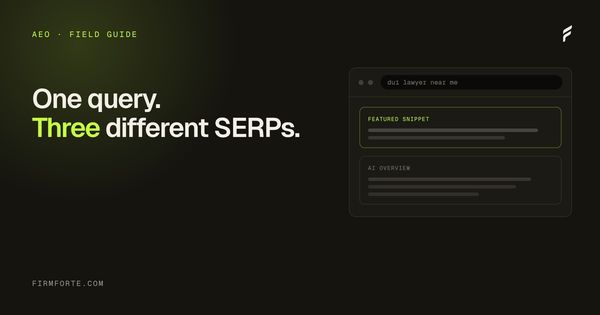
Last Tuesday I ran a search for "what is the statute of limitations for medical malpractice in California" on three different days at three different times. The first time, I got a featured snippet from a state bar website. The second time, I got an AI Overview citing three law firms and the state bar. The third time, the AI Overview included a featured snippet inside it as the cited source. Same query. Three different result shapes within five days.
That's how 2026 looks. Featured snippets aren't dead. They've been absorbed and they appear alongside AI Overviews, sometimes inside them, sometimes adjacent. The approach for both is now nearly identical, with two or three subtle differences. Most law firm content still hasn't been rewritten for this reality.
This piece walks through when each surface appears, what they share, what they don't, and how to build a single page that wins both.
When each surface appears
Walk through the SERP shapes by query type.
Definitional and factual queries still show featured snippets often. "What is the statute of limitations for personal injury in Texas?" tends to return a snippet from a single source (state legal aid, state bar, NOLO). Single fact, single source, no synthesis needed. The snippet is the right shape because the question has one right answer.
Comparative and multi-step queries tend to surface AI Overviews. "How do I file a wrongful termination claim in California?" returns a multi-paragraph AI answer citing two or three sources. Multi-step, multi-source, synthesis required. The snippet doesn't fit because there isn't a single 60-word answer that covers the whole question.
Local and "near me" queries almost always get the map pack first, with both snippets and AI Overviews suppressed. "DUI lawyer near me" pulls up three Google Business listings before any organic result. This is where the E-E-A-T trust signals matter most because the map pack ranking is heavily influenced by review consistency and category match.
Long-tail or ambiguous queries are where AI Overviews show up most aggressively. The harder the question is to answer from a single source, the more likely you're seeing a generated paragraph.
Definitional queries with regional variation trigger both surfaces in sequence. "What is the statute of limitations on a personal injury claim?" might show an AI Overview that cites multiple state-specific sources, with a featured snippet for one state shown inside the Overview's citations. Same query, two surfaces, layered.
Knowing which surface a query triggers matters because the page work is similar but not identical.
What both surfaces want
The good news for law firms: 80% of the work pays off in both places. Both surfaces want:
- A direct answer in the first 40 to 80 words after the heading
- Question-format headings (H2 or H3) that match how people actually phrase the query
- Definitive language: state the answer, don't list disclaimers first
- Schema markup (FAQPage for question pages, LegalService for practice content)
- Trust signals around the author and the source. The E-E-A-T framework for law firms covers this in depth.
A worked example of the exact format both surfaces want:
H2: What is the statute of limitations on a slip and fall in Florida?
Direct answer (first 60 words after the H2): "Four years from the date of the injury, under Florida Statute 95.11(3)(a). The clock starts on the date you were injured, not the date you discovered the injury. Some exceptions extend the deadline, including claims involving minors, claims against government entities (different notice rules apply), and cases where the property owner concealed the dangerous condition."
That structure: H2 phrased as the question, answer in the first 60 words, definitive language, statutory citation, brief enumeration of exceptions. Both surfaces lift from this format.
The page that wins a featured snippet for "What is the statute of limitations for personal injury in Texas?" is almost identical in structure to the page that gets cited in an AI Overview for "How long do I have to file a personal injury claim in Texas?" The questions differ. The page that answers either one cleanly tends to surface in both.
Passage indexing: the underlying mechanic
Google introduced passage indexing in 2020. The mechanism: instead of indexing pages as monolithic units, Google identifies specific passages within a page that answer specific queries. The passage is the unit of retrieval, not the page.
AI Overviews extend this by using the indexed passage as the raw material for synthesis. The engine extracts the passage, possibly rewords it slightly, and inserts it into the AI answer with attribution to the source page.
The implication: a 2,000-word knowledge-base article can win citations for ten different queries if it contains ten clear question-and-answer passages, each properly structured. A 2,000-word essay that buries answers in narrative wins citations for zero queries.
The knowledge-base architecture for law firms covers the page structure that maximizes passage indexability.
What snippets want that AI Overviews care less about
A small set of patterns are snippet-specific.
Liftable formatting. Featured snippets are pulled from specific page sections. Numbered lists, definition paragraphs, and tables get lifted more often than dense prose. A page with a clean numbered list of "Steps to file a claim in [state]" will outperform the same content written as paragraphs for snippet capture.
Concise length. Snippets are bounded. Google lifts roughly 40 to 60 words. If your answer is buried in a 300-word paragraph, the snippet engine will struggle to extract it. AI Overviews are more forgiving since the engine synthesizes across longer passages.
Single source citation. Snippets show one source. AI Overviews show two to four. A snippet candidate page wins or loses on its own. An AI Overview candidate page just needs to be one of several credible sources.
What AI Overviews want that snippets care less about
The reverse list.
Entity reinforcement. AI Overviews lean heavily on the entity graph: firm name, attorney name, practice area, location all linked through schema and external sources. Snippets don't, since they're pulling a passage rather than judging credibility. For the entity layer, see the entities SEO playbook.
Conversational phrasing. AI engines were trained on conversation, so they cite content that sounds like an answer to a spoken question. "A first-offense DUI in Arizona carries..." reads as an answer. "DUI Penalties (First Offense)" reads as a category label, even if the same information follows.
Cross-source consistency. AI Overviews compare what multiple sources say and tend to cite the one that matches the consensus. If your page disagrees with the bar association, the courthouse, and three other firms on a basic legal fact, you probably won't be cited.
Schema for FAQ entries. AI Overviews specifically prefer FAQPage schema where the question is the mainEntity name and the answer is the acceptedAnswer text. Snippets are agnostic on schema (they parse the visible HTML), but AI Overviews give a meaningful boost to properly-marked FAQ content.
A SERP analysis worked example
Take the query "what is the statute of limitations for medical malpractice in California."
Run this in Google. What you'll see, in order from the top:
- AI Overview: a paragraph starting with "In California, medical malpractice claims are subject to a three-year statute of limitations from the date of injury, or one year from the date the patient discovered or reasonably should have discovered the injury, whichever occurs first..." Three sources cited inline: a state bar publication, a personal injury firm, and the California courts.
- People Also Ask box with four expandable questions
- Featured snippet (sometimes, depending on the day): a paragraph lifted from one of the AI Overview's cited sources
- Map pack (if location is enabled)
- Organic blue links
One 2026 results page · top to bottom
A generated paragraph that cites two to four sources inline. Synthesised from indexed passages.
Expandable follow-up questions, each pulling a liftable answer from a page.
Shows some days, often nested inside the Overview. One source, roughly 40–60 words lifted.
On local and "near me" queries, three Google Business listings sit above the organic results.
Everything else, ranked the classic way, below all of the above.
The page that's getting cited in the AI Overview's "personal injury firm" slot looks like this:
- URL ending in /medical-malpractice/statute-of-limitations/
- H1: "California Medical Malpractice Statute of Limitations"
- First H2: "How long do you have to file a medical malpractice claim in California?"
- Direct answer in the first 60 words under that H2
- FAQPage schema with five mainEntity questions including this one
- LegalService schema on the parent practice page
- Multiple internal links to and from related practice pages (statute of limitations across practice areas, the broader medical malpractice pillar, related procedural pages)
- An attorney byline with Person schema linked to the firm Organization
That's the page architecture. It's not exotic. It's the knowledge-base shape applied to a single specific question.
The audit for your own site
Five-minute test, no tools required.
- Pick five queries you'd want to rank for. Make them question-format.
- Run each one in Google. Note whether you see an AI Overview, a featured snippet, both, or neither.
- For the queries where you see either surface, check whether your firm is cited or shown.
- Open the corresponding page on your own site. Find the H2 closest to the query. Read the first 60 words after the H2. If they don't directly answer the query, that's the fix.
- Pull up the page source. Search for "FAQPage" and "mainEntity." If neither appears, that's the second fix.
Both fixes together usually take less than an hour per page. The first results show up within a few weeks of recrawl. If you'd rather not eyeball it, our answer-first content scorer runs the same checks from on-site signals — a direct answer under a question-shaped heading, FAQ schema, readability — and scores the page for you.
One page, both surfaces
The practical takeaway is to build pages that win both. Question-format H2s, direct 40 to 80 word answers, the FAQPage and other schema types a law firm page needs, entity-reinforced byline, and follow-up content for depth. This isn't a stretch. It's a slightly more disciplined version of what good SEO has always been, and it's the architecture our AEO work ships on every page.
The firms that lose are the ones still chasing snippet-only thinking from a 2020 playbook (table-heavy, anonymous, cramped) or the ones writing only for AI Overviews (conversational, vague, structurally loose). Both surfaces reward the same underlying craft. Win that craft once, surface in both places.
For the broader context on how AI search shifted what gets cited, see the AEO vs SEO comparison for law firms. For the foundational citation playbook, see the guide to getting cited by ChatGPT and AI engines.
Questions we get about this
-
What is the difference between a featured snippet and an AI Overview?
A featured snippet quotes a passage from a single page; an AI Overview generates an answer from several sources and cites them. The practical consequence is that a snippet is winner-take-all while an Overview has room for more than one firm. Both are extracted from page content rather than being something you can submit to, and both favor a plain, self-contained answer. Optimizing for one largely serves the other.
-
How do I get a law firm page into a featured snippet?
Answer the question directly, immediately under a heading phrased as the question, in a passage that makes sense lifted out of context. Google extracts passages, so the paragraph has to stand alone — a sentence beginning "as we discussed above" can't be quoted. Keep the answer short enough to display, then expand underneath for the reader who continues. Match the format the question implies: a list question wants a list, a definition question wants a sentence.
-
Can one page win both surfaces?
Yes, and that's the sensible target rather than optimizing separately for each. Both are extracting a passage that answers a question, so the page structure that serves one serves the other: question-shaped headings, direct answers underneath, self-contained paragraphs. Where they diverge, an AI Overview leans harder on corroboration and entity clarity, which is off-page work. Build the page for extraction, then do the corroboration work once for everything.
-
Do featured snippets still matter now that AI Overviews exist?
Yes — they haven't been replaced, and they still appear on a large share of queries where no Overview does. Which surface shows up varies by query type and changes over time, so writing off either is a bet on something you don't control. The reason not to worry much about the split is that the work is the same: a self-contained answer near a matching heading. Optimize for being extractable and let the surface take care of itself.