
The short answer
Personal branding for an attorney in 2026 is mostly a technical problem, not a charisma problem: it's whether you exist as a resolvable entity that a search or AI engine can confirm. A consistent name, a bar record that matches, bylines and speaking listings under the same name, and Person schema tying them together. It isn't posting more, and it isn't a personality.
Two-attorney firms have a pattern worth looking at. One attorney founded the practice, so the website is largely about them: the long bio, the populated Person schema, the law school and bar admission and practice areas all filled in. The second attorney gets four paragraphs and an empty schema block.
Run both names through Perplexity and ChatGPT and the gap shows up immediately. The founder surfaces occasionally. The second attorney surfaces never — and often that attorney has the deeper courtroom record in the practice area the firm most wants to be known for. Tried cases, a teaching post at a law school, a couple of press quotes. None of it connected to her name anywhere a machine can follow.
That's the gap this piece is about: not merit, but whether an attorney exists as an entity. It's also about why personal branding for attorneys looks completely different in 2026 than it did three years ago.
The shift that nobody noticed
Walk through how a potential client actually finds a lawyer in 2026.
They start with a question. They ask ChatGPT or Google. They get a paragraph that names a few firms and a few attorneys. They then do something the marketing playbooks didn't predict: they search the attorney name, not the firm name.
Watching session recordings on legal-vertical sites, the pattern is striking. After the AI summary surfaces "Sarah Chen of Chen and Associates" or "Joe Markey of Markey Law Partners," the next click is rarely the firm's homepage. It's a search for the attorney's name. The user wants to know if this is a real person, what they've done, and whether to trust them. Then, and only then, the firm visit.
This shift, from firm research to attorney research, changes what a law firm's marketing should focus on. For the deeper framework on how AI engines build the graph that decides who shows up in those summaries, see the entities SEO playbook.
The signal AI engines look for
When an AI engine builds the entity graph that decides who gets cited, named attorneys are nodes too. The engine asks: is this person real? Are they licensed? What do they practice? Where did they train? Who else mentions them?
The clearer the answer to each of those questions, the more likely the engine is to cite the attorney by name in a response. And once the attorney is cited, the firm gets carried along. Citation flows from individual to organization, not the other way around.
This is why most law firm sites get the entity structure backwards. They invest in the firm brand, leave attorney bios as prose paragraphs, and wonder why ChatGPT never names anyone from their firm specifically.
The piece on E-E-A-T for law firms in the AI search era covers the Experience and Expertise layers in depth. The personal-branding angle is the implementation layer for both.
What a real attorney entity profile contains
Three layers, just like firm-level entity work.
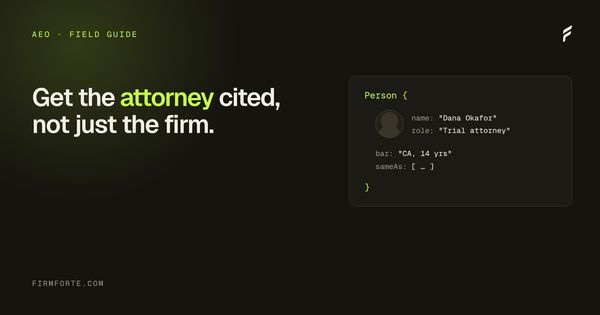
Layer one: on-site Person schema. Every named attorney needs a bio page with structured Person schema underneath the visible content.
Here's the shape, with placeholder values throughout — swap in your own and delete any field you can't actually substantiate:
{
  "@context": "https://schema.org",
  "@type": "Person",
  "@id": "https://www.examplelawfirm.com/attorneys/jane-attorney/#person",
  "name": "Jane Q. Attorney",
  "givenName": "Jane",
  "familyName": "Attorney",
  "additionalName": "E.",
  "jobTitle": "Partner",
  "worksFor": {
    "@id": "https://www.examplelawfirm.com/#firm"
  },
  "image": "https://www.examplelawfirm.com/images/jane-attorney.jpg",
  "url": "https://www.examplelawfirm.com/attorneys/jane-attorney/",
  "alumniOf": [
    {
      "@type": "EducationalOrganization",
      "name": "University of California, Berkeley School of Law",
      "url": "https://www.law.berkeley.edu"
    }
  ],
  "hasCredential": [
    {
      "@type": "EducationalOccupationalCredential",
      "credentialCategory": "license",
      "name": "California State Bar License",
      "recognizedBy": {
        "@type": "Organization",
        "name": "State Bar of California"
      },
      "validIn": {"@type": "State", "name": "California"}
    }
  ],
  "knowsAbout": [
    "Family Law",
    "Divorce Law",
    "Child Custody",
    "Domestic Violence Restraining Orders",
    "Premarital Agreements"
  ],
  "homeLocation": {
    "@type": "City",
    "name": "Sacramento"
  },
  "sameAs": [
    "https://apps.calbar.ca.gov/attorney/Licensee/Detail/123456",
    "https://www.linkedin.com/in/jane-attorney/",
    "https://www.avvo.com/attorneys/jane-attorney.html",
    "https://www.martindale.com/jane-attorney",
    "https://law.example.edu/faculty/jane-attorney/",
    "https://www.examplebar.org/find-a-lawyer/attorney-jane"
  ]
}
Six fields do most of the work in that schema:
- @id gives the attorney a stable canonical identifier the engine can refer back to
- worksFor with the firm's @id connects the attorney to the firm entity. Without this, the attorney is an orphan node.
- alumniOf establishes the educational pedigree
- hasCredential establishes the licensed authority with the issuing bar named
- knowsAbout explicitly enumerates the practice areas. This is what gets matched against query intent.
- sameAs tells the engine "this person is the same person at these other six places"
Common mistake: schema on the attorney bio but no worksFor reference back to the firm's Organization @id. The attorney becomes an unconnected entity. Add the worksFor field and the attorney joins the firm's entity graph.
Layer two: consistent external profiles. State bar profile, county bar profile, Avvo, Martindale, LinkedIn, and the firm's bio page. Each one gets the same headshot, the same credential summary, the same bar admission dates, the same law school. Identical formatting across all six. Then add all six URLs to the Person schema sameAs array on the firm's bio page.
The six sameAs URLs that matter most for a US attorney, in rough order of weight:
- State bar profile (the canonical source, highest weight)
- County bar profile, in markets where county bars maintain directories
- Avvo (especially if the attorney has Q&A activity)
- Martindale-Hubbell (especially with a peer-review rating)
- Law school alumni or faculty page, if applicable
- LinkedIn (weights less than people think, but useful for the verification loop)
sameAs sources, in rough order of weight
The piece on what actually builds off-site authority in 2026 walks through the broader directory landscape.
Layer three: earned mentions. Press quotes in regional papers. Podcast appearances on practice-specific shows. CLE teaching. Bar journal articles. Court records where the attorney's name appears as counsel. Quote-of-record appearances in state or federal opinions. None of these are buyable. All of them compound. Earning those placements at scale is the core of our attorney branding service.
For a working attorney, the earned mentions that tend to matter most are:
- A law school faculty page, if the attorney teaches or guest-lectures (built once, weighted heavily by Google's knowledge graph)
- Any regional newspaper quote, surfaced on the bio with a direct link rather than left to be discovered
- A published opinion where the attorney appears as counsel of record
Six months after we wired the schema, fixed the NAP across the six external profiles, and surfaced the three earned mentions on her bio with verifiable links, her citation rate in our test query basket went from zero to four out of ten. The firm hadn't changed. The signals had become legible.
What personal branding isn't
The phrase gets misused. Two patterns to actively avoid.
Performative LinkedIn content. Posts about "the legal industry," generic motivational threads, AI-generated thought-leadership written without actual thought. None of this builds entity authority. Most of it actively dilutes it by associating the attorney's name with low-quality output. The LinkedIn paradox is that the platform feels productive (likes, comments, reshares) but the entity-graph payoff is close to zero compared to a single press quote or a published CLE engagement.
LinkedIn does count, mostly as a verification surface (the same name, same firm, same credentials, matched against other profiles). It does not count as a place where authority gets built. Treat it as a profile to keep current, not a content channel that earns citations.
Aggregate firm branding pretending to be personal. A bio reading "a seasoned attorney who has dedicated her career to fighting for justice" is firm-brand copy with a name pasted in. It contains zero verifiable information. AI engines ignore it. Use it once on the website if you must. It doesn't count as personal branding.
Real personal branding looks more like: "has tried 92 contested custody cases at Sacramento County Superior Court between 2014 and 2024, and teaches family law trial advocacy at McGeorge School of Law." Every clause there can be checked by someone who wants to. That's an entity profile.
The portability tradeoff
Many firms hold their attorneys back from public-facing personal branding. The worry is reasonable: the attorney becomes more portable, the firm name becomes secondary. If the lead associate becomes a recognized regional expert in family law and then leaves, the firm loses meaningful authority.
The math has changed in 2026 in a way that makes the old caution self-defeating.
If clients now research the attorney first and the firm second, a firm with no recognizable attorneys is invisible in the new search reality. The risk of building attorney visibility is real but contained: the attorney might leave, but the firm gets cited in AI summaries while they're there. The risk of not building attorney visibility is uniform: the firm gets cited rarely or never, regardless of partner tenure.
The firms that win in 2026 are the ones where the attorneys are visible entities and the firm is a strong second node in their graph. The firms that lose are the ones still trying to brand the firm as a faceless authority while named competitors get cited in every AI response.
For a 1-2 attorney firm, push the named attorneys forward. The work compounds. For a 5+ attorney firm, push the partners forward and your two strongest senior associates. Don't try to build everyone's profile at the same intensity; the resource cost outpaces the return.
The hour-a-week routine
Most attorneys can't dedicate hours per day to personal branding. Most don't need to. An hour a week, sustained, is enough to build a credible entity in 12 to 18 months.
The hour budgets best as four 15-minute slots:
- Respond to one client question on a public forum. Quora, Reddit r/legaladvice, Avvo Q&A, your state bar's free public Q&A if it has one. A substantive answer that gets attached to your profile. The platform matters less than the substance.
- Update or expand one external profile. Bar listing, Avvo, Martindale, LinkedIn. Rotate through one per week.
- Write or refine one paragraph on the firm site. Either the attorney's own bio or a knowledge-base page where the attorney is named as the author. The work shows up under the attorney byline.
- Comment substantively on one piece of legal industry writing. Bar journal article, podcast episode, industry publication. Sign with the real bio and firm affiliation. Three or four substantive comments a year tend to get noticed by reporters and bar association editors.
None of these are publishing-volume activities. All of them feed the entity graph. After a year, the attorney's name is associated with their practice area across dozens of independent surfaces.
This routine pairs naturally with the knowledge-base architecture for law firms, since the on-site content the attorney refines weekly lives on question-format pages that AI engines specifically prefer for citation.
The measurement test
Three queries, run quarterly. No tools required.
Query one: "Who are the top [practice area] lawyers in [your city]?" Note whether your name appears.
Query two: "[Your name] attorney" in Google. Look at the first ten results. Count how many are surfaces you don't control (bar, news, alumni page, court records, podcasts) versus surfaces you do (firm website, LinkedIn, Avvo). A healthy attorney entity has at least five non-controlled results in the first ten.
Query three: "[Your full name]" in Google, including the middle name or initial if you use one publicly. Check whether a knowledge panel appears on the right side. The knowledge panel is Google's visible signal that it recognizes you as an identifiable entity. Most attorneys don't have one. Getting one is the long-form goal.
For the foundational AEO playbook that pairs with this work, see the guide to getting cited by ChatGPT and AI engines.
Set your expectations on the timeline. Knowledge panels, where they appear at all, tend to take the better part of a year after the entity signals become coherent across surfaces, and no amount of schema makes that faster. The attorney with more years and more press will still get cited more often, and that is fair. The point isn't to overtake them. It's to be citable at all, which is the difference personal branding actually makes.
Questions we get about this
-
What is personal branding for attorneys?
Being identifiable and verifiable as a specific person across the web, rather than being a name inside a firm's website. Concretely: one consistent version of your name, a bar listing that matches it, work published or quoted under it, and structured data connecting those records to each other. Engines can't assess whether you're a good lawyer, so they check whether you're a real, corroborated entity — and that check is what the term now describes. Charisma is optional; consistency isn't.
-
Should a law firm build the firm brand or the attorney brands?
Both, because they do different jobs and neither substitutes for the other. Individual attorneys are what an engine can verify against bar records, publications, and speaking histories, so a firm whose people are corroborated entities is stronger than one that only speaks corporately. The firm carries the practice-area and location signals and outlives any individual. The failure mode is a firm whose entire authority rests on one person, so make sure more than one attorney is independently findable.
-
What happens to an attorney's personal brand if they leave the firm?
It goes with them, which is the real tradeoff and the reason some firms hesitate. An attorney whose bylines, speaking record, and bar profile are all under their own name takes that record to their next firm, and the old firm keeps only what was built on the firm entity. That's a genuine cost, but the alternative — anonymous content under a firm name — builds less of anything for anyone, because there's no person for an engine to verify. Spread the investment across several attorneys rather than trying to avoid it.
-
How much time does this actually take?
Less than the term suggests, because most of the value is in one-time consistency work rather than ongoing output. Standardizing your name everywhere, correcting your bar listing, and getting Person schema on your bio are afternoon tasks you do once. What's ongoing is modest: being available when a reporter asks, saying yes to the occasional panel, and publishing under your own name rather than anonymously. An hour a week sustains it once the foundation exists.