

The short answer
Local SEO is about appearing in the map pack for searches near you, driven mostly by your Google Business Profile, reviews, and proximity. Organic SEO is about ranking in the ordinary results, driven by content and authority. Local is faster and cheaper to move, so it's where most firms should start — but it's capped by geography in a way organic isn't.
For most law firms, local SEO versus organic SEO isn't a choice, it's a sequence. You need both, and local usually comes first because it produces calls faster. Local SEO wins the map pack and the "near me" searches from people ready to hire. Organic SEO wins the broader informational and practice-area searches from people still researching. Local is the quicker return; organic is the one that compounds. Understanding which does what tells you where to spend first.
Here's how the two differ, which brings clients sooner, and how to sequence them for a law firm.
What's the difference between local and organic SEO?
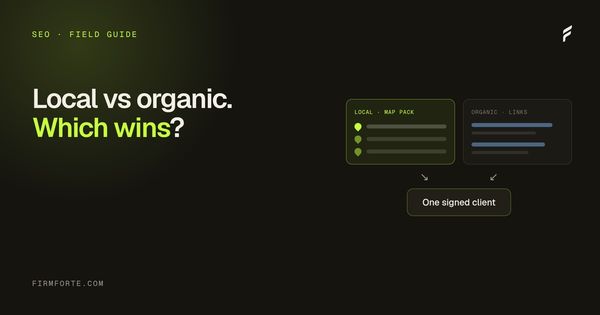
Local SEO is about ranking in the map pack, the three-business block with a map that Google shows for location-based searches, and it runs on your Google Business Profile, your reviews, your proximity, and your local signals. Organic SEO is about ranking in the classic blue links below that, and it runs on your website's content, structure, authority, and links. Same search results page, two different games.
The mechanics differ enough that they're almost separate disciplines. Local SEO is heavily about your Google Business Profile and how close you are to the searcher; you can't out-content your way past proximity in the map pack. Organic SEO is about your pages being the best, most authoritative answer to a query, where location matters less and content and links matter more. A firm can be strong at one and weak at the other, which is exactly why treating them as a single blur leads to spending in the wrong place.
Which one gets a law firm clients faster?
Local, in most cases. The map pack sits at the very top of location-based searches and shows your phone number and reviews inline, so a well-optimized Google Business Profile can start producing calls before your organic rankings have climbed anywhere. For a firm whose clients are nearly all local, and search with local intent, the map pack is the shortest path to the phone ringing.
This matters because most law firm searches carry local intent, people want a lawyer they can actually see, in their city. Winning the map pack means being one of three firms a ready-to-hire searcher sees first, and that's a faster, more direct route to a call than organic rankings, which take longer to build and sit below the pack. So if you need calls sooner rather than later, local is where the quick wins are, and it's why we argue that for a small local firm, local SEO isn't a part of the strategy so much as the core of it. The full local playbook is in the Google Business Profile guide from setup to map pack.
So should a firm just do local and skip organic?
No, because local only captures the searcher who's already ready to call. Organic SEO captures the much larger audience earlier, the people researching their problem before they're ready to hire, through informational content and practice-area pages. Skip organic and you're only competing for the ready-to-call minority, handing the research phase to whichever firm answered the question first.
The two audiences are different sizes and different stages. A relatively small number of people search "divorce lawyer near me" ready to hire; a much larger number search "how is property divided in a divorce" while they're still figuring things out. Local wins the first group. Organic content wins the second, and by earning their trust early, it feeds them toward you when they're ready. Your practice-area pages, the highest-converting organic asset you own, are covered in why practice-area pages are the highest-ROI page a firm builds. A firm doing only local is leaving the top of the funnel entirely to competitors.
How do local and organic work together?
They cover different stages of the same journey and reinforce each other. Organic content builds trust and captures people early, in the research phase. Local captures them at the moment of decision, when they search with intent to hire. And the content and links that power your organic rankings also strengthen the overall authority signals that help your local ranking, so the two aren't isolated, they compound.
Picture the client's path. They search an informational question, land on your well-written practice-area or FAQ content (organic), come away trusting you, and weeks later search "[practice] lawyer near me" ready to act, where your map pack presence (local) closes it. Neglect either end and the path breaks: all content and no local means you inform people who then hire the firm in the map pack; all local and no content means you only ever meet people at the last second, competing on proximity alone. The keyword strategy that connects both, choosing the right local and informational terms, is in keyword strategy for solo law firms.
Which should a firm prioritize first?
For a local practice, nail local first, then build organic. Local delivers faster returns and the foundational pieces are quick and often free: claim and complete your Google Business Profile, get the category right, gather genuine reviews, and clean up your NAP consistency. Our local SEO checker grades the on-site half of that — a visible NAP, LocalBusiness/LegalService schema, an embedded map, and clear city and practice-area signals. Those moves can move your map-pack visibility in weeks. Then layer in the slower, compounding organic work: practice-area pages and informational content.
This sequence gets a firm to calls fastest while building the long-term asset in parallel. The local foundation is a sprint you can largely finish, and it starts paying quickly; the organic content is a marathon that pays more over time. Do the local sprint first so the phone starts ringing, then commit to the organic marathon so the pipeline compounds. Trying to do the reverse, pouring months into content while your Google Business Profile sits half-built, leaves the fastest wins on the table.
When does organic matter more than local?
When your practice is less tied to a single location, when you serve a wide area or multiple offices, or when your market's map pack is so saturated that organic and content are where you can actually differentiate. A firm competing statewide, or in a practice where clients will travel for the right expertise, leans more on organic authority than on proximity.
Practice area shapes this too. A hyper-local, high-urgency practice lives and dies in the map pack. A more considered, expertise-driven practice, where clients research carefully and will look beyond the nearest office, gets more from organic content and authority. So the "local first" default holds for most local firms, but read your own situation: if your clients don't choose by proximity, weight organic accordingly. Either way, the two together beat either alone. To see where your firm stands on both fronts, run the free review, and the full method is in the complete law firm SEO guide, with the ongoing work handled through our SEO service.
Questions we get about this
-
What's the difference between local SEO and organic SEO?
Local SEO competes for the map pack — the block of business listings with a map — and is driven by your Google Business Profile, reviews, citations, and how close you are to the searcher. Organic SEO competes for the ordinary blue links and is driven by content, structure, and authority. They use different signals and are won in different ways, which is why a firm can dominate one and be invisible in the other. Most firms need both, in that order.
-
Which gets a law firm clients faster?
Local, usually by a wide margin. Profile and citation work can move within weeks, the map pack sits above organic results for location-intent searches, and the people using it are close to hiring. Organic takes months and pays off over years. If you need something to move this quarter, local is where the movement is available.
-
Should a law firm just do local SEO and skip organic?
No, because local has a ceiling that organic doesn't. Proximity is a ranking factor you can't change, so a firm competing for a metro from one office is limited by where that office is — and the map pack shows three results regardless of how many firms want in. Organic reaches people researching before they search locally, and it reaches beyond your immediate radius. Start local, but treat organic as the thing that compounds.
-
When does organic matter more than local for a law firm?
When the client doesn't search by location — practice areas where people hire on expertise rather than proximity, or where the matter is handled remotely. It also matters more when you're competing across a large metro from one office, since proximity will always cap the map pack, and when the research phase is long and someone reads several pages before contacting anyone. Estate planning and specialized commercial work skew this way; personal injury and criminal defense skew local.