We ran our AEO playbook on ourselves.
We sell AEO: the work of making a law firm's site eligible to show up in AI answers. It's fair to ask whether we do it on our own site, and whether it works. So here's that same work on firmforte.com, and what Google's and Bing's own reports show after about 90 days — the real numbers, with the caveats.
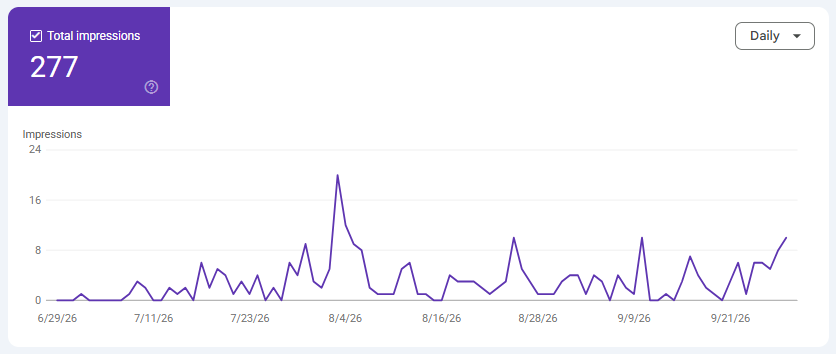
- 277 Appearances in Google's AI features
- 486 Citations in Bing's AI answers
- 60 Of our pages surfaced in AI answers
Three months ago, neither report had anything in it. We didn't chase a hack. We did the dull fundamentals we build into every client site, and watched two independent engines start pulling our pages into their answers.
Two engines, two different words.
Google Search Console has a Generative AI Features view that counts how often your pages showed up in Google's AI surfaces, AI Overviews and AI Mode. It reports impressions: appearances, not clicks, because Google doesn't yet break out clicks for AI features. Bing Webmaster Tools has its own AI performance report, and it counts citations, meaning the times your pages were cited in Bing's AI answers. "Citation" is a stronger word than "appearance," but it's still Bing's own count on Bing's own surface. It isn't a click, and it isn't a lead.
Both reports share one blind spot: each only sees its own engine. Neither tells you anything about ChatGPT, Claude, or Perplexity, because none of those publishes a per-site report. The only way to know whether one of them named you is to ask it the question and read the answer yourself.
No hack. Just the fundamentals.
Crawlable without JavaScript
The content is in the HTML, not assembled by a script a bot may never run. A crawler gets the real page, not an empty shell.
Answer-first writing
Pages lead with a direct, liftable answer to a real question, then expand. An engine can take the first paragraph and have something useful.
Schema as hygiene
Accurate LegalService, Person, and FAQ markup. Not a magic citation trick, because it isn't one, but it removes ambiguity about what a page is.
An open door, and real depth
A robots.txt that lets the answer-engine crawlers in, over a real knowledge hub of interlinked posts, so we're a reasonable source to pull from.
A fair word on cause and effect: we did this work, and these appearances and citations followed. We can't prove the first caused the second to the standard we'd hold a client's claim to, because search is noisy and plenty we don't control moves it too. What we can say is that none of it is exotic, and every step is something your firm can copy.
Both engines bent upward.
| Month (2026) | Google appearances | Bing citations |
|---|---|---|
| July | 62 | 18 |
| August | 119 | 104 |
| September (to the 28th) | 96 | 364 |
On Google, 60 different pages turned up, from the homepage to blog posts to service and comparison pages, so this isn't one page getting lucky. The most-surfaced pages include the homepage, our pricing page, and our AEO service page. An AI answer surfacing a pricing page is the useful kind of visibility. Fifty-nine percent of those impressions were in the United States, our actual market, and most were on desktop.
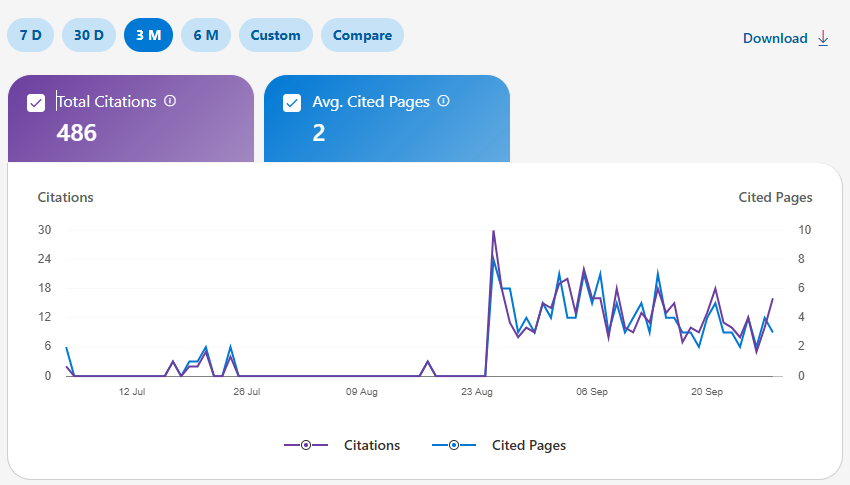
These are early numbers, in a narrow niche, and we're not going to dress them up as more than that. What makes them worth publishing is the direction: both engines started near zero, both climbed, one is still climbing, and the visibility is spread across dozens of pages instead of resting on a single fluke. The number that would really count is inquiries, and these reports can't measure that. What they can show is that the door is open and the engines are walking through it.
Want to know whether AI answers can see your firm?
We'll show you what the crawlers can and can't reach, and where you turn up in AI answers — free, read by a human, back in 48 hours.
Free site reviewData windows: Google Search Console (Generative AI Features) and Bing Webmaster Tools (AI performance), Jul – Sep 2026. Google reports appearances, not clicks; Bing reports citations. Last updated October 1, 2026.