

The short answer
You can ask a client for an honest review, and you should. What the rules prohibit is paying for reviews, offering anything of value in exchange, and writing or editing them yourself. The genuinely dangerous part is responding to a negative one: under ABA Formal Opinion 496 you cannot reveal information relating to a representation in a public reply, even to defend yourself, even if the review is unfair.
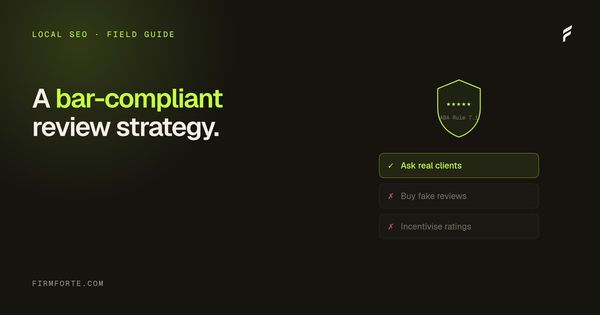
You can build a strong review profile without stepping on a single bar rule, and it comes down to three things: ask real clients honestly, never publish or feature anything misleading, and never reveal client information when you respond to a bad one. Reviews are a genuine ranking and trust factor for a law firm. The ethics don't live in whether you collect them. They live in how you ask, and how you answer.
Here's the compliant version of a review strategy, including the one that trips up the most lawyers: what to do when the review is negative.
Can lawyers even ask clients for reviews?
Yes. Asking a satisfied former client to leave an honest review is permitted and, frankly, expected in 2026. What's prohibited is manufacturing reviews, offering something of value in a way that improperly induces them, or presenting them so they mislead. The ask itself is fine. The manipulation is what the rules are built to stop.
This matters because a lot of lawyers avoid review-gathering entirely out of a vague sense that it's somehow forbidden, and then wonder why the firm two doors down owns the map pack. Genuine reviews from real clients, gathered honestly, are exactly what the rules contemplate. You're not doing anything questionable by asking a happy client to share their experience. You'd be doing something questionable by writing it yourself, paying for it, or dressing it up as a guarantee, and those are lines that are easy to stay well clear of once you know they exist.
What makes a review or testimonial cross the ethics line?
Making it false or misleading. Under ABA Model Rule 7.1, a lawyer can't make a false or misleading communication about their services, and that reaches the testimonials you solicit or feature. The classic problem is a testimonial that promises a result ("she got my whole case dismissed") displayed so it leads prospective clients to expect the same outcome.
The fix for that isn't to hide every good review; it's to avoid presenting outcome-based claims as if they're typical. A review that describes a specific result may need a disclaimer noting that outcomes depend on the facts of each case, because otherwise it can create the unjustified expectation Rule 7.1 treats as misleading. In practice, most Google reviews from happy clients talk about the experience, the communication, the way they were treated, and those are safe to collect and display as they are. It's the results-promising ones you handle with care. And because bar rules vary by state, with some stricter than the model rule, the specific disclaimer language is worth confirming against your own jurisdiction.
How do you actually ask for reviews the right way?
Simply, at the right moment, and without pressure or payment. The best time is right after a good outcome or a positive interaction, when the client's goodwill is highest. Make it effortless by sending a direct link to your Google profile, ask once, and don't incentivize it. A steady, natural flow of honest reviews is the goal, not a pile all at once.
The mechanics that work are unglamorous. A short, personal message thanking the client and including the direct review link removes the friction that kills most review requests. Asking at the natural high point, rather than months later, catches people while they're still grateful. And keeping it to a genuine ask, with nothing offered in return, keeps you clear of both the bar rules and Google's own policies against incentivized reviews. Done this way, a firm accumulates real reviews at a steady pace, which is also what ranks best: a consistent trickle over time reads as authentic, where a sudden burst of fifty looks exactly like what it usually is.
What can you do about a negative review?
Far less than your instinct wants, and that restraint is the rule, not a suggestion. The critical point, from ABA Formal Opinion 496, is that you cannot reveal information relating to a client's representation in a public response, even to defend yourself, and even if the review is unfair or inaccurate. A negative review does not trigger the self-defense exception to confidentiality.
This is where good lawyers get into real trouble, because the urge to correct the record is strong and the response feels justified. It isn't permitted if it discloses confidential information, and the duty of confidentiality under Model Rule 1.6 is broad. The ABA's guidance is blunt: often the best response is no response at all. Where you do respond, the permissible moves are narrow: ask the platform to remove a review that violates its policies, invite the person to discuss it offline through a non-public channel, or post a brief, general reply that your professional obligations prevent you from responding to the specifics. What you can't do is tell your side of the story if telling it means revealing anything about the representation. A measured, content-free response, or silence, protects you. A detailed rebuttal can turn a bad review into a bar complaint.
Do reviews actually help you rank?
Yes. Reviews are part of the prominence signal that helps decide the local map pack, and both the quantity and the steady pace matter. A firm with a healthy, growing set of genuine reviews is more likely to land in the three-result block that catches local searches before anyone scrolls to the organic results.
So the compliant strategy and the effective strategy are the same strategy, which is convenient. Asking real clients honestly, at the right time, builds the exact review profile that both converts nervous prospects and feeds your local ranking. Reviews are one leg of the local visibility work, alongside your category and your NAP consistency, all of which we cover in the full Google Business Profile guide from setup to map pack. Get the reviews right and you're strengthening the single highest-return piece of local marketing a firm owns.
What about your specific state's rules?
Check them before you build a program, because the model rules are a floor and some states go further. A handful of jurisdictions have stricter advertising and testimonial requirements, specific disclaimer mandates, or tighter solicitation rules, and your state bar's guidance controls over the ABA model. A few minutes confirming your state's position is cheap insurance.
None of this should scare a firm off review-gathering, because the compliant path is clear and well within reach. Ask real clients honestly, keep testimonials truthful and free of unjustified promises, stay silent or general when responding to criticism, and confirm your state's specifics. That's the whole framework, and it produces a review profile that's both ethical and effective. To see how your current reviews and local presence stack up against the firms beating you in the map pack, run the free review, or have the whole local setup handled through our Google Business Profile service.
Questions we get about this
-
Can lawyers ask clients for Google reviews?
Yes, in general — asking a satisfied client for an honest review is permitted, and the prohibitions are on incentives and authorship rather than on asking. What you can't do is pay for a review, offer a discount or gift in exchange, write one yourself, or edit what a client wrote. Your state bar's advertising rules are the controlling authority and they vary, so read yours before you build a process around this. Keep the ask neutral, mention nothing about outcomes, and never script what the client should say.
-
How should a law firm respond to a negative review?
Carefully, and usually with far less than instinct demands — under ABA Formal Opinion 496 you cannot reveal information relating to a client's representation in a public response, even to defend yourself and even if the review is inaccurate. A negative review does not trigger the self-defense exception to confidentiality, and the duty under Model Rule 1.6 is broad. The permissible moves are narrow: ask the platform to remove a review that breaks its policies, invite the person to talk offline, or post a brief general reply saying your professional obligations prevent you from discussing specifics. A detailed rebuttal can turn a bad review into a bar complaint.
-
Can a law firm offer a discount for leaving a review?
No. Offering anything of value in exchange for a review breaches both bar rules on incentivized testimonials and Google's own review policies, and it puts the reviews you already have at risk. That includes discounts, gift cards, entry into a drawing, and waived fees — the value doesn't have to be large to count. If a review platform detects a pattern of incentivized reviews it can remove them wholesale. Ask for honesty and nothing else, which is also the version that survives scrutiny.
-
Do Google reviews help a law firm rank?
Yes — reviews feed the prominence signal Google uses to rank the local pack, and they also carry heavily in whether someone picks you once they've seen you. Steadiness matters more than bursts: a consistent flow of genuine reviews reads as an active practice, where fifty in one week followed by silence reads as exactly what it usually is. Build the ask into how a matter closes so it happens without anyone remembering to do it. The ranking benefit is real but secondary to the conversion benefit.