
The short answer
Most law firm Google Business Profiles lose on the same seven things: a primary category that's too broad, an empty services section, an unmonitored Q&A anyone can answer, photos years out of date, unused posts, reviews chased in bursts rather than steadily, and a name-address-phone footprint that contradicts the website. None of it costs money. All of it sits above your website in local results.
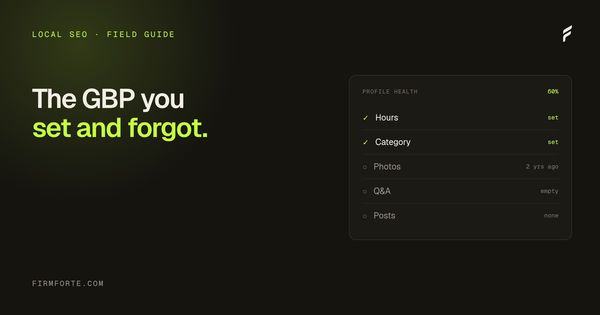
Somewhere around 2021, your firm's Google Business Profile got set up. Maybe you did it yourself, maybe an agency did it as part of a package, maybe Google half-created it from public records and sent you a postcard to claim it. Either way, there's a profile. It shows your address, a phone number, probably your hours. You verified it, it went live, and then nothing. You moved on.
That's the modal law firm GBP situation. Claimed, verified, ignored. And it's costing map-pack rankings in a specific, fixable way that has nothing to do with how many reviews you have.
The primary category is probably wrong
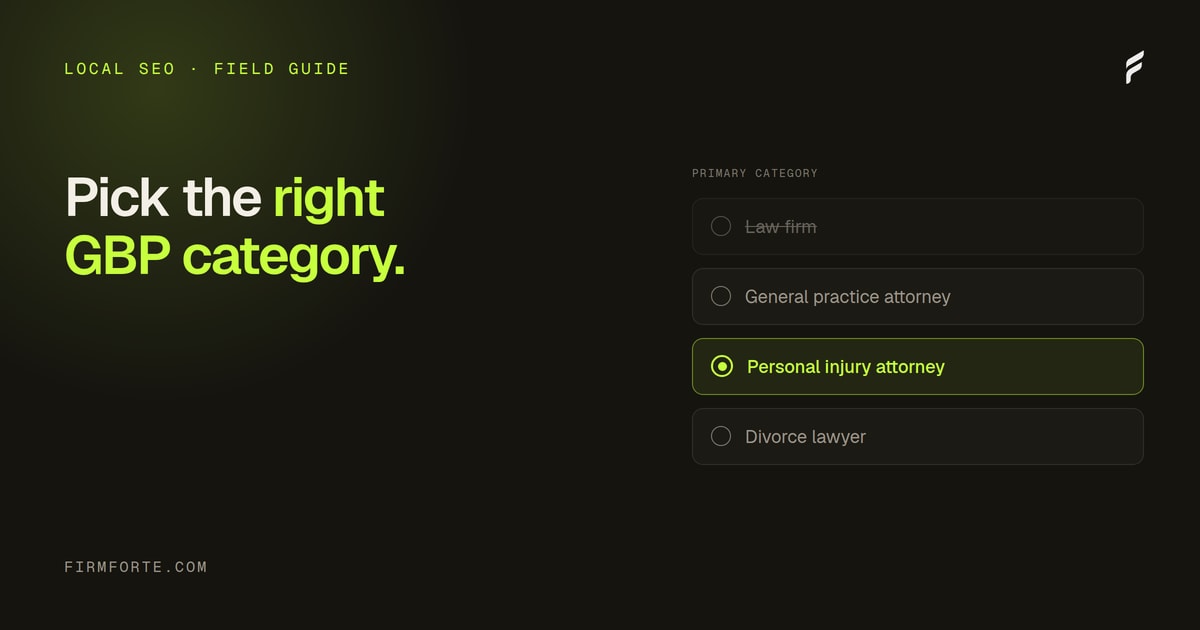
Google lets you pick one primary business category and several secondaries. Most lawyers either chose "Lawyer" or "Law firm" years ago and left it there. Both are too broad. If you practice personal injury, your primary category should be "Personal injury attorney." Family law? "Family law attorney." Criminal defense? "Criminal justice attorney."
Google's map pack is geo-filtered by category. When someone searches "personal injury lawyer Houston," Google shows businesses it's tagged as personal injury attorneys. A profile categorized as "Lawyer" has a real disadvantage against a competitor who picked the right one. Check yours. You can change it without any risk. Choosing the primary and secondaries well, and the mistakes that quietly cap your visibility, is worth its own read: how to pick Google Business Profile categories for a law firm.
The services section is usually empty or generic
GBP has a Services tab where you list what you actually do, each entry with a name, category, and optional description. Most profiles have it blank, or a copy-pasted version of whatever the default loaded in. This is searchable content. "Motorcycle accident claims," "wrongful death suits," "slip and fall cases": those specific phrases get indexed by Google and matter for which queries your profile surfaces against.
Write real service descriptions. 150 to 200 words each if you can. Answer the question the client is already asking: what do you actually do for me, and what does it involve. This is one of the few places on a GBP where you can publish substantial content, and most firms leave it blank.
Nobody is monitoring the Q&A section
There's a Q&A section on every Google Business Profile. Anyone (a client, a competitor, a bot) can ask a question there. Anyone can answer it. And most firms have no idea what's sitting in theirs. We've seen profiles where a competitor answered a question with wrong information, where outdated details got posted as answers, where questions sat unanswered for two years. All of it appears publicly on the profile as if the firm endorsed it.
Check your Q&A section today. Then set a calendar reminder to check it weekly. Answer every question yourself, because if you don't, someone else will. Google actually recommends that businesses pre-populate their own Q&A with the questions they get asked most often, which is a legitimate move and something almost nobody does. Three or four well-written Q&As about your intake process, your fee structure, and what practice areas you cover takes 20 minutes and sits there working indefinitely. The Q&A section and Posts are both easy to overrate, though, so it's worth knowing what each is actually worth before you pour time in: whether GBP posts and Q&A actually matter.
Photos from 2021 are aging your profile
Google weights freshness. A profile that hasn't had a new photo added in two years is a signal the business may not be active. Not a ranking killer on its own, but it's one of several freshness signals Google tracks, and the fix is trivially easy.
Six to eight photos, added every couple of months, is enough. They don't need to be professional shots. Interior and exterior of the office, headshots of the attorneys, the conference room where client meetings happen. Anything that says this firm is real and currently operating. If you have zero photos, that's the first thing to fix. Google's own data shows businesses with photos get substantially more clicks to their website and direction requests than those without, and a law firm profile with no images reads as abandoned.
Google Posts exist and nobody uses them
GBP has a feature called Posts, which lets you publish short updates directly to your profile. They show up on your listing in both Google Search and Maps. Most law firms have never posted once.
You don't need to post every week. Once or twice a month is enough to signal activity. A note about a blog post you published, a reminder that you offer free consultations, a seasonal practice area reminder before tax season or open enrollment. Keep it short — 150 words or less — and always include a photo. These posts expire after seven days, which means adding them regularly creates a natural freshness signal without any technical work on your end.
The review problem isn't volume
Everyone focuses on getting more reviews. That's not wrong, but it misses the actual issue most firms have. The issue is response rate. A profile with 30 reviews and zero responses looks abandoned. A profile with 12 reviews and a thoughtful reply to every one looks like a firm that pays attention.
Respond to every review, good or bad. For negative ones, don't argue, don't post any confidential detail, and don't apologize for things that didn't happen. A short professional acknowledgment is enough. Bar rules in most states allow responses that don't admit liability or disclose client information, but check your state's advertising rules before you draft a template, because they vary. The full compliant playbook, including how to gather reviews without crossing a bar line, is in a bar-compliant review strategy for law firms.
On getting reviews in the first place: the most reliable method is also the most obvious. Ask, immediately after a good outcome, with a direct link. Not a vague "feel free to leave us a review" at the bottom of a final invoice — a specific text message that says "if you're willing, here's the link, it takes about two minutes." Response rates on a direct ask sent while the experience is fresh are dramatically higher than passive requests buried in paperwork. The difference isn't marginal.
NAP consistency is the foundation all of this sits on
None of the above works if your name, address, and phone don't match across the web. Your GBP says "Smith & Jones Law" and your website header says "The Law Offices of Smith & Jones" and your state bar listing says "Smith Jones PLLC" — that's three different entities from Google's perspective, and it costs you on both map-pack ranking and AI engine entity recognition. We covered how that consistency gap plays out in entities SEO for law firms, and in the post on how AI engines make citation decisions.
Run the 90-minute audit and check your citations under the local section. You want every major directory — Justia, Avvo, Martindale, FindLaw, Yelp, your state bar directory — showing the same legal business name, the same address, one phone number. When they disagree, the fix is usually free and just tedious, which is why most firms never do it. The full cleanup, including the call-tracking-number trap that quietly fragments your NAP, is in NAP consistency for law firms.
What a worked GBP actually does
NAP consistency the base
Same legal name, same address, one phone across every directory. Get this wrong and nothing above it counts.
Primary category
Pick "Personal injury attorney," not "Lawyer." The map pack filters on it.
set onceServices tab
Real 150-word descriptions, not the default blank.
set onceQ&A section
Answer them yourself before a competitor posts something wrong.
weeklyPhotos
Six to eight, refreshed every couple months. Stale reads as closed.
monthlyGoogle Posts
Once or twice a month, always with a photo. They expire in seven days by design.
monthlyReviews
Reply to every one. Response rate beats raw count.
weeklyThe payoff compounds. Entity consistency raises the floor for both map-pack ranking and AI citations. Add the photo cadence, the Q&A monitoring, the correct primary category, and the Posts routine on top of that, and you've got a GBP that's actively working rather than passively sitting there. The whole thing takes about 90 minutes to set up properly and 30 minutes a month to keep running. For the complete version, from first setup through winning the map pack, see the Google Business Profile guide from setup to map pack, and to see where your profile stands against the firms beating you locally, run the free review. Full details on what that looks like done for you are on the Google Business Profile service page.
Questions we get about this
-
What is the most important part of a law firm Google Business Profile?
The primary category, because it decides which searches you're eligible for at all. A firm doing mostly family work listed under the generic "Lawyer" is competing on a broader, weaker signal than one listed as "Divorce Lawyer" or "Family Law Attorney". Everything else on the profile — services, posts, photos, reviews — tunes performance within the categories you've chosen, so getting the category wrong caps what the rest can do. Check it first, and revisit it when your practice mix shifts.
-
Can anyone answer questions on my law firm Google profile?
Yes, and that's why the Q&A section needs monitoring. Google's profile Q&A is open — any member of the public can post a question and any member of the public can answer it, including people with no connection to your firm and no idea what they're talking about. Those answers are visible to everyone comparing you against two other firms. Seed the section with the questions you actually get asked, answer them yourself, and check it on the same schedule you check reviews.
-
Do Google Posts and photos actually help a law firm profile?
They help conversion more reliably than they help ranking, which is still a reason to do them. A profile with current photos and recent posts reads as an active practice; one whose most recent photo is years old reads as a firm that may not still be there. Posts also give you a place to answer a timely question in your own words where a searcher will actually see it. Treat them as the storefront rather than as a ranking lever, and the effort makes sense.
-
What is NAP consistency and why does it matter?
NAP is your name, address, and phone number, and consistency means they're identical everywhere they appear — website, Google profile, bar directory, aggregators. It matters because an engine trying to confirm you exist compares those records, and a mismatch reads as ambiguity rather than as a typo. Suite numbers, abbreviations, tracking phone numbers, and old office addresses are the usual culprits. It's the foundation everything else on the profile sits on, so fix it before optimizing anything above it.