
The short answer
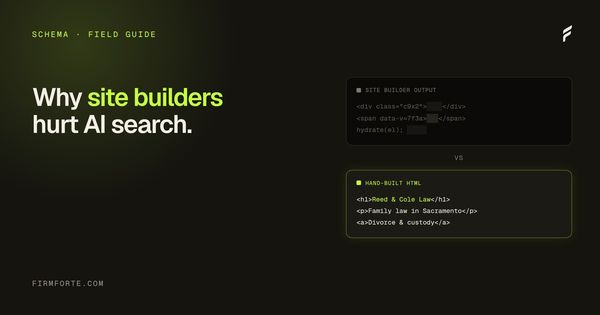
The common website builders hurt AI visibility in four specific ways: they render content with JavaScript that some crawlers never execute, they ship schema that's missing or wrong, their default robots rules can block AI crawlers outright, and their templates rarely state plainly what the firm does and where. None of these are visible to you in a browser, which is exactly why they persist.
Every few weeks, a lawyer's site comes through the free review and the scan comes back with the same pattern: no schema, homepage never mentions the city or practice area, AI crawlers blocked, score in the low 20s out of 100. Almost every time, it's a GoDaddy Website Builder site. Sometimes Wix. Occasionally Squarespace. Rarely WordPress.
The easy explanation is that the lawyer used a tool designed for simplicity, not search. But that misses what's actually happening technically. These platforms don't just make SEO harder. They have specific structural characteristics that make them systematically poor at the signals AI engines now rely on. Understanding the exact problems is worth the trouble, because it explains why a rebuild isn't about aesthetics.
The JavaScript rendering problem
GoDaddy's Website Builder and Wix both render a significant portion of page content in JavaScript. When Googlebot visits a typical Wix or GoDaddy page, it often sees a shell on the first pass — the HTML frame. The actual text content, the headings, the paragraphs that establish what the page is about, loads from JavaScript that runs after the page is fetched. Google does eventually render this JavaScript, but it happens in a second wave that can lag the first crawl by days or weeks. Some pages never get properly rendered at all.
For a law firm homepage, this matters immediately. Google may see a page with no indexable text about the attorney's name, practice area, or city on the first pass. The content that would make this recognizable as a "personal injury attorney in Sacramento" page isn't there for the crawler that counts.
AI engines have a different problem. Perplexity, ChatGPT's web browsing, and similar tools often don't render JavaScript at all. They fetch the HTML and read whatever's there. A Wix page with its content in JavaScript is often a nearly blank document to an AI engine trying to read it. The firm exists. The content exists. But neither the AI engine nor the prospect who finds it through an AI-generated answer can see it.
Same firm · what an AI crawler actually reads
Website builder
GPTBot fetches the HTML →
Text renders in JavaScript; the HTML is a near-empty shell
No LegalService or FAQPage the platform can emit
robots.txt may block GPTBot, ClaudeBot, PerplexityBot
Hero reads "Fighting for you" — no practice area, no city
Custom WordPress
GPTBot fetches the HTML →
Practice area, city, and attorney name in crawlable text
Full schema stack: LegalService, FAQPage, Person
robots.txt is a file you control; AI crawlers allowed
Answers sit in plain HTML the engine can lift
Schema is either missing or broken
All three platforms — GoDaddy, Wix, Squarespace — have added some schema support in recent years. Squarespace handles Organization and LocalBusiness markup reasonably well for basic setups. GoDaddy's Website Builder produces almost no structured data by default. Wix has a schema editor, but it's limited, and the LegalService type that law firms specifically need either isn't available, or requires a workaround most lawyers won't know to pursue.
What this means in practice: a typical law firm on a website builder has no LegalService schema (worth 22 points in our audit scoring), no FAQPage schema, and often no proper LocalBusiness markup either. That's three of the seven signals we check, all failing, because of a platform decision made a few years ago. We list all seven schema types a law firm site should have in the full schema guide. On WordPress, adding and customizing all of them takes an afternoon with a decent plugin. On a website builder, some simply can't be added at all.
The robots.txt defaults can block AI crawlers
AI engines use named crawlers to read and index content. GPTBot (ChatGPT), ClaudeBot (Anthropic), PerplexityBot, and Google-Extended all announce themselves in their user-agent string and respect robots.txt directives. Website builders, particularly older GoDaddy configurations, sometimes ship with defaults that block these crawlers — either explicitly, or by blocking entire user-agent categories that include them.
This is the specific thing that produces complete AI invisibility. A site can have decent content, a clean design, and reasonable traditional SEO, and still be completely invisible to ChatGPT because GPTBot is blocked in robots.txt, often without the lawyer's knowledge. Check yours: type your domain followed by /robots.txt and look for any "Disallow" lines referencing GPTBot, ClaudeBot, PerplexityBot, or Google-Extended. If any of them are blocked, that's your first fix. On a website builder, changing it typically requires a support ticket, because you usually don't have direct access to the file.
The homepage probably doesn't say what the firm does or where it is
This problem isn't exclusive to website builders, but their templates make it dramatically worse. The default hero text on a legal template tends to be something like "Fighting for your rights" or "Experienced. Compassionate. Dedicated." The templates are designed to look professional, not to answer the questions Google and AI engines actually care about: what kind of lawyer are you, and what city are you in?
A homepage that leads with a vague tagline and never mentions "bankruptcy attorney" or "Chicago" in crawlable text fails the local identity signal. The attorney's name might be in the logo as an image file. The practice area might be gestured at in a photo caption. The city might appear only in the footer address. None of that is sufficient for an AI engine trying to establish whether this page is relevant to a "bankruptcy attorney in Chicago" query. And this is exactly the pattern we see over and over in low-scoring audit results — a site that looks fine visually but says almost nothing that a crawler can read and use.
WordPress, for all its overhead, makes it trivial to put the right words in the right places in an indexable format. The block editor is explicit: you're placing visible, crawlable text. Website builders often abstract that away to the point where what you're typing isn't rendering as text a crawler can use. The post on how AI engines make citation decisions covers why the local identity signal sits so high in what matters.
The template problem compounds
Thousands of law firms use the same Wix legal template. Same heading hierarchy, same div structure, same class names. Google has seen this template so many times it can identify it instantly. A site built on a template that feels unique to the lawyer is, to a crawler, indistinguishable from every other site on that template.
This creates a differentiation floor problem. Content quality matters less when the structural context says "generic law firm on the Wix legal template." And the signals that distinguish one firm from another — practice area depth, location specificity, real FAQ content, entity corroboration — are hard to express within the template's constraints, easy to neglect when the template handles the visual work of looking complete.
A custom WordPress build, even a simple one, doesn't have this problem. The structure is yours, the schema is fully customizable, and the robots.txt is a plain text file you control directly.
Why this gap is widening
Two years ago, a GoDaddy site could rank acceptably on traditional Google if the SEO fundamentals were otherwise solid. Google had gotten better at JavaScript rendering, and page-level signals could compensate for some of the technical gaps.
AI search doesn't work that way. ChatGPT and Perplexity don't rank anything. They retrieve and cite. A site that AI crawlers can't read doesn't get a lower ranking — it gets zero. Invisible to GPTBot means not in the training data and not in web browsing results. Invisible to PerplexityBot means no citation ever. There's no partial credit, no second page, no "still getting some traffic from position 9."
The firms that move first on this get a compounding advantage. The ones still on website builders in 2027 won't have a ranking problem. They'll have a non-existence problem in the channel that's now handling a growing share of how people find attorneys. We covered what you actually own (and don't) on a website builder in who owns your law firm website. The short version: if you can't edit the robots.txt, can't add custom schema, and can't move your site without rebuilding it from scratch, the platform owns more of your visibility than you do. That's a different kind of lock-in than a bad contract, and in some ways a worse one.
Questions we get about this
-
Do website builders hurt law firm SEO and AI visibility?
They can, in ways that don't show up when you look at your own site. The four recurring problems are JavaScript-rendered content that some crawlers never execute, schema that's absent or malformed, robots.txt defaults that block AI crawlers, and templates whose homepage never states the practice and the city in plain text. Your browser runs the JavaScript and fills in the gaps, so the site looks fine to you and reads as empty to a crawler that doesn't. Check what a crawler sees rather than what you see.
-
How do I check whether an AI crawler can read my site?
Fetch your page without JavaScript and read what comes back — if the practice areas, city, and phone number aren't in that response, a crawler that doesn't execute scripts isn't getting them either. Then read your robots.txt for rules blocking AI user agents, which some platforms add by default. Our free tools do both, and so do a dozen others; the point is to look at the raw response rather than the rendered page. This takes about ten minutes and is the cheapest diagnostic available.
-
Does my law firm need to leave Wix or Squarespace?
Not necessarily — check which of the four problems you actually have before you move. Robots rules and missing schema are usually fixable in place, and a homepage that doesn't say what you do and where is a copy problem on any platform. What's harder to fix is a builder that won't let you edit the head, control structured data, or serve content without JavaScript. Migrate when the platform is the constraint, not because a vendor told you the platform is the problem.
-
Is this gap getting wider or narrower over time?
Wider, because the share of searches answered without a click keeps growing while the builders' defaults stay the same. A rendering or schema gap that cost you a little organic traffic five years ago now also costs you inclusion in the answer, which is a second penalty for the same defect. That's an argument for fixing it sooner rather than a reason to panic — the fixes themselves haven't gotten harder. Audit once, fix what's real, and recheck after any template change.