

A Maryland firm's Knowledge Hub, inside Google's AI answers.
Our first case study on this firm showed what reorganizing a scattered blog into a Knowledge Hub did for its Google clicks. Here's the same site seen a different way — through Google's Generative AI Features report, which counts how often those pages turn up inside AI Overviews and AI Mode. Since that report began in mid-May, davidwaranch.com has logged 119,849 of those appearances, across 603 pages, climbing all summer.
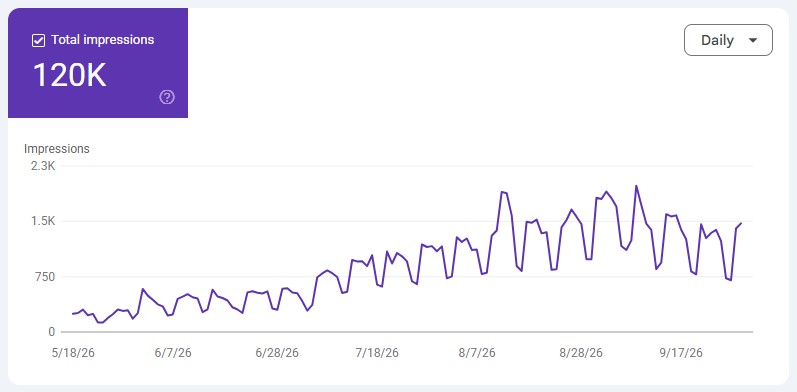
- 119,849 Appearances in Google's AI features
- 603 Of the firm's pages surfaced in AI answers
- ~5× Growth in daily appearances across the window
This is the same Knowledge Hub from our first Waranch case study, measured on a surface that reported nothing a year ago. The pages built to answer one clear Maryland question each are exactly the kind an AI engine pulls from.
Appearances, not clicks.
Google Search Console has a Generative AI Features view that counts how often your pages showed up in Google's AI surfaces — AI Overviews and AI Mode. It reports impressions: appearances, not clicks, because Google doesn't yet break out clicks for AI features. So 119,849 means the firm's pages were shown inside a Google AI answer that many times. It is not 119,849 visits, and it is certainly not 119,849 clients.
The report also only sees Google. It says nothing about ChatGPT, Claude, or Perplexity, because none of those publishes a per-site report — the only way to know whether one of them named the firm is to ask it and read the answer, which is the manual half of tracking AI citations. Read this page as one engine's count on one engine's surface: real, specific, and narrow.
The Hub pages, not the homepage.
This is the part that ties back to the first case study. Of the 603 pages that surfaced, the homepage ranks eleventh. The ones doing the work are the deep question pages the Knowledge Hub was built from — each answering one specific thing a Maryland driver actually searches. That single-question shape is precisely what an AI answer lifts from.
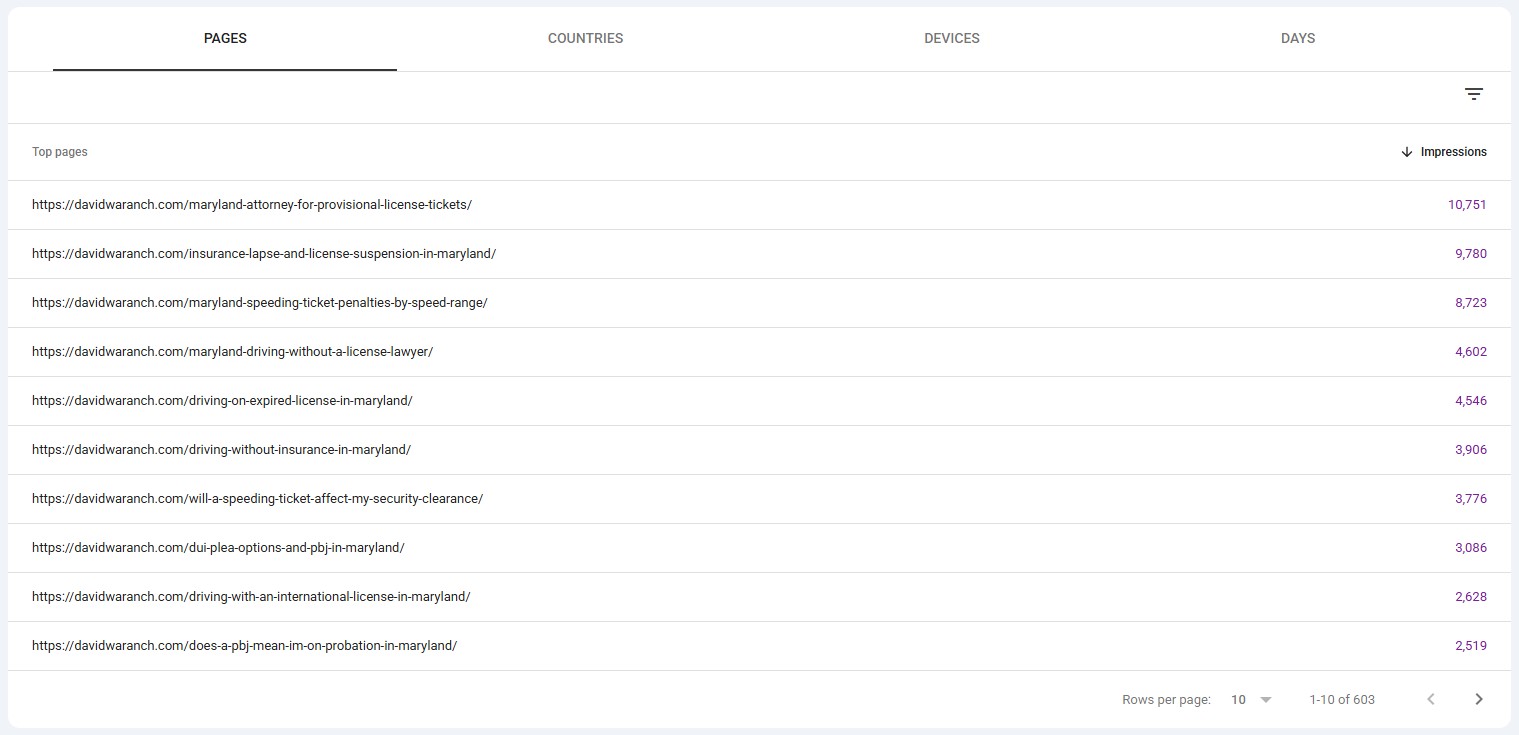
None of these is a brochure page. They're the kind of narrow, plainly-written answers a person types in a panic and an engine can quote cleanly — "provisional license ticket," "insurance lapse suspension," "speeding ticket and security clearance." The breadth matters too: 603 pages surfacing means this isn't one lucky article, it's an architecture doing its job across the whole topic.
A line that only bends up.
| Month (2026) | AI appearances |
|---|---|
| May (from the 18th) | 3,293 |
| June | 12,975 |
| July | 25,370 |
| August | 39,132 |
| September (to the 29th) | 39,079 |
The three full months tell it cleanly: June to July roughly doubled, July to August climbed again, and September had already matched August with a day still to run. Daily appearances went from about 235 in the opening fortnight to about 1,200 in the closing one — a single-day peak of 1,983 landed on 8 September. Roughly 98% of the appearances were in the United States, the firm's actual market, and most were on mobile, which is where someone reads an AI answer about a ticket they just got.
The usual honesty applies, and it matters more here because the number is large. These are appearances, not clicks, leads, or cases — Search Console can't measure any of those, and we won't imply it can. They're on Google's AI surface only. And while this growth followed the Knowledge Hub work, search is noisy and we can't prove cause to the standard we'd hold a client's claim to. What the data does show, unambiguously, is a firm that was invisible in AI answers in spring becoming a source hundreds of its pages get pulled into by autumn.
Want to know whether AI answers can see your firm?
We'll show you what the crawlers can and can't reach, and where you turn up in AI answers — free, read by a human, back in 48 hours.
Free site reviewData window: Google Search Console (Generative AI Features), 18 May – 29 September 2026 — the full span available since the report began. Google reports appearances (impressions), not clicks, and only for its own AI surfaces. Last updated October 3, 2026.