The short answer
Two free dashboards now cover part of it: Google Search Console reports impressions where your pages appeared in AI Overviews and AI Mode, and Bing Webmaster Tools reports how often its AI surfaces cited you. Neither covers ChatGPT, Perplexity, or Claude, so pair them with a repeatable manual check — run the same five or six client questions across those engines monthly and log who gets named. Dashboards for volume, the manual check for everything else.
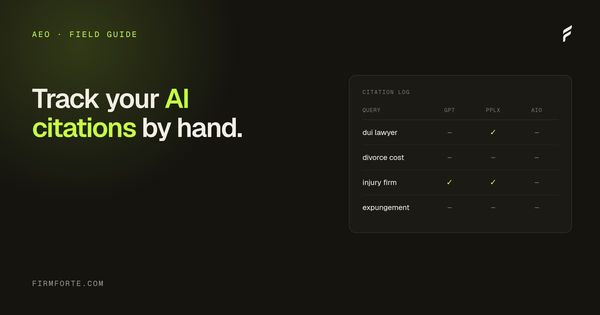
You can find out whether AI engines cite your firm in an afternoon, without buying a tool. There are two halves to it. Google and Bing now report their own AI surfaces in dashboards you already have — free, passive, and attributed to your actual pages. For everything else (ChatGPT, Perplexity, Claude) nothing reports back, so you run a quick manual check: pick your most important queries, run each a few times in clean sessions, and record whether your firm gets mentioned, cited, or skipped in favor of a competitor. Do both once a month and you have a trend line. It's not statistically perfect, but it turns "are we in AI answers?" from a shrug into a spreadsheet.
Here's both halves, start to finish, and how to read what they tell you.
Why track AI citations at all?
Because you can't improve what you don't measure, and AI answers are increasingly the first thing a potential client sees. When someone asks ChatGPT or Google's AI Overview "who's a good estate planning lawyer in my city," the answer either includes you or it doesn't, and if you're not watching, you have no idea which. Tracking turns an invisible channel into one you can actually work on.
This matters more every quarter as people lean on AI to shortlist professionals. The firms that show up in those answers are quietly winning consideration before the traditional search results even load. You don't need to obsess over it, but you should know your baseline: which of your key queries surface your firm, which surface competitors, and whether that's moving in the right direction as you do the work. Flying blind here means you find out you're absent only when a client mentions they "asked ChatGPT and it recommended someone else."
What's the difference between a mention and a citation?
They're not the same thing, and the distinction shapes what you're looking for. A mention is when the AI names your firm in its answer text ("firms like Smith & Jones handle these cases"). A citation is when it links to a specific page on your site as a source. Both matter, but a citation with a link is the stronger signal and the one that can send actual traffic.
Track both, in separate columns, because they tell you different things. A mention means the engine knows your firm exists and associates you with the topic, which is largely an authority and entity-consistency question. A citation means a specific page of yours was good enough to be used as a source, which is more about that page being answer-first and extractable, the mechanics we cover in how Perplexity chooses which legal sources to cite. Seeing which you get, and which you don't, points you at what to fix.
How do you run the manual check?
Use clean sessions, run each prompt several times, and check across engines. Open a fresh, logged-out chat (or a separate account) so the engine's memory of you doesn't skew the answer, then run each of your target queries three to five times in ChatGPT, Perplexity, and Gemini, adding Google's AI Overviews for the searches that trigger one. Record each run as its own row.
Try this yourself
Start with one query, right now
I need a [practice area and city] lawyer. Who would you recommend, and why those firms specifically?
Opening a link sends the prompt to that company, the same as typing it there yourself. Nothing is sent to us.
The clean-session part is easy to get wrong and important. If you run these logged into an account the engine associates with your firm, its memory features will bias the answers toward what it thinks you want to see, which makes you look more cited than you are. Logged out, or in a private window, gives you the answer a stranger would get. Running each prompt multiple times matters too, because these systems are probabilistic and a single run isn't representative. A widely referenced guide to monitoring your brand in AI search recommends exactly this: run each prompt three to five times, in clean sessions, across the major engines, and log every run.
Which queries should you test?
Your money queries first: the searches a ready-to-hire client actually makes. "Best [practice area] lawyer in [your city]," "who should I hire for [specific legal problem] near me," and the informational questions that lead to hiring, like "what to do after [situation] in [state]." Fifteen to twenty-five prompts covering your real practice areas and locations is plenty to start.
Build the list the same way you'd build your keyword strategy: from genuine client demand, not from what sounds impressive. Include the high-intent hiring queries where being named is worth the most, a handful of the informational questions your clients ask on the way to a decision, and a few that name your competitors or your city specifically. Keep the list stable month to month so you're comparing like with like. The point isn't to test every possible phrasing; it's to watch a consistent, representative set over time and see whether your presence in it grows.
How do you make sense of the results?
Look for patterns across the runs, not a single verdict. For each query, note how often your firm appeared, whether it was mentioned or actually cited, which competitors showed up instead, and what sources the engine pulled from. After a couple dozen prompts run a few times each, the shape is clear: where you're strong, where you're absent, and who's eating your lunch.
Two patterns are especially useful. First, which competitors keep getting cited, because looking at their pages shows you what the engines currently reward for your queries. Second, which sources the engines lean on, directories, specific publications, particular firm pages, and very often Reddit, because that tells you where authority for your topics is concentrated. Reddit in particular shows up constantly, for reasons worth understanding, which we cover in what Reddit's dominance in AI citations means for law firms. Treat the whole thing as directional: running twenty-five prompts five times gives you a hundred-plus data points, enough to see obvious patterns, not enough to claim a precise "visibility rate." That's fine. You're looking for direction and change, not a lab result. The underlying reasons you're in or out are what we break down in how AI engines decide which law firm to cite.
The free dashboards Google and Bing now give you
The manual check above is the only way to see ChatGPT, Perplexity, or Claude, because none of them report anything back to you. But two of the engines now expose their own AI surfaces in dashboards you already have access to, and both are free, passive, and worth checking monthly alongside the spreadsheet.
Google Search Console. Open the Performance report and use the Search Appearance filter — Google now breaks out its AI features (AI Overviews and AI Mode) as their own rows. Filter to those and you see impressions and clicks for the pages that appeared in Google's AI answers. It's volume, not verdicts: it tells you how often and on which URLs you surfaced, not whether you were named ahead of a competitor or what the answer actually said. But it's real, it's attributed to specific pages, and it's the closest thing to a console that exists for AI visibility. A year ago this data didn't exist at all.
Bing Webmaster Tools. Bing reports AI data too, inside its Search Performance view: a citations count showing how often Bing's AI surfaces referenced your pages, plus the clicks that followed. It's the same kind of passive, page-level signal as Google's. One careful caveat worth knowing — ChatGPT's web search has historically leaned on Bing's index, so a rising Bing citation count is the nearest passive hint you have for what ChatGPT's search might pull. It's a loose, one-way proxy, not a measurement of ChatGPT, so treat it as a good sign rather than proof that ChatGPT is citing you.
GA4, for Perplexity. Perplexity is the one chat engine whose citations are always clickable, so any referral traffic it sends lands in your GA4 under Acquisition, filtered to perplexity.ai. That's a third passive signal, and the only one that captures an actual click from a chat assistant rather than an impression.
None of these replace the manual spreadsheet — they cover only Google and Bing, they report volume rather than the competitor picture, and they lag by a few days — but together they let you watch AI visibility on a chart as well as in a spreadsheet. For a worked example of what a quarter of this data actually looks like for a real firm, see our own AI-visibility numbers.
How often should you check, and what do you do with it?
Monthly is the right cadence, and the output is a to-do list, not just a scoreboard. Re-run the same prompt set once a month, log the results next to last month's, and watch the trend. Where you're absent or losing, the fix is the actual AEO work: answer-first content, entity consistency, readable pages, and real authority. The tracking tells you where to point that effort.
Read the two halves together. The Google and Bing dashboards give you the trend volume on their surfaces; the manual spreadsheet gives you the engines nothing reports on and the competitor context neither console shows. Both are genuinely something a firm can do itself in an afternoon a month. The tracking is the easy part. Being the firm the engines want to cite is the work, and it starts with making sure they can even read your site, which we cover in how to check if ChatGPT can read your website. If you'd rather skip the afternoon, the free review runs this check for you, and closing the gaps is the core of our AEO service.
Questions we get about this
-
How do I know if AI engines are citing my law firm?
Two ways, used together. Google Search Console and Bing Webmaster Tools now report where your pages appear in their own AI answers — impressions in Google's AI Overviews and AI Mode, citations in Bing's AI surfaces — so that part is a free, passive dashboard. For the chat engines nothing reports on (ChatGPT, Perplexity, Claude) you run a repeatable manual check: pick five or six questions a real client would ask, run them in clean sessions, and record which firms are named and which URLs are linked. The value is in the trend across months, not in any single run.
-
Do Google Search Console and Bing show AI citations?
For their own AI surfaces, yes. Google Search Console's Performance report lets you filter Search Appearance to its AI features, showing impressions and clicks where your pages appeared in AI Overviews and AI Mode. Bing Webmaster Tools reports a citations count and clicks from its AI answers. Both are free, passive, and attributed to specific URLs — but they only cover Google's and Bing's AI, not ChatGPT, Perplexity, or Claude, and they show volume, not whether you were named instead of a competitor.
-
What's the difference between a mention and a citation?
A mention is your firm named in the text of an answer; a citation is a link to your page as a source. Both matter and they're worth tracking separately, because they come from different things — a mention often reflects your entity being known, while a citation reflects a specific page being retrieved and used. A firm can be mentioned without any of its pages being cited, which usually means the reputation exists but the content isn't extractable. Knowing which one you're missing tells you what to fix.
-
Which queries should a law firm test?
The ones a client would actually type, not the ones you'd like to rank for. Start with "best [practice area] lawyer in [city]", the two or three questions you answer on the phone most often, and one comparison question people ask before hiring. Keep the list short and fixed, because changing the questions each time destroys the comparison. Add a query only when it reflects a real new area of work.
-
How often should I check AI citations?
Monthly is enough for most firms, and quarterly is fine if nothing has changed. Checking more often mostly measures the engines' own variance rather than anything you did, which is a good way to draw conclusions from noise. Give any change you make at least a few weeks before expecting it to show. What you do with the results is the important part: a query where competitors are consistently named and you aren't is a content brief.