
The short answer
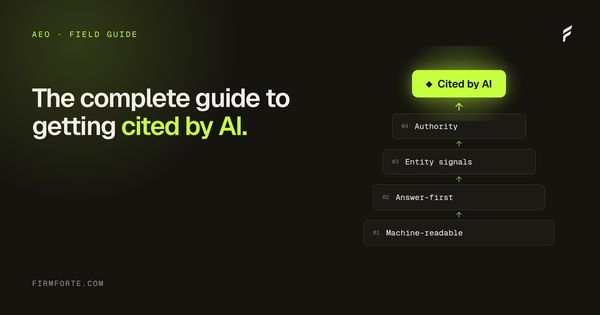
AEO is the work of getting your firm named inside a generated answer rather than ranked in a list of links. For a law firm it comes down to five things: crawler access, content that answers questions directly, consistent entity signals, third-party corroboration, and schema underneath. It shares most of its foundation with SEO, and it cannot promise citations — those are the engine's call.
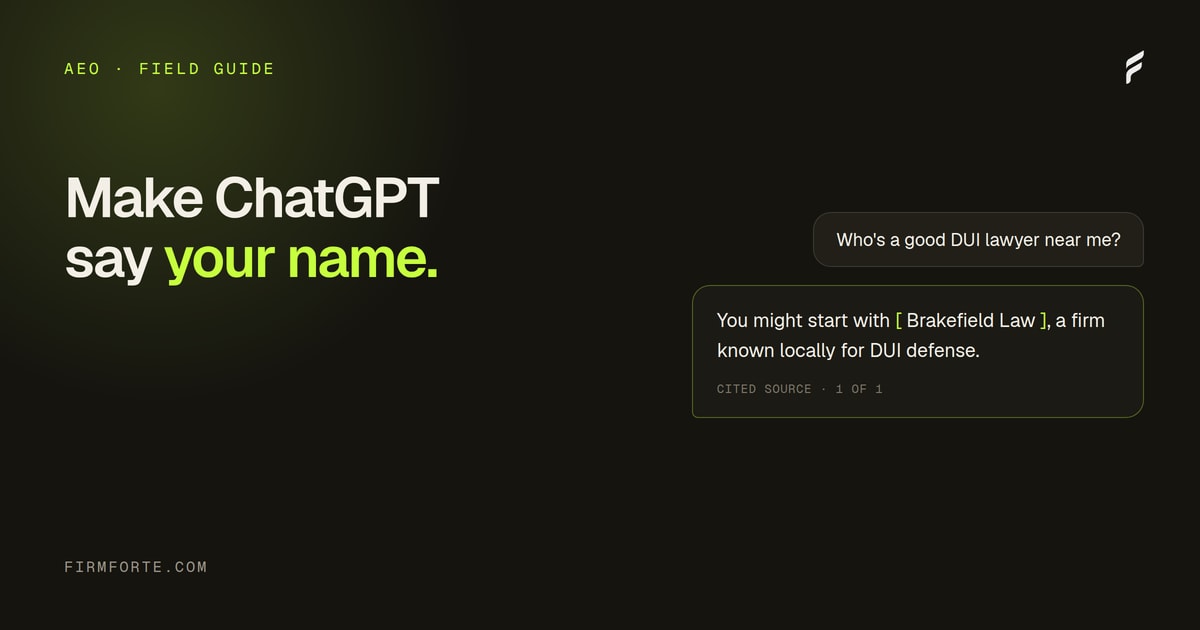
AEO, answer engine optimization, is the work of making your firm the source an AI names when someone asks it a legal question. It's the same instinct as SEO pointed at a different surface: instead of ranking a page in a list of ten blue links, you're trying to be the firm ChatGPT, Perplexity, Claude, or a Google AI Overview cites in the answer it writes for the user. The mechanics overlap heavily with good SEO, but the goal has shifted from "rank" to "get cited," and that shift changes what you prioritize.
This is the whole subject for a solo practitioner or a small firm, in the order you should actually approach it: what AEO is, whether it matters yet, how the engines pick a firm, what work moves the needle, how to measure it, and the honest limits nobody selling AEO wants to name. Where a section has a deeper standalone piece, it links to it. Read this top to bottom and you'll have the full map.
What is AEO, and how is it different from SEO?
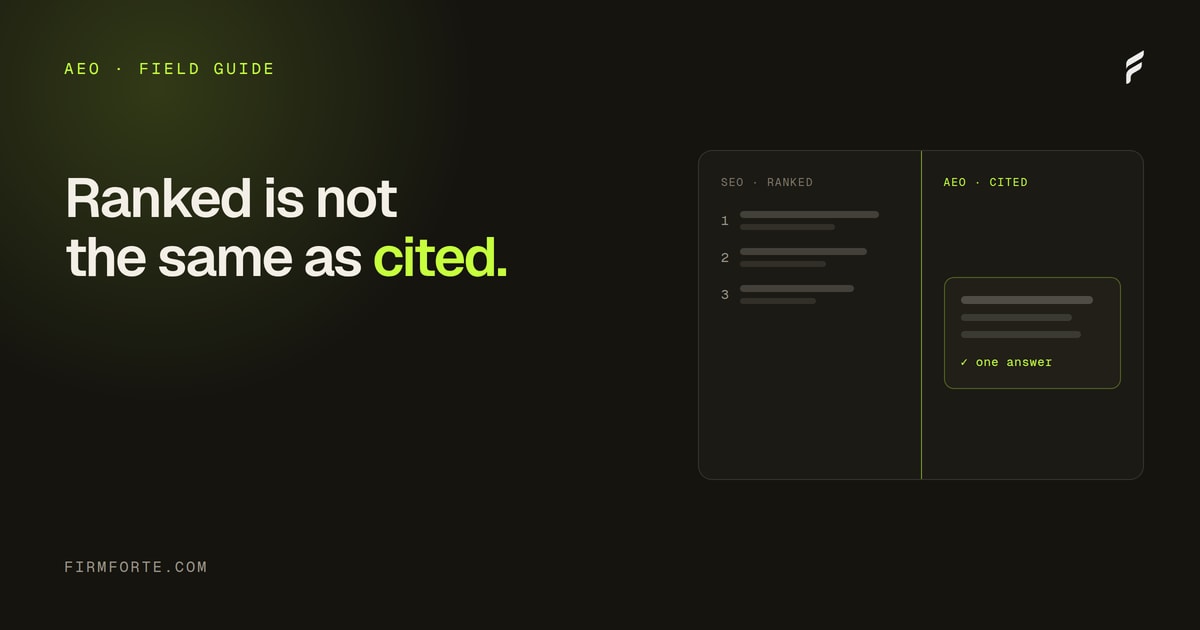
AEO optimizes for AI-generated answers; SEO optimizes for the ranked list of links beneath them. Classic SEO tries to get your page into the top few results so a person clicks it. AEO tries to get your firm named or cited inside the answer an engine writes, where there's often no list to climb and no second place. The two share most of their foundation and differ mainly in what winning looks like.
The practical overlap is large enough that AEO isn't a separate discipline you bolt on. Google's own 2026 guidance is blunt that optimizing for its AI features is mostly just SEO done well: clear content, a recognizable entity, clean structure. What AEO adds is a sharper focus on being quotable, being the single best answer to a specific question rather than one of ten decent pages, because an answer engine picks one or two sources, not a page of them. We take the distinction apart in full in AEO vs SEO for law firms. For now, hold onto the core difference: SEO earns a click, AEO earns a citation, and being third is worth nothing because there is no third.
Does this actually matter yet for a law firm?
Increasingly, yes, because a real and growing share of legal research now starts inside an AI answer. Across all verticals, AI Overviews trigger on 48 to 60 percent of searches (Ahrefs, Q1 2026). For legal queries specifically, SE Ranking measured a 42 percent trigger rate in 2025, and it has climbed since as Google pushes AI Overviews into higher-intent categories. On top of that, a rising number of people skip Google entirely and ask ChatGPT or Perplexity directly.
What that means for a firm is that the first impression is often formed before anyone reaches your site. When a stressed person asks "who's a good estate planning lawyer in my city," the AI's answer either includes you or it doesn't, and the firms it names win consideration before the classic results even load. Featured snippets, the old top-of-page prize, are now frequently nested inside these AI answers rather than replaced by them, which we unpack in featured snippets and AI Overviews. The uncomfortable version of this is watching a competitor get cited for a query you rank well for in classic search, which is common enough that we wrote a full diagnostic: why your firm shows up in Google but not AI Overviews. This isn't a future you're preparing for. It's already deciding some of your intake.
How do AI engines decide which firm to cite?
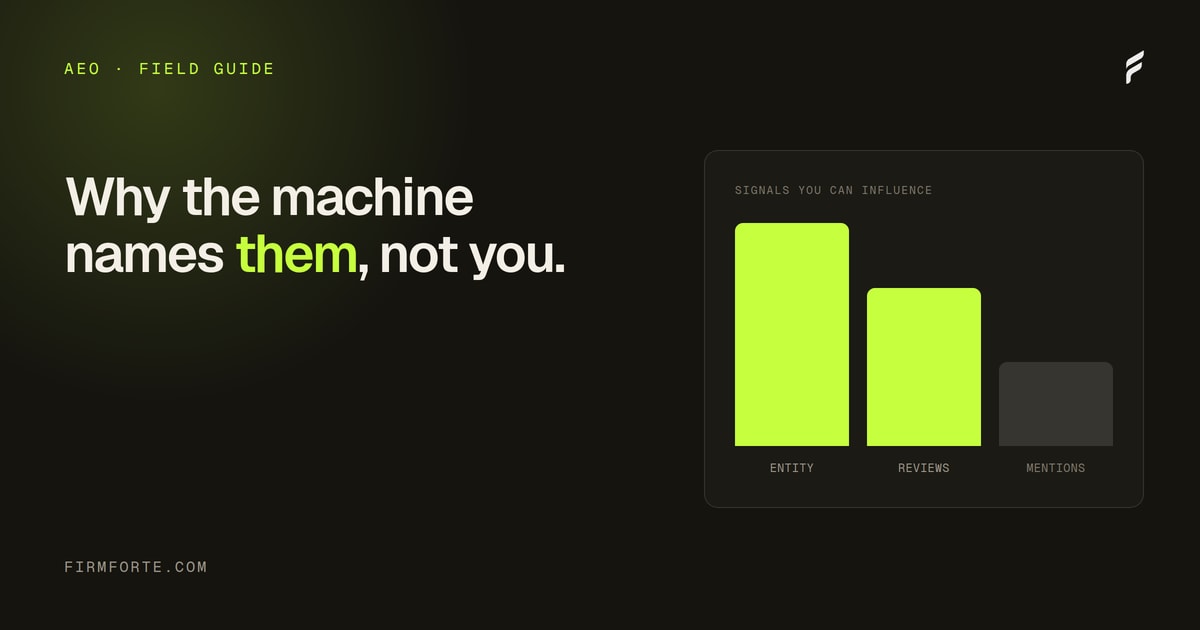
They retrieve rather than rank, then quote the source that's easiest to trust and easiest to lift. An answer engine doesn't hand the user ten options; it pulls a few candidate sources, synthesizes an answer, and names one or two. Winning that comes down to three things you can actually influence: the engine has to recognize you as a real, specific firm, someone other than you has to corroborate that, and your page has to make the answer easy to extract.
None of those three is a trick, and the full breakdown of each is in how AI engines decide which law firm to cite. Engines also differ in how they source: Perplexity, for instance, leans hard on retrieving and citing live pages, which makes its logic unusually legible and worth studying on its own, covered in how Perplexity chooses legal sources. The throughline across all of them is that they reward clarity and corroboration, not cleverness. A firm that reads as one consistent, credible entity with clean, quotable answers is the firm they reach for.
Can the engines even read your site?
Often not, and this is the failure that quietly disqualifies firms before content or authority ever matters. If your pages render their text with JavaScript, or hide the real content behind scripts a crawler doesn't execute, an AI may see an empty shell where your answer should be. You can't be cited for content the engine never sees, so machine-readability is the floor everything else stands on.
Check it before you invest in anything downstream. The quick version is to view your page the way a crawler does, with scripts off, and confirm your actual answers are present in the raw HTML, which we walk through in how to check if ChatGPT can read your website. Site builders that depend heavily on client-side rendering are a frequent culprit here. Get this wrong and the rest of AEO is moot; get it right and you've cleared the bar most competitors trip over.
What kind of content actually gets cited?
Answer-first content: a clear, self-contained answer to a real question, placed right where a machine can lift it. The pattern that works is a question-shaped heading followed immediately by a tight, complete answer of roughly 40 to 60 words, before you expand into detail. The question should match how people actually talk to an AI, full and specific, not the clipped keywords they'd type into Google, which we cover in writing content for how people actually ask AI legal questions. Engines cite the page that answers the question cleanly and early, not the one that buries the answer under three paragraphs of throat-clearing.
This is a different way of writing than the brochure copy most firm sites carry, and it's the single highest-return change most firms can make. The full pattern, including how to structure a page so it's quotable, is in how to get cited by ChatGPT. It works best when your pages are organized as a connected body of answers rather than a scattered blog, an approach we call building a knowledge base, laid out in build a knowledge base, not a blog and architecturally in how to design a law firm knowledge hub. Write the answer a client actually needs, put it up top in plain language, and you've done most of the work.
How much does schema markup matter?
Less than most people selling it claim, and it's hygiene rather than a citation lever. Schema is structured markup that makes your content unambiguous to a machine: that a name on the page is a real attorney, that a block of text is a question and its answer, that the business is a law firm. It can raise an engine's confidence and keeps you eligible for the rich results that still exist, but it doesn't earn a citation on its own and it can't rescue thin content.
The honest order of importance is content first, entity second, schema third. Google's 2026 guidance is explicit that structured data is not required to appear in AI Overviews, so treat schema as the layer that makes good content legible, not the thing being ranked. The two pieces worth getting right are a consistent entity, covered in entity SEO for law firms, and the specific markup types a firm site actually needs, in the seven schema types every law firm website needs. One thing you can safely deprioritize is an llms.txt file: it's a tidy, low-effort addition once your fundamentals are solid, but no major engine has confirmed it reads one, which we cover honestly in whether llms.txt matters for law firms. Do the markup because it's cheap and correct, not because you expect it to do the content's job.
Do you need authority beyond your own website?
Yes, because the corroboration signal, someone other than you vouching for your expertise, is one of the three things engines weigh, and it lives off your site. An AI is more willing to cite a firm whose named attorneys show up in trade press, directories, bar profiles, and genuine third-party mentions, because that external agreement is evidence you're a real, credible expert rather than a site making claims about itself. You can't fully manufacture this, which is exactly why it's worth building.
For a solo or small firm, the most credible entity you have is the named lawyer, so authority work runs through the attorney: real credentials made visible, bylines and quotes earned over time, a consistent professional presence across the web. This compounds slowly and can't be shortcut, which is what makes it defensible once you have it. The full method is in how attorneys build the authority AI engines cite. It's the slowest part of AEO and often the one that separates the firm that gets cited from the one that merely could be.
Why does the AI keep citing Reddit instead of a law firm?
Because engines lean heavily on discussion and experience content, and Reddit is where real people describe real experiences at scale. In one large study, Reddit was the single most-cited source in AI answers, ahead of Wikipedia and YouTube, partly because AI companies pay to train on it. For a law firm, the lesson isn't to go spam Reddit; it's to understand that Reddit answers the human-experience half of a question while your firm answers the legal half.
That split is the opportunity. When someone asks what a process actually felt like, the engine may pull lived experience from a forum; when the question turns to what the law requires, it needs a clear, credentialed source, and that's the citation you can win. The full picture, including the ethics traps for lawyers tempted to participate, is in what Reddit's dominance in AI citations means for law firms. Don't resent the sources you can't control. Be the obvious answer for the half of the question that's yours.
How do you measure AEO?
Honestly, and with the understanding that the measurement stack is still immature. There's no perfect dashboard yet, so the core method is manual: pick your most important queries, run each several times in clean, logged-out sessions across ChatGPT, Perplexity, and Google's AI Overviews, and log whether your firm is mentioned, cited, or skipped for a competitor. Do it monthly and you have a trend line instead of a shrug.
That manual check, run the same way each month, is genuinely something a firm can do itself in an afternoon, and the step-by-step is in how to track AI citations for your firm. Watch two things beyond your own presence: which competitors keep getting cited, because their pages show you what the engines currently reward, and which sources the engines lean on for your topics. Treat the whole thing as directional, not precise. You're looking for whether your presence is growing over time, not a lab-grade percentage.
What AEO can't do: the honest boundaries
Nobody can guarantee you a citation, and anyone who does is selling something they can't deliver. These systems are probabilistic and no one controls their output, so the honest promise is to make your firm the kind of source they prefer to cite, not to promise they will. We hold that line across everything we publish, and you should be wary of any agency that doesn't.
Two more boundaries worth stating plainly. Schema is not a magic citation trick; it's hygiene that makes good content legible, and it can't substitute for the content or the authority. And AEO is not intake automation: getting cited by an engine brings a potential client to your door, but the work of answering, screening, and converting that lead is still human and still yours. Anyone bundling "AI intake" or a chatbot into an AEO pitch is selling a different, unrelated thing. AEO's job is to make the engines name you. What happens after the click is a separate discipline entirely.
Where should a firm actually start?
In priority order: make sure the engines can read your site, rewrite your key pages to answer real questions first, get your entity consistent, add the cheap schema, then build authority over time. Machine-readability is the floor, answer-first content is the biggest single lever, entity and schema are the legibility layer, and off-site authority is the slow compounding work. Do them roughly in that sequence and each one makes the next more effective.
The mistake is starting at the wrong end, pouring effort into schema or chasing platforms while your pages are unreadable or your content still reads like a brochure. Get the foundation right and the citations become possible; skip it and no amount of markup helps. To see where your firm currently stands, which of your queries send clients to a competitor, and what to fix first, run the free review. It checks the same signals this guide walks through and hands back a prioritized list. And if you'd rather have the whole stack built and maintained for you, that's the core of our AEO service. Either way, the firms that treat this as real work now are the ones the engines will be citing when your competitors finally notice.
Questions we get about this
-
What is AEO for law firms?
Answer Engine Optimization — the work of being included in an AI-generated answer rather than ranked in a list of blue links. For a law firm the practical content is crawler access, answer-first pages, a consistent entity footprint, earned third-party mentions, and clean structured data. Most of that overlaps with good SEO, which is why it should not arrive as a separate invoice. What's genuinely different is writing for extraction rather than for a click.
-
Does AEO matter yet for a small law firm?
Yes, though how much depends on your market and practice area. AI answers now sit above organic results on a growing share of queries, and a firm absent from them is invisible to anyone who stops reading there. The reason to act now isn't that AI has replaced search — it hasn't — but that the work that improves AI visibility is the same work that improves ordinary search visibility. You're not making a bet; you're doing the foundation either way.
-
Why do AI engines keep citing Reddit instead of law firms?
Because forum threads are full of specific, plainly-worded answers to the exact question someone asked, and most law firm pages are not. An engine looking for a liftable answer finds one in a Reddit comment and finds marketing copy on a firm's page. That's a content problem rather than a conspiracy, and it's addressable: answer the real question in the first sentence, in plain language, on a page about that question. The firms that do this stop losing to forums.
-
What can't AEO do?
It can't guarantee a citation, control what an engine says about you, or produce results on a fixed timeline. It also can't fix a firm whose underlying problem is intake, reviews, or capacity — being named more often doesn't help if the calls aren't answered. And it can't substitute for having something worth citing. Be suspicious of anyone selling AEO who won't name those boundaries, because the boundaries are what make the rest credible.