
The short answer
Conversational content means writing the way a client asks, not the way a lawyer drafts: real questions as headings, direct answers underneath, plain words where legal terms would do. It wins AI citations because an engine looking for a liftable answer finds one. It doesn't mean being less precise — it means putting the precision in a sentence someone can actually use.
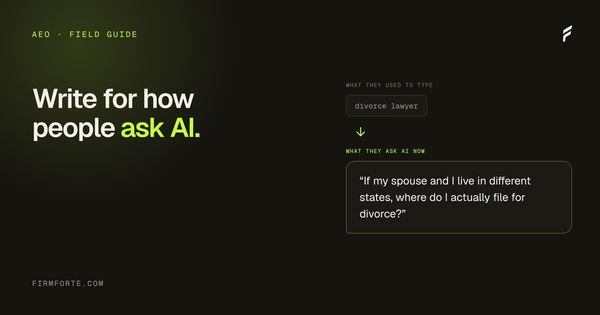
Conversational content is writing that answers the full, natural-language questions people actually ask an AI, rather than the clipped keyword phrases they type into Google. Someone searches Google for "divorce lawyer Austin," but they ask ChatGPT "my husband and I are separating and we own a house together in Texas, do I need a lawyer or can we do this ourselves?" Content built for the keyword misses the question. Content that answers the real question, in the words a real person uses, is what AI engines pull from. Writing for that shift is one of the highest-return moves in AEO, and it doesn't mean dumbing anything down.
Here's what conversational content actually is, why it earns citations, and how to write it for a law firm without losing precision or credibility.
What makes content "conversational"?
It's content shaped around complete, specific, natural questions and answered in plain, direct language, the way you'd actually explain something to a client across the desk. Conversational content anticipates the messy, detailed way people phrase real problems, includes the context they include, and answers in clear prose rather than keyword-stuffed marketing copy. It reads like a knowledgeable person talking, not a brochure optimizing for a search string.
The shift matters because AI queries are longer and more specific than search queries. People give an engine their whole situation, several facts at once, an emotional register, a specific jurisdiction, because the conversational interface invites it. So the content that matches gets specific too: it names the real scenario, addresses the real worry, and answers the actual question asked. This is the natural way to write a knowledge base rather than a blog, an approach we lay out in build a knowledge base, not a blog.
Why does conversational content win AI citations?
Because it matches the question the engine is trying to answer, and it's easy to lift a clean answer from. When an AI gets a detailed question, it looks for a source that addresses that exact situation clearly and can be quoted directly. A page that poses the real question as a heading and answers it in a tight, self-contained paragraph is far easier for the engine to cite than one that dances around the topic with keyword-optimized fluff. Our answer-first content scorer grades a page on exactly that, from on-site signals alone — whether it leads with the answer, uses question-shaped headings, and stays readable.
This is the same answer-first pattern that wins any AI citation, applied to the specific way people phrase things conversationally. The engine wants a clean, complete answer to the real question, placed where it can grab it, which is exactly what we walk through in how to get cited by ChatGPT. Conversational content wins because it's written from the reader's actual question outward, and that alignment, question to answer, is what these engines reward. Perplexity in particular makes this legible, since it shows which pages it pulled from, covered in how Perplexity chooses legal sources.
How do you find the real questions to answer?
Start from what clients actually ask you, then phrase each as the full question a person would type into an AI. Your intake calls, your consultations, and your inbox are full of the real, specific questions people have, usually more useful than any keyword tool. Write those down in the client's own words, including the context and worry they carry, and each becomes a heading you can answer.
The trick is to resist compressing them back into keywords. "Child custody" is a keyword; "can my ex move out of state with our kids if we have joint custody" is a real question, and it's the one an AI will be asked. Collect the long, specific versions, the ones with a situation attached, because those are what people bring to a conversational engine. A firm that systematically answers the fifty questions its clients actually ask, in full, has built exactly what the engines want to cite, and it maps naturally onto the practice-area content that already converts.
Does conversational mean less precise or less professional?
No, and this is the fear that keeps lawyers writing stiff, keyword-driven copy. Conversational doesn't mean casual, vague, or dumbed down. It means clear and direct, answering a real question in plain language while keeping every bit of the legal precision that makes the answer trustworthy. The best conversational legal content reads like a sharp attorney explaining something clearly, not like a chatbot and not like a statute.
In fact, precision is what makes it citable. An engine reaching for a source on a legal question wants the accurate, specific, credentialed answer, so vagueness loses you the citation as surely as jargon does. The goal is to sound like an expert who can explain things simply, which is harder than sounding either formal or casual, and it's exactly the register clients trust. Plain and precise aren't in tension. Together they're the whole point.
How does this fit with keyword SEO?
It complements it rather than replacing it, because the two capture different moments. Keyword-optimized pages still catch the person typing short phrases into Google, and conversational content catches the person asking an AI a full question, and a well-built page can do both: a clear question-format heading with a direct answer serves the classic searcher and the AI at once. You're not choosing between them; you're writing so one page works for both.
The overlap is large because good conversational content is usually good SEO content too, clear, specific, genuinely useful. What changes is that you stop writing only for the three-word query and start also writing for the full sentence, which widens what you can be found and cited for without extra pages. Build each page to answer the real question well and it earns the blue-link click and the AI citation from the same words. The larger method that ties conversational content into the whole AEO picture is in the complete guide to AEO for law firms.
Where should a firm start?
Pick your ten most common client questions, write each as the full question a person would ask an AI, and answer each one cleanly at the top of the relevant page. That's a week of work that reshapes your most important pages around the questions clients actually have, and it pays off in both search and AI answers. Start with the questions tied to the matters you most want more of, since those are the citations worth winning.
From there it's a habit: every time a client asks something on a call, note the real phrasing and make sure your site answers it. Over months that builds a body of content matched to how people genuinely ask, which is what the engines increasingly reward. To see which of your clients' real questions your site already answers well enough to get cited, and which it doesn't, run the free review, and the ongoing content work is the core of our AEO service.
Questions we get about this
-
What makes law firm content conversational?
Headings phrased as the questions people actually type, answers that begin with the answer, and plain-language nouns where both a legal term and an everyday one exist — divorce rather than dissolution of marriage, DUI rather than the statutory name. It also means shorter sentences than legal writing habits produce, and addressing the reader directly. The test is whether a client could read a section aloud and have it sound like something a person would say.
-
Why does conversational content win AI citations?
Because engines extract passages, and a passage that answers one question completely is far easier to lift than a paragraph that develops an argument. Conversational structure produces self-contained answers almost by accident: the heading states the question, the first sentence answers it, and the rest qualifies. Content written in legal register tends to build to its conclusion, which means the quotable sentence arrives too late or never. It's a formatting advantage more than a tone one.
-
Does conversational mean less precise or less professional?
No — and treating it as a trade-off is how firms end up writing neither well. Precision lives in the substance: the statute cited, the deadline named, the exception flagged. Plain phrasing puts that precision where a reader can use it rather than burying it in subordinate clauses. A page that says "two years from the date of injury under C.R.S. 13-80-102" is both more conversational and more precise than one that gestures at limitation periods generally.
-
How do I find the real questions clients ask?
Take them from your own intake — the questions you answer on the phone every week are the ones with proven demand, and you already know how people phrase them. Supplement with what the engines autocomplete when you start typing your practice and city, and with what people ask in public forums about your area of law. Keyword tools are useful for refining that list, not for generating it. The phrasing matters as much as the topic, so write down the client's words, not your paraphrase.