

The short answer
Authority, to a search or AI engine, is not how good you are — it's how much verifiable corroboration exists about you somewhere other than your own website. Bar records, trade press quotes, conference listings, consistent citations, and named authorship all count. Your own claims about yourself count for almost nothing, which is why the strongest authority work happens off your site.
Authority is the one thing in law firm marketing you can't fake and can't buy. It's the set of signals that tell both Google and the AI engines that your firm is a real, credentialed source worth trusting, and it's built off your own website as much as on it: named expert authorship, genuine credentials, mentions in places you don't control, and a reputation that lines up everywhere. It's slow. It compounds. And in a market where anyone can spin up a slick site in a weekend, it's the moat that actually holds.
This is the long version of why some firms get quoted by ChatGPT and ranked by Google while better-designed competitors stay invisible. It comes down to authority, what it means to a machine, and how a small firm builds it without a PR budget.
What does "authority" actually mean to Google and AI engines?
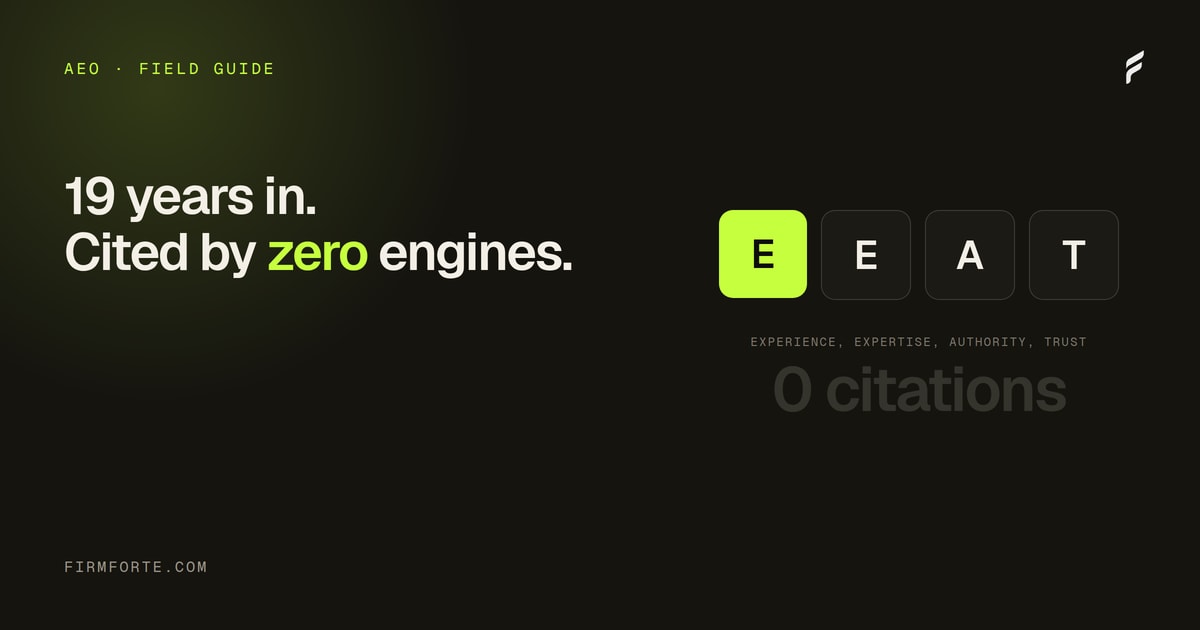
It means Google's E-E-A-T framework: Experience, Expertise, Authoritativeness, and Trustworthiness. Google uses it to judge the quality of content, especially for topics that affect people's lives and money. The four aren't equal. Google's own guidance is that Trust is the most important, and Experience, Expertise, and Authoritativeness all exist to support it, not to replace it.
Break the four down for a law firm and they get concrete. Experience is first-hand involvement: an attorney who has actually litigated the thing they're writing about. Expertise is credentialed knowledge: the bar admission, the degree, the board certification. Authoritativeness is reputation: whether others in the field recognize and reference you. Trust is the sum, plus the basics of being a real, transparent, contactable business. Google introduced the original E-A-T years ago and added the second E, Experience, in 2022 precisely because it wanted to reward content that could only come from someone who'd actually done the work. For lawyers, that's a gift, because you've done work most content marketers only read about.
Why does authority matter more for law firms than most businesses?
Because legal content is YMYL, "your money or your life," and Google holds it to a higher standard than almost any other category. Advice about a custody dispute or a criminal charge can materially change someone's life, so the engine is far more cautious about who it ranks and cites. For a law firm, essentially every page is YMYL by default, and thin or anonymous content is penalized harder here than it would be for a hobby blog.
That higher bar has been getting higher. Google's recent core updates have leaned hard on YMYL quality, and legal was among the hardest-hit verticals in the December 2025 update, which legal-SEO analysts reported as rewarding content that could only be produced by someone with real expertise while filtering out generic how-to pages that repeat what a hundred other sites already say. The direction is unmistakable. The web is flooding with competent-looking, AI-assisted, authorless content, and the engines are responding by leaning even harder on the signals that separate a real, accountable expert from a content mill. For law firms, that shift is an advantage, if you actually are the real thing and you make it legible.
What are the authority signals you can actually build?
The ones that prove a real, credentialed human stands behind the work. The highest-return move most firms can make today is to attribute every page to a named attorney with a linked bio that lists real credentials. From there: bar memberships, degrees, board certifications, mentions in places you don't own, and a firm identity that's consistent everywhere it appears.
In rough order of impact for a small firm:
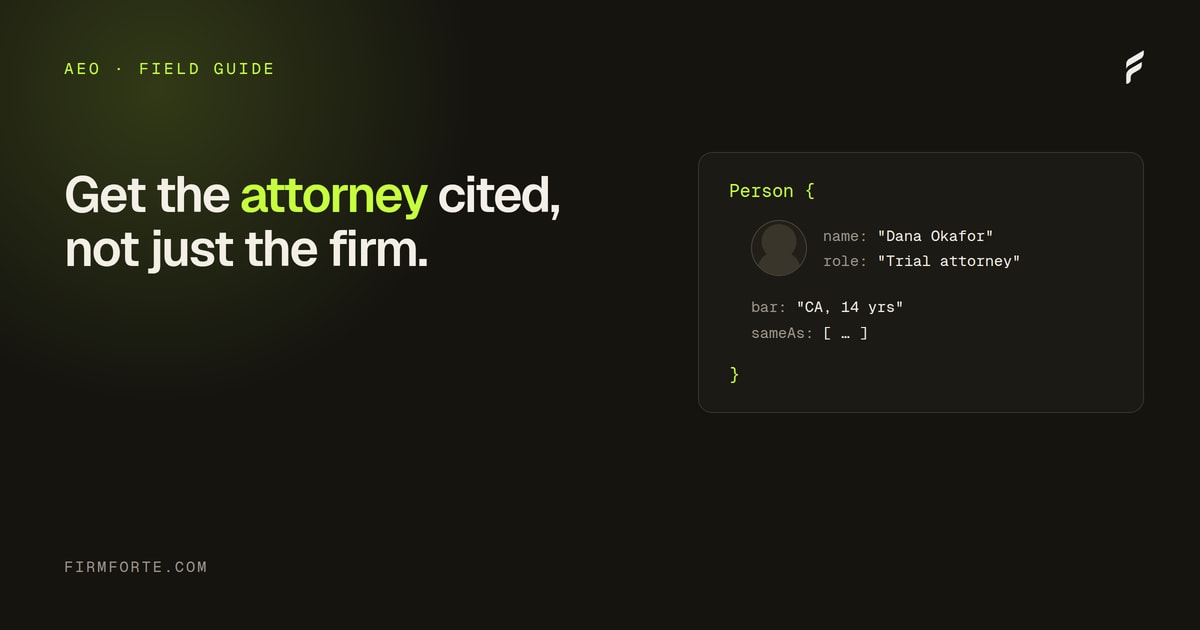
- Named, credentialed authorship. Anonymous content is the most common E-E-A-T failure. Put a real attorney's name and linked bio on every substantive page, and make the bio prove expertise: bar admissions, law school, certifications, years in the practice area. If a writer helps produce that content, keep the byline honest the way we cover in ghostwritten bylines for attorneys.
- A real, deep attorney bio. The bio page is an authority hub. Board certifications, published articles, speaking, CLE teaching, notable matters (within confidentiality). This is where Experience and Expertise live.
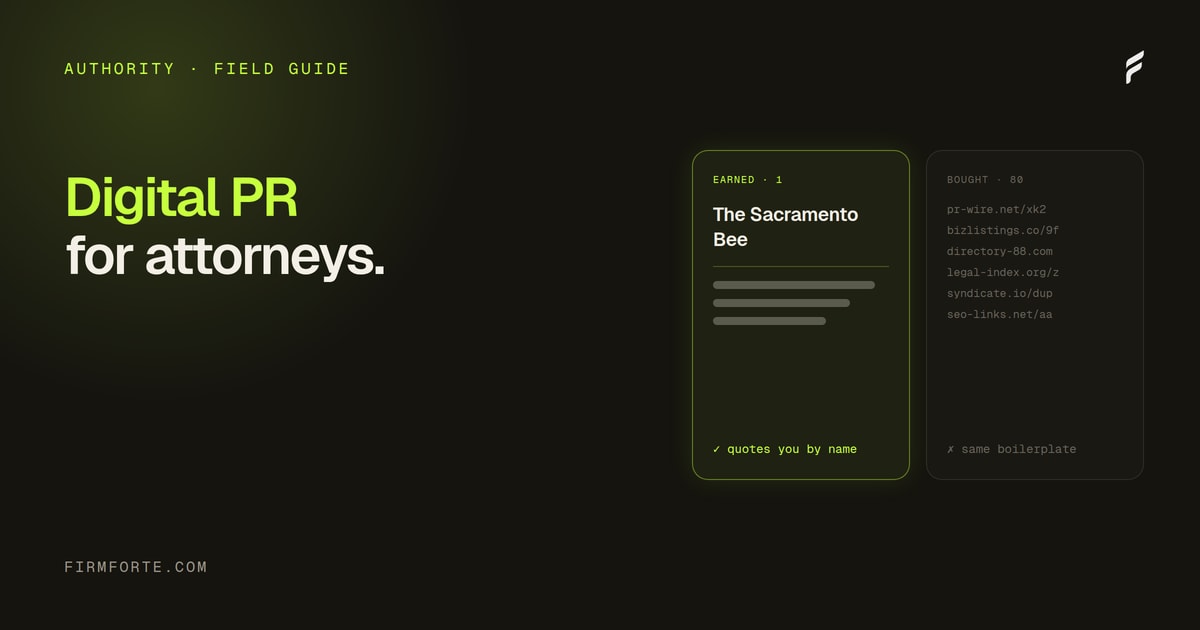
- Off-site mentions and press. Being quoted, cited, or referenced on sites you don't control is what turns claimed expertise into recognized authority. It's the hardest signal to fake and the one that counts most.
- Entity consistency. Your firm's name, people, and details lining up across your site, your profiles, bar listings, and directories, so an engine is confident all these mentions are one real firm.
- Genuine reviews and reputation. Real client sentiment, earned over time, within your bar's advertising rules.
None of these is a purchase. That's the point. We go deeper on the framework itself in E-E-A-T for law firms, but the theme runs through all of it: authority is evidence that you're real and good, assembled where a machine can see it.
How do AI engines use authority to decide who to cite?
They quote sources they can verify are real and corroborated elsewhere. An AI engine answering a legal question is trying not to cite something wrong, so it leans toward sources that show credentials, that other pages reference, and that match a consistent identity across the web. Authority off your own site is that corroboration. It's how a machine tells a genuine firm from a convincing-looking one.
Here's the honest boundary, and we hold it across everything we publish: nobody can promise you a citation. Any agency guaranteeing that ChatGPT or Google's AI Overviews will name your firm is selling something it can't deliver, because these systems are probabilistic and no one controls their output. What you can do is make your firm the kind of source they prefer to cite: a clearly credentialed, consistently identified, externally corroborated expert with content that answers the question cleanly. We break down the mechanics in how AI engines decide which law firm to cite. Authority is the part of that mechanism you build over months, and it's the part competitors can't shortcut, which is exactly why it's worth the time.
How do you get quoted in legal press without a PR firm?
By making yourself available to the journalists already looking for legal experts. Reporters and writers put out requests for expert sources constantly, and an attorney who answers fast, on point, and quotably gets named in the article. That named mention on a publication you don't own is a genuine authority signal, and it's free beyond the time it takes.
The practical version is a habit, not a campaign. Services that connect journalists with sources surface legal queries daily; a lawyer who watches for the relevant ones and sends a tight, useful, jargon-free response will land placements over time. Contributed articles in trade and local business press do the same job. So does being a genuinely good podcast guest in your niche, one of the lowest-risk authority plays a lawyer has, which we walk through in podcast guesting for attorneys. The compounding is the point: each real mention adds a little corroboration, and a year of them builds a web presence that says, from many independent directions, that you're an expert others turn to. We lay out the tactics in digital PR for attorneys, and the current platforms for landing quotes (now that HARO has shut down) in getting quoted in legal trade press. The mistake is treating this as a one-time push. Authority is a rate, not an event.
What kills authority fastest?
Three things, and they're common. Anonymous content with no named author. Template pages, especially near-duplicate city or practice pages spun up at scale to chase local rankings. And outdated legal information: a page citing a statute that's since been amended or a case that's been overruled. Each one signals to Google that no accountable expert is minding the content.
The outdated-content trap deserves special attention in law, because the whole field moves. A confidently written page about a legal process, left untouched for four years while the law changed underneath it, doesn't just go stale; it actively harms the reader and tells the engine that no knowledgeable professional is maintaining the site. That's the opposite of the signal you're trying to send. The fix is maintenance: a named attorney reviewing and updating the substantive pages as the law moves, with a visible "reviewed" date. It's unglamorous and it's exactly the kind of thing a content mill won't do, which is why doing it separates you. Scaled template pages fail for a related reason, and it's the same instinct behind building a real attorney personal brand instead of a faceless firm site: the engines and the clients are both looking for a real person, and thin, mass-produced pages are the signal that there isn't one.
Where do personal brand and firm brand fit together?
They reinforce each other, and small firms win by building both. An attorney's personal authority (their bylines, credentials, and reputation) flows into the firm's authority, and the firm's consistency and content give the attorney a platform. For a solo or small firm, the named lawyer is the most credible entity you have, so lead with the human and let the firm carry the structure. The platform where that plays out most directly is covered in LinkedIn for attorneys: personal profile or firm page.
This is where a small firm actually has the edge over a large one. A big firm's authority is diffuse, spread thin across dozens of names and a corporate brand. A solo or small firm can concentrate it: one or two real attorneys who write, get quoted, maintain their pages, and show up consistently as themselves across the web. That's a sharper, more citable signal than a faceless multi-office site, and it's buildable without a marketing department. The work is patient and off the flashy path, which is why so few firms do it, and why the ones that do end up as the source everyone else's content quietly cites.
Authority is the slowest thing in this whole field and the only one that can't be bought out from under you. A competitor can copy your design in a week and outbid you on ads tomorrow. They can't manufacture a decade of real credentials, earned mentions, and maintained expertise. Build it deliberately: named experts on every page, deep bios, a steady habit of earning outside mentions, and content you keep current. If you want to see whether the engines currently treat your firm as a real source or skip past it, that's what the free review checks, and the ongoing off-site work is the heart of our digital PR service.
Questions we get about this
-
What does authority mean to Google and AI engines?
Corroboration from sources other than you. An engine can't assess whether an attorney is good, so it uses what it can check: whether independent sources reference the firm, whether the bar record matches the claim, whether named authors exist elsewhere on the web, whether the entity is described consistently across sites. This is why a page asserting twenty years of experience adds almost nothing while a bar profile and two trade-press quotes confirming it add a great deal. Build the record, don't just restate it.
-
How can attorneys get quoted in legal press without a PR firm?
Answer reporters' questions faster and more usefully than the competition, and be findable when they look. Journalists on deadline need a licensed attorney who will say something specific and quotable within hours; being reachable, specific, and prompt is most of the job. Pick the two or three publications that actually cover your practice area and jurisdiction rather than pitching everything. This compounds slowly and legitimately, which is why it's the part most firms skip and the part that holds up.
-
What kills a law firm’s authority fastest?
Inconsistency between what you claim and what independent sources say. A name, address, or credential that differs between your site, your directory listings, and your bar record doesn't read as a typo to an engine — it reads as an entity it can't confidently resolve. Ghostwritten bylines with no verifiable author, awards that link nowhere, and case results without a source do the same damage. Fix the contradictions before you invest in building anything new on top of them.
-
Should authority be built on the firm or the individual attorney?
Both, and they reinforce each other rather than compete. Individual attorneys are the entities engines can verify against bar records, publications, and speaking records, so a firm with named, corroborated people is stronger than one that speaks only in the corporate voice. The firm is what carries the practice-area and location signals. The failure mode is a firm whose entire authority sits with one departing partner, so make sure more than one person is a verifiable entity.