

The short answer
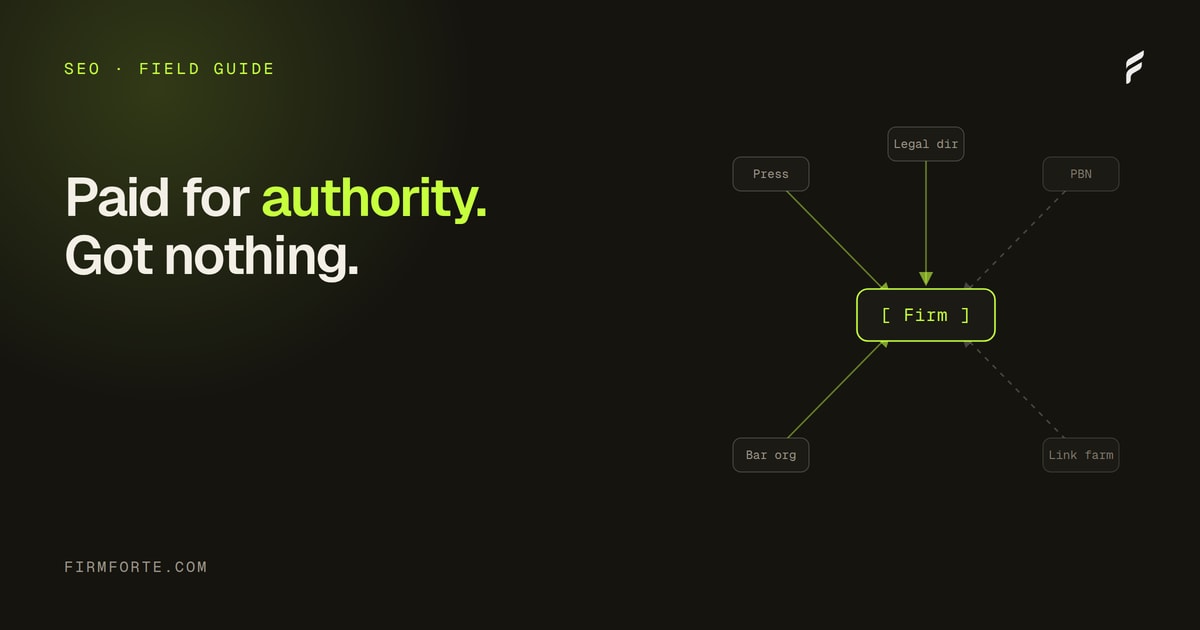
Digital PR for an attorney means earning mentions on sites you don't own — trade press quotes, bar association pages, conference and panel listings, law school affiliations, regional media. It matters because your own claims about yourself carry almost no weight with a search or AI engine, and independent references do. It is not press releases, and it is not paid placements dressed up as coverage.
A lot of agencies will tell you they do digital PR. What they mean is they'll submit your firm to 40 directories, post a press release to PRNewswire, and include the resulting link count in a monthly report. That's not press. It's a spreadsheet with links.
Real digital PR, the kind that actually builds an attorney's authority, is harder to measure and harder to sell because it takes months and doesn't come with guaranteed deliverables. Which is exactly why agencies package the easy version and label it the same thing.
The distinction used to matter mostly for rankings. It matters a lot more now, because AI engines use editorial coverage as one of the core signals for deciding which lawyers they trust enough to cite.
What counts as earned media for an attorney
Earned means a third party chose to include you without being paid. A journalist quoted you as a source on a case. A podcast host invited you on. A legal trade publication ran a byline piece under your name. A local business journal listed you in its 40 under 40. A bar association blog published your analysis of a recent appellate decision.
All of those are earned. None of them are guaranteed. You can work to position yourself for them, since there are specific tactics that move the odds, but you can't buy the outcome the way you buy an ad placement. That's the defining feature.
What's not earned: paid directory listings (even ones with a blue "featured" badge), press releases (a PRWeb release is marketing copy, not journalism), sponsored content sections, and awards you paid to enter. These have their place, and some of them matter for entity consistency and NAP coverage. But they don't carry the same weight with AI engines, because AI engines are better than you'd think at distinguishing editorial from commercial content.
Authority weight: earned vs sold as PR
Why it matters more now
Google has been trying to figure out which attorneys are genuinely authoritative for years. E-E-A-T (experience, expertise, authoritativeness, trust) is the framework Google uses for legal and medical content, and the A and T specifically come from external signals. We covered what that looks like for law firms in the E-E-A-T post.
AI engines are doing something similar but faster. ChatGPT, Perplexity, Claude, and Google's AI Overviews are drawing on text data that includes editorial coverage, not just your homepage. When they try to answer "who's a good estate planning attorney in Boston," they're synthesizing what they've read across the broader web. An attorney who got quoted in the Boston Globe, had a byline in Massachusetts Lawyers Weekly, and appeared on two legal podcasts has a very different data footprint than one who's only ever appeared in their own marketing copy.
That corroboration is the thing. Your site can say you're an expert in nursing home abuse cases. It means very little if nothing outside your site agrees. We went into how AI engines use that corroboration to build citation decisions in off-site SEO for law firms.
What agencies usually sell instead
Three things get packaged as digital PR that either aren't, or aren't the high-value version.
Press release distribution. A release about your firm winning an award or opening a new location goes out over the wire to 500 media outlets, most of which are automated aggregators. A few pick it up verbatim. Those pages typically have no organic traffic and exist primarily to generate inbound links. The links are generally low quality because everyone knows that's what wire releases produce. There's nothing wrong with an occasional release for a genuinely newsworthy event, but don't mistake it for coverage.
Directory submissions. Justia, Avvo, Martindale-Hubbell, FindLaw, Super Lawyers: these matter for NAP consistency and entity corroboration, and a well-maintained Avvo profile has real value. But paying a retainer to "submit your firm to 80 directories per month" is mostly paying for automated submissions to sites that don't move the needle. The ten directories that actually count, you can claim yourself for free in an afternoon.
Aggregated awards and lists. "Best Lawyers in America," "Super Lawyers," "Rising Stars": some require a submission, some a nomination fee, some a paid profile to be listed. They're not worthless. But they're not editorial, and most lawyers in a given market collect the same designations, so the differentiation signal is close to zero.
What's worth doing
The single highest-return thing an attorney can do for real digital PR is become quotable. That sounds abstract, so here's what it actually means: have a clear position on at least three topics in your practice area, be available to respond to journalist queries within a couple of hours, and maintain an updated media page on your website with a headshot and a bio that reads like a journalist might have written it.
In 2026, the practical channels for source requests are Qwoted, Featured.com (which replaced HARO), and Source of Sources. Journalists post queries looking for attorney sources. You respond with a clear, quotable take. If they use you, you get an earned mention in actual editorial content. It's slow and hit-or-miss, but a single placement in a regional publication carries more authority signal than a year of directory submissions. The attorney personal branding post covers the full pitch workflow, including how to set up your media page and what journalists are usually looking for from legal sources.
Bylines are the other thing worth the effort. A 600-word piece in your state bar journal or a legal trade publication covering your practice area, under your name, with your firm name in the bio. It takes time to write and pitch and place. But the resulting page (published by a third party, carrying your name, discussing your specialty) is exactly the kind of content AI engines use to build a picture of who an attorney is. This is harder to fake and harder to buy than any directory listing, which is also why it matters more.
Person schema connects the dots
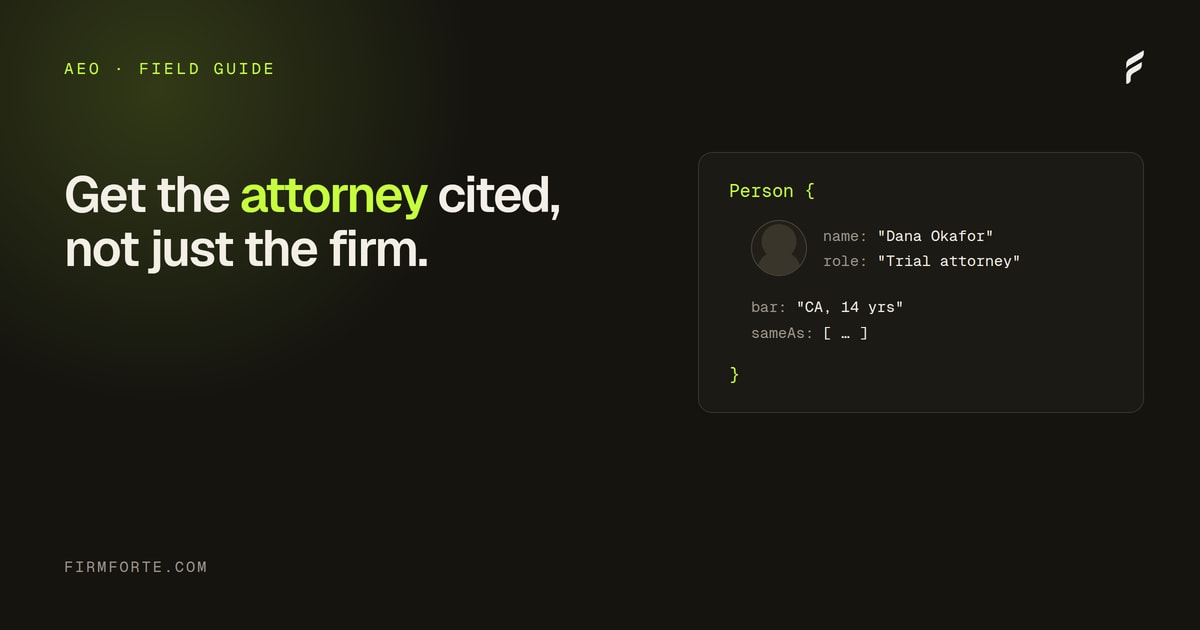
When earned coverage exists, Person schema on your attorney bio pages is how you tell search engines that the Layla Reyes quoted in the Austin American-Statesman and the Layla Reyes on the bio page at reyeslawaustin.com are the same person. Without it, the corroboration is there but the engine may not connect it to your site. With it, you're explicitly claiming the relationship.
This is what most attorneys skip even when they do everything else right. Good press gets earned, bylines go live, and nobody ever adds the structured data that ties it back to the firm. If you have attorney bio pages, and you should, get Person schema on them. We detail what that markup needs to contain in the seven schema types every law firm site needs.
Real digital PR is slow. That's why most agencies don't deliver it and most lawyers don't pursue it. The firms that do, three years from now, will be the ones AI engines reach for as the default authorities in their practice area and city. The economics of that position are better than any ad spend because the position, once built, doesn't invoice you monthly.
Digital PR is one strand of the broader authority work that decides whether engines treat you as a real expert, laid out in full in how attorneys build the authority AI engines cite, and one of its most accessible tactics for a lawyer is podcast guesting, which borrows an audience while staying clear of the solicitation rules. To see how your firm's authority currently shows up where clients look, run the free review. Full detail on how we approach this is on our Digital PR page.
Questions we get about this
-
What is digital PR for attorneys?
Earning references to you on websites other people control, so an engine and a prospective client can confirm you exist and are credible without taking your word for it. In practice that's being quoted in trade publications, appearing on bar and association pages, being listed as a speaker or panelist, and turning up in regional coverage of matters you worked on. It's different from marketing content because you don't control the outcome — which is exactly why it counts for more. Every mention does two jobs: authority and corroboration.
-
Do attorneys need to hire a PR firm?
Usually not for the work that matters most, which is being reachable and useful when a journalist needs a licensed attorney fast. Reporters on deadline want someone who will say something specific and quotable within hours, and being that person is a habit rather than a retainer. A PR firm earns its cost when you're pursuing national coverage or managing something sensitive. For most solo and small firms the constraint is responsiveness, not access.
-
What doesn't count as digital PR?
Press releases pushed to distribution wires, paid placements presented as editorial, guest posts on sites that exist to sell guest posts, and directory listings you bought. None of them are independent, which means none of them corroborate anything — an engine can tell the difference between a mention you earned and one you purchased, and so can a reader. They also cost money that would do more good spent on being available to reporters. If you paid for the placement itself, treat it as advertising and judge it as advertising.
-
How does digital PR connect to schema and AI citations?
The mentions are the evidence and your Person schema is the claim, so they only work together. A Person node whose sameAs list points at a bar profile, a trade-press byline, and a speaking listing gives an engine a path from the entity you assert to independent records confirming it. Without the mentions the schema asserts something unverifiable; without the schema the mentions are harder to attribute to the same person. Build the record first, then make sure the markup points at it.