
The short answer
Put the effort into personal profiles, not the firm page. Individual profiles consistently outperform company pages on reach and engagement, and the personal profile is also the entity a search or AI engine can verify against bar records and publications. The firm page still has a job — it's the address people check — but it isn't where the work pays off.
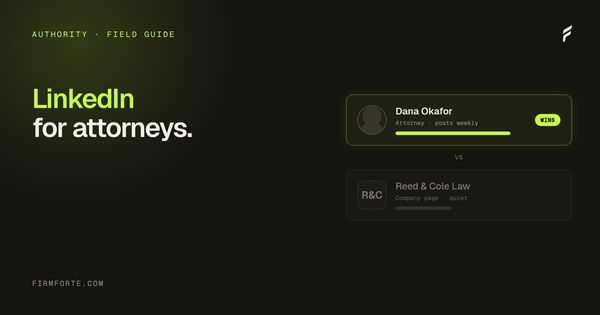
For an attorney, the personal profile beats the firm page, and it isn't close. LinkedIn's audience and algorithm both reward a real, named lawyer posting over a faceless company page, because people engage with people, not logos. The strategy that works is an active personal profile for each key lawyer, a maintained firm page as the credible backdrop behind them, and native content that keeps readers on the platform. Done consistently, it builds the personal authority that supports your search rankings and your standing with AI engines both.
Here's how to split your effort between the two, what actually performs on LinkedIn now, and why any of it matters beyond LinkedIn itself.
Should a lawyer focus on their personal profile or the firm page?
The personal profile, by a wide margin. Personal LinkedIn profiles consistently get more engagement than company pages, so the individual attorney is where the reach and the relationships actually happen. The firm page still matters as a professional presence, but it's the supporting act, not the headliner. If you have to choose where to spend your limited time, spend it on the named lawyer's profile.
This surprises firms that instinctively pour their effort into the branded company page, treating personal profiles as an afterthought. It's backwards. Guidance for legal marketers, including analyses from firms like Good2BSocial on the LinkedIn algorithm, is consistent that individuals outperform pages on reach and engagement. The most effective approach combines a polished firm page with active personal profiles from the key lawyers, but the center of gravity is the people. A logo doesn't build trust or authority the way a real attorney sharing real insight does.
Why does the personal profile win?
Because authority on LinkedIn, like authority everywhere, attaches to people. The platform's algorithm favors individual voices, its audience connects with named humans over brands, and a lawyer sharing genuine expertise reads as credible in a way a company post never can. The personal profile is where your professional reputation actually compounds.
This is the same principle that runs through all authority work: a real, credentialed person is the strongest signal you have, which is the whole argument in building a real attorney personal brand. On LinkedIn it just plays out in engagement numbers. A partner posting a short, useful take on a legal development will out-reach the firm page posting the same thing, because people follow and trust people. For a small firm especially, this is an advantage, because your named attorneys are more relatable and more credible than any brand you could build around them. Lead with the human.
What content actually performs on LinkedIn now?
Native content that keeps people on the platform, with short video leading for individuals. Attorneys who post 60-to-90-second talking-head videos explaining a legal topic see dramatically higher reach than text-only posts, and you don't need a production crew, just a decent phone, good light, and a clear delivery. Native documents and carousels also perform strongly, while external links get suppressed.
That last point is a real shift worth adjusting to. LinkedIn's algorithm increasingly deprioritizes content that pulls users off the platform, and the click-through rate on external links has dropped noticeably, while native documents published directly on LinkedIn generate far more engagement than link posts. The practical takeaway: don't just paste a link to your latest blog post and call it LinkedIn marketing. Share the actual insight natively, a short video, a carousel, a substantive text post, and save the link for the comments or a lighter touch. Teach something in the post itself, where the platform will actually show it to people.
What's the firm page actually for?
A credible, maintained backdrop, and a hub your people can amplify. The firm page won't drive the engagement your attorneys' profiles do, but a professional, current company page signals legitimacy when someone checks you out, and it gives your team something to share and reinforce. Its best formats now are documents and images rather than the video that carries individual profiles.
The real multiplier for the firm page is employee advocacy: when the firm's people share and engage with its content, the organic reach jumps well beyond what the page achieves posting alone. So the two layers work together, the firm page as the credible anchor, the personal profiles as the engine that carries it. Keep the page current and professional, post the formats that suit it, and lean on your attorneys' profiles to extend its reach. Don't expect the page to do the heavy lifting by itself; that was never its job.
How does LinkedIn build authority that helps search and AI?
By adding real, corroborating, off-site presence for your named experts. A strong LinkedIn profile is another independent place where your attorney shows up as a credentialed, identifiable professional, which feeds the same authority signals search and AI engines weigh, and it's a natural target for the sameAs links in your Person schema that help an engine confirm the lawyer is real.
This is where LinkedIn connects to the broader authority work rather than sitting off to the side. It's one of the off-site signals that build the reputation engines reward, described in full in how attorneys build the authority AI engines actually cite, and the profile is exactly the kind of verified external source you point to from your attorney Person schema. It also compounds with earned press: an active, credible LinkedIn presence makes you easier for a journalist to find and verify when you pitch, which ties into getting quoted in legal trade press. The profile isn't a silo; it's one more node in the web of corroboration that says you're the real thing.
How much time does this actually take?
Less than firms fear, but it has to be consistent. A post or two a week from a key attorney, plus genuine engagement with others in your professional network, is enough to build presence over time. The goal isn't going viral; it's credibility and connection, built steadily, which is exactly what LinkedIn's current algorithm rewards.
Consistency beats intensity here, the same way it does with every authority tactic. A lawyer who posts a short, useful thing twice a week for a year builds real standing; one who does a burst of ten posts and then vanishes builds nothing. Keep it sustainable: a brief video or text post on something you actually know, a few genuine comments on colleagues' and referral sources' posts, and a firm page kept current in the background. It's a habit, not a campaign, and like the rest of authority work, it can't be bought, only earned over time. To see whether the engines currently treat your firm and its attorneys as real, credible sources, run the free review, and the ongoing off-site and authority work is the heart of our digital PR service.
Questions we get about this
-
Should a lawyer focus on their LinkedIn profile or the firm page?
The personal profile, clearly. Individual profiles reach and engage far better than company pages, which is consistent across the guidance written for legal marketers. The profile is also the verifiable entity: it carries a name, a title, a firm, and a history that can be checked against a bar record, where a company page carries a logo. Keep the firm page current and complete, then spend the actual attention on the people.
-
What content works on LinkedIn for attorneys?
Short, specific observations from the work — a thing clients keep getting wrong, a change in a rule and what it means, what a process actually involves. Write it as yourself rather than as the firm, and skip anything that reads as an advertisement. Consistency beats volume: a useful post every week or two sustained for a year does more than a burst that stops. Never post anything about a specific matter or anything that could imply an outcome.
-
How does LinkedIn help search and AI visibility?
A complete profile is an independent, high-authority page confirming that a named attorney exists, works where they say, and has the credentials claimed — which is exactly the corroboration search and AI engines weight. Link it from your Person schema's sameAs so the markup on your bio points at it. That turns a profile from a networking page into an entity signal. The consistency matters: the name, firm, and title should match your site exactly.
-
How much time does LinkedIn take for an attorney?
Twenty minutes a week is enough to sustain it once the profile itself is done properly. The profile is a one-time job — a real photo, a headline that says what you do and for whom, an honest summary, and the bar admissions filled in. After that it's a short post every week or two and replying to people who comment. Firms that treat it as a daily obligation burn out and stop, which is worse than a modest pace kept up.