

The short answer
AI Overviews are the generated summary that appears above ordinary results for some searches. AI Mode is a separate conversational experience you enter deliberately, with its own retrieval. They draw on overlapping but distinct processes, which is why appearing in one doesn't get you the other — and why neither is something a firm can directly control.
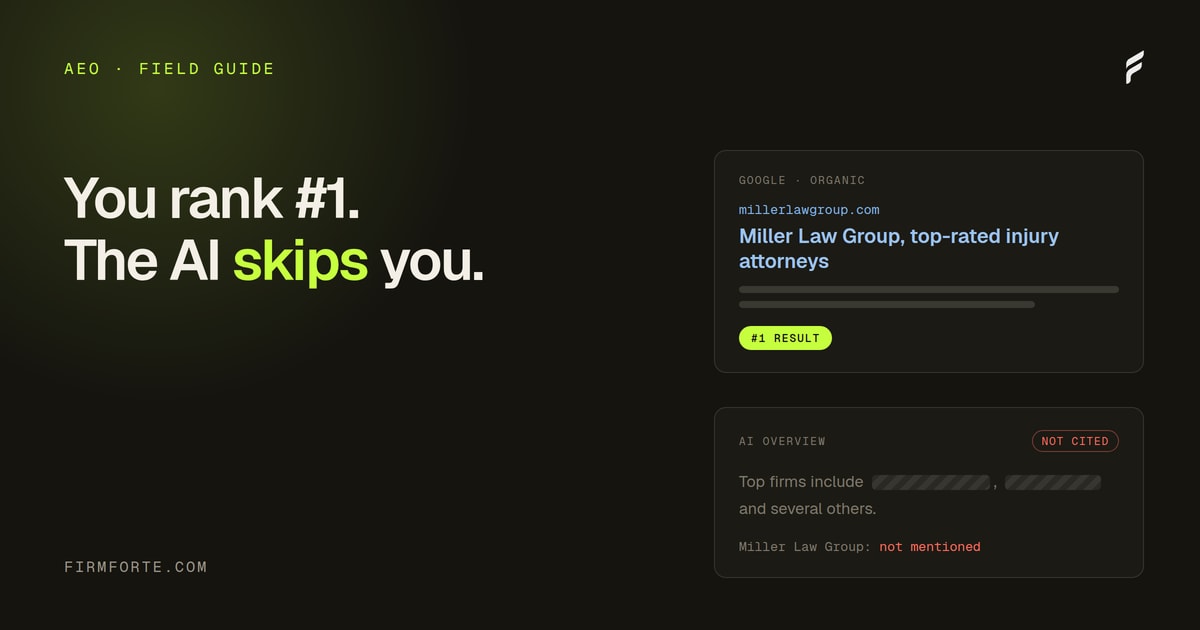
Most people treat "Google's AI stuff" as one thing. It isn't. AI Overviews and AI Mode are two different products on two different surfaces, and they behave differently enough that showing up in one tells you almost nothing about whether you'll show up in the other. If you're a law firm trying to figure out where you stand, that distinction matters, because the work that makes you eligible is roughly the same, but the outcome you can promise for either is roughly none.
Here's the plain version. AI Overviews is the summarized answer box that appears at the top of a normal Google results page, above the blue links, on some searches. AI Mode is a separate, conversational experience you opt into, where Google runs a fuller back-and-forth and pulls from many angles of your question at once. Same company, same underlying index, very different front doors. Let's walk through what actually separates them and what a small firm can do about it.
What is AI Overviews, really?
AI Overviews is a summary that sits on top of the regular search results. You type a query, you land on the familiar page of links, and for certain questions Google stacks a generated answer above them with a handful of cited sources. You didn't ask for it and you can't turn it on or off per search. Google decides whether the query warrants one.
The key thing about AI Overviews is that it's tied to a single search. It's answering the exact words you typed, quickly, and linking out to a few pages it drew from. It's closely related to how featured snippets have always worked, which is why the two share a lot of the same eligibility signals. We wrote about that overlap in featured snippets and AI Overviews. If your page can cleanly answer a discrete question, it has a shot at being one of the sources. If it can't, it doesn't.
What is AI Mode, and how is it different?
AI Mode is a conversational search experience, and the difference that matters most is what happens under the hood. When you ask AI Mode a question, it doesn't run one search. It breaks your question into several related sub-questions and searches for all of them at once, then assembles an answer from everything it gathered. Google calls this fanning out. You ask one thing; it quietly asks a dozen.
That changes the game. In AI Overviews, you're competing to answer one query. In AI Mode, you might get pulled in because your page happened to answer one of the sub-questions Google generated on its own, questions the searcher never typed. A hypothetical example: someone asks AI Mode "what happens after a rear-end collision in a no-fault state." Google might fan that into sub-questions about no-fault rules, when you can step outside no-fault, how medical bills get paid, and what a demand letter is. A firm's page might surface because it clearly answered the demand-letter piece, even though the person never used those words.
It's also a back-and-forth. Someone can follow up, narrow the question, and Google keeps building on the thread. That means more entry points and more branches where your content could get referenced, and far less predictability about which branch you'll show up on, if any.
Why doesn't showing up in one get you the other?
Because they're triggered differently and they're assembling answers differently. AI Overviews fires on specific queries Google judges suitable, and it's anchored to the words in that one search. AI Mode is opt-in, runs its fan-out, and pulls sources across a spread of sub-questions. Different triggers, different retrieval, different moment in the results.
So you can be one of the sources in an AI Overview for a clean, high-intent question and never surface in an AI Mode conversation on a related topic, because AI Mode's fan-out went in directions your pages don't cover. The reverse happens too. Being referenced in a sprawling AI Mode thread doesn't mean you'll win the tidy summary box on the single query. Treat them as two searches you win separately, because that's what they are.
One honest caveat: these are Google products, and Google changes them. The exact triggers, the look, and how much overlap exists between the two are all moving. Anyone who tells you they've got the formula pinned down is selling you certainty that doesn't exist.
What can a law firm actually control?
Not placement. Nobody controls placement, and any agency that promises you a spot in AI Overviews or AI Mode is either confused or lying. What you can control is your eligibility, whether your site is even in a shape to be found, understood, and used as a source. That's hygiene, not a citation trick. Here's where the effort actually goes.
Make your identity unmistakable. Both surfaces have to understand who you are before they'll lean on you: the firm's name, where you practice, what areas of law you handle, who the attorneys are, and how it all connects. Clear, consistent entity signals across your site, your profiles, and your schema markup help Google resolve that you're a real firm covering a real topic in a real place. Schema here is plumbing that makes your facts legible, not a magic wand that gets you cited. We go deeper on that in how AI engines decide which law firm to cite.
Write self-contained, answer-first pages. A page that leads with a direct answer to a specific question, then supports it, is easier for either surface to lift a clean passage from. That serves the anchored AI Overview and the fan-out of AI Mode at the same time, because in both cases something on your page has to stand on its own without the rest of the site for context. If a passage only makes sense after reading three other paragraphs, it's a weak candidate.
Cover the questions around the question. Because AI Mode fans out into sub-questions, the firms with genuinely thorough coverage of a topic have more surfaces that can catch. That's not about churning out thin pages for every keyword. It's about actually answering the real questions a client has near a practice area, in plain language, the way a person would ask them. Our take on writing that way is in conversational content for law firms.
Stay crawlable. None of this matters if the machines can't read the page. If your robots setup blocks crawlers, your key content is buried in scripts that don't render, or pages are slow and broken, you've disqualified yourself before the question of quality even comes up. Technical crawlability is the floor, not a differentiator, but plenty of firms are sitting below the floor without knowing it.
So what should a firm expect?
Expect to do the work that makes you eligible, and expect no guarantees on either surface. That's not a dodge, it's the honest shape of it. You can build clear identity signals, write pages that answer real questions on their own, cover a topic thoroughly, and keep the site clean and fast. All of that raises the odds that Google can find you useful on either surface. None of it hands you a placement, because placement isn't yours to hand out.
What's genuinely outside your control is a long list: whether a given query even triggers an AI Overview, how AI Mode fans out a question on any given day, which sources it decides to lean on, and how Google reshapes both products next quarter. Good marketing means doing the controllable work well and being straight with you about the rest. If you want the fuller picture of why a firm can rank fine in classic search and still miss the AI layer, we laid it out in why your firm shows up in Google but not AI Overviews.
The practical move is to stop thinking about "getting into Google's AI" as one target and start treating your site as something both surfaces should be able to use. That's the work we do, and it's the honest version of it. You can read more about our approach to AEO for law firms, or if you'd rather just see where your firm actually stands right now, send us your URL for a free review and we'll show you the gaps worth fixing first.
Questions we get about this
-
What is the difference between AI Overviews and AI Mode?
AI Overviews is the generated answer that appears at the top of a normal results page for some queries, alongside the usual links. AI Mode is a separate conversational surface you choose to enter, which handles follow-up questions and does its own retrieval across a query. They're different products with different behavior, so the same search can produce very different results in each. Being cited in one says little about the other.
-
Why doesn’t appearing in AI Overviews get you into AI Mode?
Because they retrieve independently, and AI Mode often decomposes a question into several sub-queries rather than answering the one you typed. That means the pages it pulls can differ substantially from what an Overview surfaces for the same wording. There's no setting or submission that links the two. The practical implication is to stop optimizing for a specific surface and make your pages retrievable and extractable generally.
-
What can a law firm actually control here?
The inputs, and only the inputs: whether crawlers can reach your pages, whether your answers are stated plainly enough to lift, whether your entity is consistent across the web, and whether independent sources corroborate you. Which surface shows what, to whom, on a given day is Google's call and changes without notice. Anyone selling placement in either is selling something they don't have. Do the inputs and let the surfaces sort themselves out.
-
What should a law firm expect from these surfaces?
Variance, and less traffic per impression than the old blue links delivered. Both surfaces answer questions without requiring a click, so being named without a visit becomes a real outcome rather than a failure — which also makes measurement harder. Expect the answers to change between users and over time. Judge your position by whether you're being named at all, not by a stable ranking that no longer exists here.