

The short answer
Lock-in comes from three places, and none of them is the monthly fee: who owns the website and its source code, how long the contract runs and what canceling requires, and whether the site sits on a platform only that agency can operate. Ask about all three before scope or price. An agency confident in its work has straightforward answers to each.
Every legal marketing agency's pitch sounds roughly the same: more cases, better rankings, a dashboard full of green arrows. The pitch isn't where the decision is. The decision is whether you can leave. If the contract, the platform, and the account logins all let you walk away clean, a mediocre agency costs you a few months. If they don't, a bad one can hold your firm's entire online presence hostage.
So the right way to choose isn't to compare promises. It's to run the exit test before you sign, and pick the agency that makes leaving easy, because that's the one betting you'll want to stay. Here's how to do that, clause by clause.
What actually locks a law firm into a marketing agency?
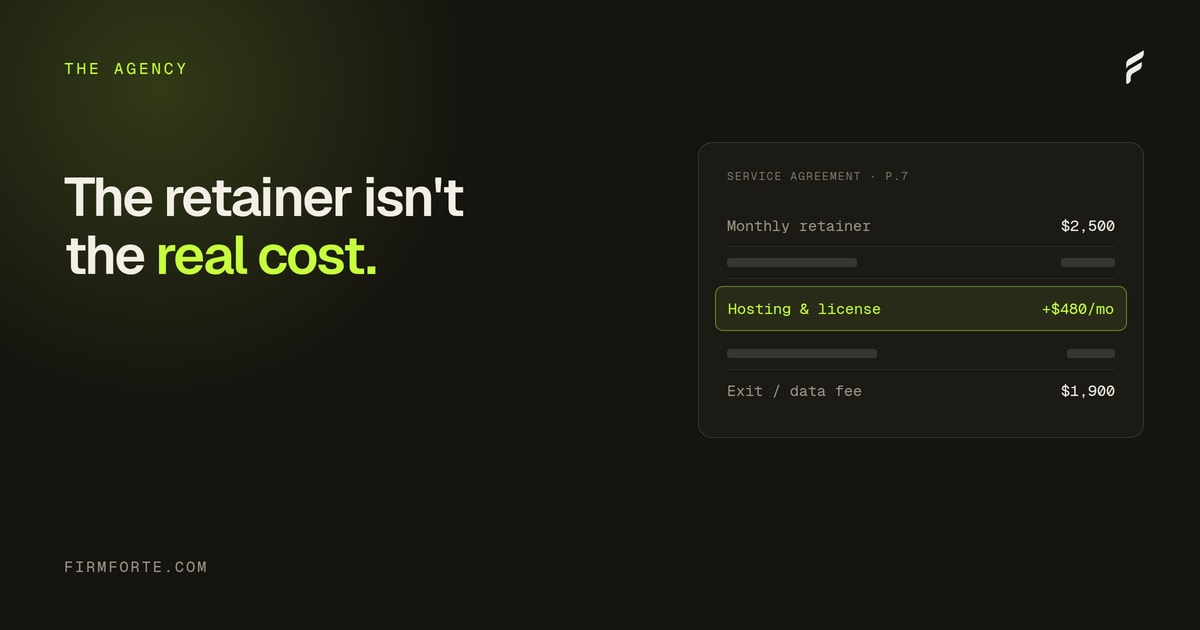
Three things, and price isn't one of them. The lock-ins are the contract (long terms, auto-renewal, early-termination penalties), the platform (a proprietary website you can't export), and the accounts (your domain, Google Business Profile, and analytics registered under the agency instead of you). Any one of those turns "we're not happy, let's leave" into a project with a cost attached.
Notice what's missing from that list: the monthly fee. A high retainer you can cancel next month is a smaller risk than a modest one welded to a twelve-month term on a site you don't own. Firms get this backwards constantly. They negotiate hard on price and sign whatever's in the contract's back half, which is exactly where the power lives. The fee is the number you see. The locks are the ones you don't, until you try to leave. Read for the locks first.
Why won't most legal marketing agencies show you their pricing?
Because for many of them, the price is set by how big your firm looks, not by the work involved. A published price list means the same number for everyone. A quote after a discovery call means the number can flex to what they think you'll pay. Opacity isn't an accident or an oversight. It's a negotiating position, and you're on the wrong side of it.
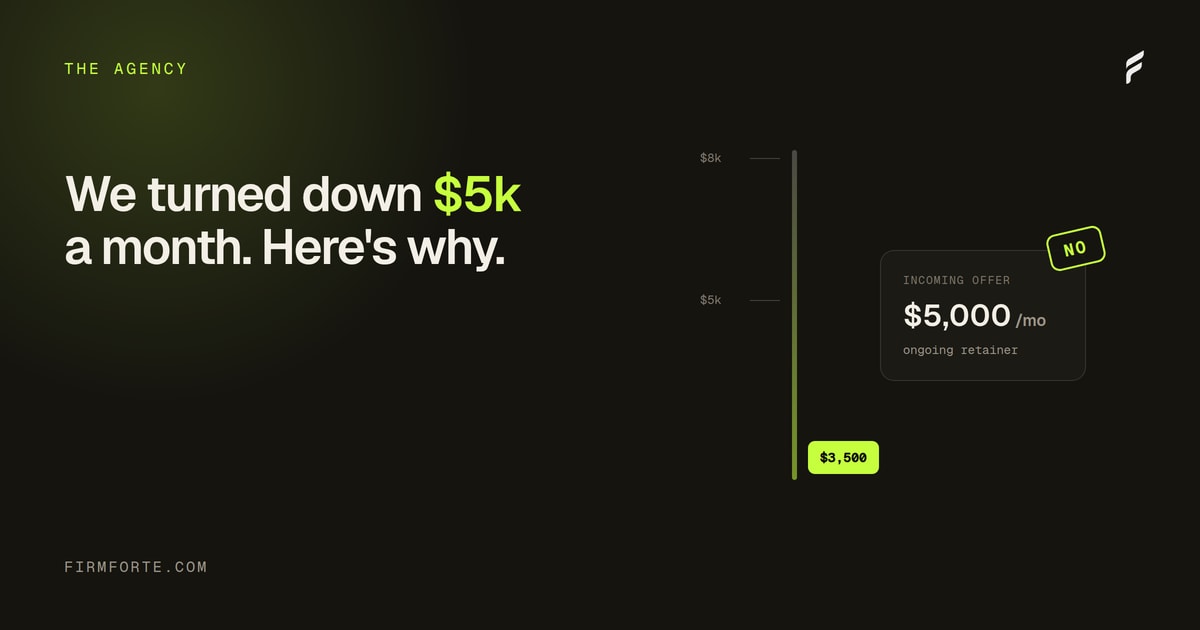
The market itself isn't a mystery, even when individual agencies act like it is. Most law firms pay somewhere between $2,500 and $7,500 a month for a real SEO and marketing retainer, and industry pricing guides put the typical monthly retainer around $3,500, with annual spends of $120,000 to $150,000 at the higher end. A 2025 legal marketing budget guide from 12AM Agency and other 2026 breakdowns land in the same territory. So when an agency won't name a number until it's seen your revenue, it's not because the number is unknowable. It's because a fixed number would cost them room to charge you more. We took the opposite position and explained it in why we charge below the median and turn down work. The full breakdown of the market rate, and how to tell if you're overpaying, is in what the median legal marketing retainer actually costs.
What does legal marketing actually cost in 2026?
A useful mental model is four tiers, and knowing which one you need protects you from paying for a bigger one. A local foundation runs $1,500 to $2,500 a month, a growth retainer $2,500 to $5,500, a competitive or multi-location program $5,500 to $10,000, and enterprise work $10,000 and up. Most solo and small firms belong in the first two, whatever the sales deck implies.
| Tier | Typical monthly | Who it fits |
|---|---|---|
| Local foundation | $1,500 – $2,500 | Solo, one metro, one practice area |
| Growth retainer | $2,500 – $5,500 | 2-5 attorneys compounding over a year |
| Competitive / multi-location | $5,500 – $10,000 | Saturated markets, several offices |
| Enterprise | $10,000+ | Large firms with real ad spend |
Watch for two pricing games layered on top of the tier. Setup fees, commonly $1,000 to $7,500, that appear after the monthly number has anchored you. And add-ons priced à la carte once you're committed, so the $3,000 retainer becomes $5,500 by month two. The fees agencies bury in contracts are a category of their own, and they're easier to catch when you know the base retainer should sit in one of the bands above. If a quote is far outside them, ask what the extra buys. Sometimes it's real. Often it's the discovery-call premium for a firm that looked prosperous.
What's in the contract that you'll actually regret?
The clauses you skim. Term length and auto-renewal, early-termination penalties, intellectual-property and ownership language, and what happens to your content, rankings, and accounts when the relationship ends. Those four decide what leaving costs you, and they're usually written in the section everyone signs without reading because the meeting's running long.
Take them one at a time before you sign. Term and renewal: how long are you committed, and does it renew automatically unless you cancel in some narrow window? Termination: is there a fee to leave early, and how much? Ownership: does the contract say, in plain words, that the site, domain, content, and logins are yours? Exit: when you go, do you keep a working website and the search equity you paid to build, or does it evaporate? If the contract is silent on any of these, that silence favors the agency, not you. Get each one answered in writing. A clause that only exists in a friendly verbal assurance isn't a clause.
How long a contract is reasonable?
Month-to-month, or a short minimum with a clear out, is the confident model. SEO genuinely takes six to twelve months to pay off, so an agency will tell you it needs time, and that's true. But needing time to show results and demanding a twelve-month lock with penalties are different things. One is honesty about the work. The other is a hedge against the work being bad, which we take apart in 12-month marketing contracts: who do they protect.
Here's the tell. A shop that's confident in its results offers you an easy exit, because it's betting you won't take it. A shop that isn't builds the exit shut, because the contract is the only thing keeping you once the reporting stops impressing. Long, penalty-backed terms are commonly reported across the legacy end of the industry, and firms describe them as the hardest part to walk away from. You don't have to accept them. FirmForte's retainers are month-to-month with a cancel-after-month-three minimum, which is enough time for real work to start showing and short enough that we have to keep earning it. Ask for terms shaped like that. If an agency can't offer anything but a year, ask what it's protecting.
The questions to ask any agency before signing
None of these are gotchas. They're the questions a confident agency answers without flinching, and the ones an evasive one suddenly needs to "check on."
- Who specifically works on my account? Names, seniority, and hours. "Our team" is not an answer, and it usually means a junior you'll never meet.
- What do the first 90 days look like, week by week? A real plan exists on paper. If they can't sketch it, there isn't one yet, and you're funding them figuring it out.
- Can I see a real monthly report from a current client, name redacted? If not, you'll be the first client to find out what their reporting actually looks like.
- If I leave, what do I keep? The site, the domain, the content, the logins. Get the answer in writing, in the contract, before design or work starts.
- What's your minimum term, and is there a fee to leave? The shape of this answer tells you how confident they are in everything else.
The exit test: run it before you sign
The cleanest way to evaluate any agency is to ask what happens the day you want to leave. Walk them through it out loud. Do you keep a working website? Is the domain already in your registrar? Do the analytics and Google Business Profile stay in your name? If any answer involves a rebuild, a transfer fee, or "we'd have to discuss it," you've found the lock before it found you. The exit test is one of several worth bringing to the first call, and the full list is in the twelve questions to ask a legal marketing agency before you sign. And if you're already in a relationship you need to end, we lay out the clean-exit sequence in how to leave your law firm marketing agency cleanly.
This test cuts through the entire pitch, because it can't be answered with a promise about results. It's structural. Either the arrangement lets you leave clean or it doesn't, and that's true no matter how good the dashboards look. The most common regret in legal marketing is a firm discovering, at the exit, that the site was never portable and the domain was never theirs, which is exactly the trap we mapped in who owns your law firm website. Running the test up front costs you one honest conversation. Skipping it can cost you your entire online presence and years of search equity. When you're comparing a big managed platform against a leaner shop, this is the axis the whole thing turns on, which is why our comparison with Scorpion leads with the exit, not the price.
Green flags: what a confident agency does
The signals cut the other way too, and they're easy to spot once you're looking. An agency worth hiring posts its prices, offers a short and honest out, tells you who's doing the work by name, puts ownership in writing, and is candid about the firms it's a bad fit for. Confidence looks like making it easy to leave. Insecurity looks like making it hard.
That last green flag is the most underrated: an agency that tells you when you're not a fit. A shop willing to say "you're too small for us" or "you'd be better served elsewhere" is a shop that isn't desperate for your signature, and desperation is what long lock-ins are made of. We turn down work that isn't a fit and say so, because a client who should have gone elsewhere becomes an unhappy client in six months. The agency that's relaxed about you leaving is the one you can trust to keep earning your stay. The one that needs the contract to keep you is telling you what it thinks of its own work.
Choose on the exit, not the pitch. Read the back half of the contract before the front. Make every quote name a number and itemize what's in it. And run the exit test out loud before you sign, on us and on everyone else you're considering. Our full pricing sits on the pricing page, posted, the same for every firm, and if you want to line up the options side by side, that's what the comparison pages are for. The best agency relationship is the one you're always free to end and never want to.
Questions we get about this
-
What actually locks a law firm into a marketing agency?
Not owning your website, a contract with a long term and a punitive exit, and a proprietary platform nobody else can take over. Those three, in combination, mean leaving costs you the site rather than just the relationship — which is the point of the arrangement. The monthly fee is the part firms negotiate and the part that matters least. Ask what you would walk away with if you gave notice tomorrow, and the answer tells you how locked in you are.
-
How long should a law firm marketing contract be?
Long enough for the work to show and short enough that you can leave if it doesn't — in practice a short initial commitment then month-to-month. SEO does take months to show, so some initial term is reasonable rather than a red flag. Twelve months with an auto-renew and a cancellation penalty is a different thing: that's not about giving the work time, it's about making departure expensive. Our own retainers cancel after month three, which is roughly where the honest version of this argument lands.
-
Why won't legal marketing agencies publish their pricing?
Usually because a published number removes the ability to price against your budget rather than against the work. The tell is being asked about your revenue or your current spend before you're given a figure — the cost of the work doesn't depend on what you earn, so that question exists to set the quote. There are legitimate reasons for ranges, since scope genuinely varies with practice areas and locations. There's no legitimate reason a firm can't be told a starting number before a discovery call.
-
What is the exit test for a marketing agency?
Ask, before signing: if we give notice next month, what exactly do we keep? The answer should be the domain in your own registrar, a working exportable website, the source code and content, and every account login. Ask for it in writing as part of the agreement rather than as a reassurance on a call. An agency that hesitates here is telling you what the business model is, and it's much cheaper to learn that now than in eighteen months.