
The short answer
Twelve questions, and the four that matter most are about ownership, contract term, what the monthly fee actually buys, and who does the work. Ask them before scope and before price. The answers you should worry about aren't the wrong ones — they're the vague ones, because vagueness is where the room to change the deal later lives.
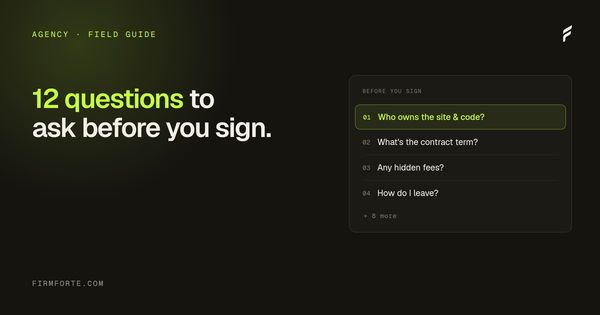
The questions that matter most to a law firm hiring a marketing agency are the ones that reveal what happens when things go wrong: who owns the website, what the contract locks you into, who actually does the work, and how you'll know if it's working. A good agency answers all of them plainly. An agency that dodges, over-complicates, or bristles at any of them is telling you something. Here are the twelve to ask on the first call, and what a straight answer sounds like.
The theme running through all of them is simple: you're testing for transparency and for whether the relationship is built to keep you or to serve you. Ask these, and the ones worth hiring make themselves obvious.
1. Who owns the website when we part ways?
The single most important question, and the one that catches the most firms. If the agency builds your site on a proprietary platform you can't take with you, then you don't own your own marketing, you rent it, and leaving means starting over. The answer you want is that you own the site, the domain, the content, and the code, and can take all of it if you go. Anything vaguer is a lock-in you'll feel later, which we cover in full in who owns your law firm website.
2. What's the contract term, and how do I cancel?
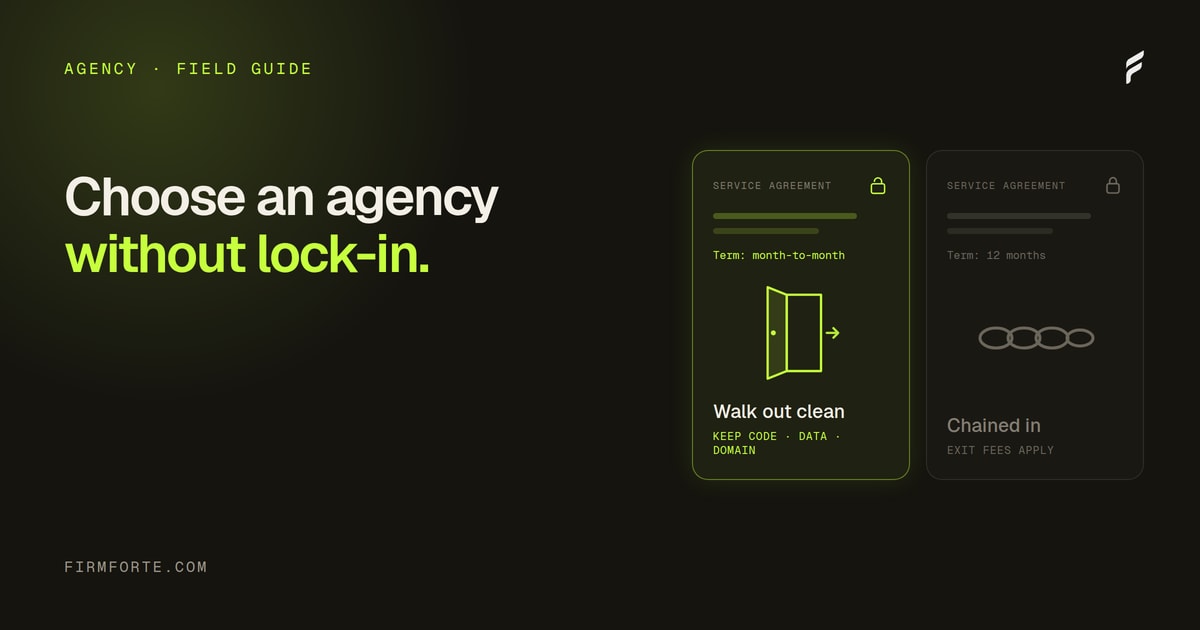
Ask for the length of the commitment and the exact cancellation process, in writing. Long fixed terms with painful exit clauses mostly protect the agency, not you, and a firm confident in its work doesn't need to trap you in a year-long contract to keep you. The answer you want is a short term or month-to-month, with a clean cancellation. The mechanics of why long contracts favor the agency are laid out in who 12-month marketing contracts actually protect.
3. What exactly am I paying for each month?
Get a specific, itemized answer, not "marketing" or "SEO and content." You want to know the deliverables: how many pages, how many hours, what work product actually lands each month. Vague scope is where padding hides, and an agency that can't tell you what a retainer buys is one that would rather you not look too closely. For a sense of what a fair number looks like, see what the median legal marketing retainer costs.
4. Are there any fees beyond the retainer?
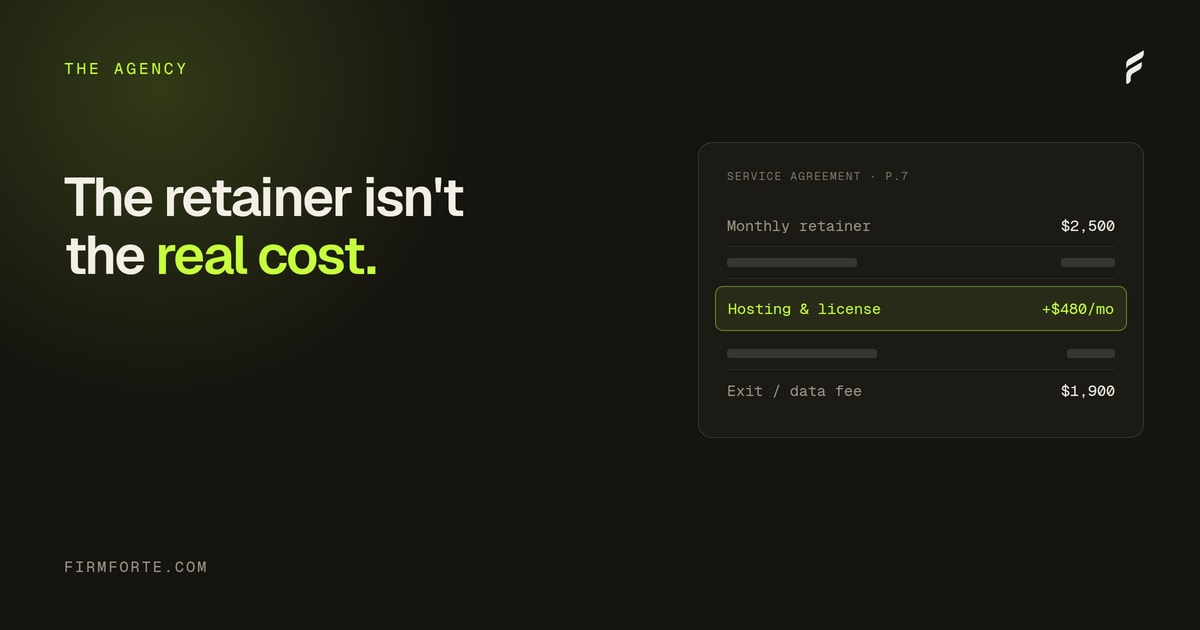
Ask directly whether the monthly number is the whole cost, or whether setup fees, licensing fees, platform fees, or per-change charges sit on top. Some agencies quote a clean retainer and then bill for every edit or bury a license fee that only bites when you try to leave. You want the total cost of the relationship named up front. The common ones to watch for are cataloged in the hidden fees legal agencies bury in contracts.
5. Who is actually doing the work?
Find out whether the people on the sales call are the people doing the work, or whether it's handed to junior staff or subcontractors overseas once you sign. This isn't snobbery, it's about accountability and quality: legal marketing done by someone who doesn't understand law firms or bar rules produces generic, sometimes non-compliant output. You want a clear answer on who owns your account and what their experience with law firms is.
6. Can you show me results from firms like mine?
Ask for real examples from comparable practices, and listen for how they talk about results. An honest agency will show you real work and be candid about timelines and what's realistic; a dishonest one will promise specific rankings or a flood of cases. Be wary of anyone guaranteeing outcomes, since no one controls Google's or an AI engine's ranking. What you want is evidence of real work and a sober description of what it achieved.
7. How do you report on progress, and how often?
You want to know what reporting looks like and whether it ties to outcomes you care about, like calls and cases, or just to vanity metrics like impressions. Regular, plain-language reporting that connects the work to business results is the sign of an agency that expects to be held accountable. Dashboards full of numbers that never mention a phone call are a way to look busy without proving value.
8. What happens to my rankings and content if I leave?
A close cousin of the ownership question, aimed at the content and gains specifically. If you cancel, do you keep the pages, the blog posts, the schema, and the rankings they earned, or does the agency take the content down or retain the accounts? You want everything you paid for to stay yours and keep working after the relationship ends. If leaving erases your progress, you never really owned it.
9. Do you follow bar advertising rules?
Legal marketing sits under rules most general agencies have never read, so ask how they handle attorney advertising compliance, disclaimers, and the line around testimonials and claims. An agency experienced with law firms will speak fluently about Model Rule 7.1 and your state's specifics; one that looks blank is a liability that can expose you to a bar complaint over their copy. You want a partner who treats compliance as part of the job, not your problem to catch.
10. How do you approach AI search and citations?
Ask how they think about being found in AI answers, not just Google's blue links, since a growing share of potential clients now start with ChatGPT or Google's AI Overviews. You want an honest, grounded answer: on-site signals, clean structure, real authority, and no promises of guaranteed AI citations, which no one can deliver. An agency claiming it can guarantee you'll be cited by a given engine is overselling. One that talks about the fundamentals is being straight with you.
11. What do you need from me, and how much of my time?
A practical question that reveals how the relationship actually runs. Good marketing needs some input from the lawyer, expertise, review, the occasional quote, so an agency that says it needs nothing from you is either doing generic work or planning to publish in your name without your eyes on it. You want a realistic picture of the time commitment and a process that keeps you in the loop without drowning you in it.
12. Why should I choose you over doing this in-house or elsewhere?
End with the direct one and watch how they handle it. A confident, honest agency can tell you plainly where it adds value and where it doesn't, and won't badmouth every alternative or pretend it's the only option. You're listening for candor and a clear sense of fit, not a hard close. The agency that answers this one honestly is usually the one that answered the other eleven honestly too.
What should I do with the answers?
Weigh them for transparency, not polish. The best answers are specific, unhesitant, and occasionally admit a limitation, because honesty about what an agency can't do is the strongest signal that it's telling the truth about what it can. Any single dodge isn't disqualifying, but a pattern of vague, defensive, or evasive answers across ownership, contracts, and cost is a clear sign to keep looking. The full framework for picking an agency that won't trap you is in choosing a law firm marketing agency without lock-in.
Bring these to the call and the decision gets easier, because the right agency welcomes every one of them. If you'd like a neutral read on your current marketing before you sit down with anyone, run the free review, compare your options honestly on our comparison page, and see exactly what we charge and deliver on our pricing page.
Questions we get about this
-
What should I ask a legal marketing agency before signing?
Start with four: who owns the website when we part ways, what's the contract term and how do I cancel, what specifically am I paying for each month, and who is actually doing the work. Those four determine what you can walk away with, how expensive leaving is, whether the fee is defined, and whether a senior person or a template is on your account. Ask them before discussing scope, because the answers change how you read everything else. Get them in writing, not on a call.
-
What are the warning signs in an agency answer?
Vagueness rather than a wrong answer. "Ongoing optimization" as a description of monthly work, "we'd have to look at your numbers" as an answer about price, and "everyone signs twelve months" as an answer about the term all avoid committing to anything checkable. A guaranteed ranking is the other clear signal, because nobody honest offers one. If an answer can't be repeated back as a specific commitment, treat it as an answer you didn't get.
-
Should I ask for results from firms like mine?
Yes, and read the answer carefully, because a good agency will be constrained here in ways a bad one isn't. Client confidentiality and bar advertising rules limit what can be shown, so expect anonymized or general answers rather than named case studies with dollar figures. What you can reasonably ask for is a live site they built, a description of what changed and over what period, and a reference call. Be more suspicious of unusually specific results than of a careful non-answer.
-
What should I do with the answers?
Compare them side by side across two or three agencies rather than judging any one in isolation, and write down what each said. Most of the difference between agencies shows up in these answers rather than in the pitch deck. Then ask for the three or four commitments that matter — ownership, term, monthly deliverables — to appear in the contract itself. An agency that will say it but not write it has told you which one is true.