

The short answer
Most of what firms want a redesign for can be fixed without one: the headline, the photography, the copy, the phone number's position, missing schema, slow images. A rebuild is warranted when the platform itself blocks the work, the structure can't support what you need, or the site can't be made to work on a phone. Redesigning to avoid a content problem carries the content problem forward at ten times the cost.
Most underperforming law firm websites don't need a full redesign; they need a handful of targeted fixes. A rebuild is the expensive default agencies reach for because it's the biggest invoice, but it's only the right call when the site's foundation is genuinely broken, when it can't be edited, isn't machine-readable, isn't yours to change, or was built so poorly that fixing it costs more than replacing it. Otherwise, a focused patch gets you most of the result for a fraction of the price. The trick is telling which situation you're in before you spend.
Here's how to diagnose whether your site needs a rebuild or a fix, and roughly what each costs.
What problems can be fixed without a rebuild?
Most of the common ones: weak or thin content, missing or wrong schema, a slow-loading page, an unclaimed or inconsistent Google Business Profile, unclear calls to action, and pages that don't answer the questions clients ask. These are content and configuration problems, not structural ones, and they can be fixed on your existing site without tearing it down. If the bones are sound and the site is yours to edit, most of what's holding it back is patchable.
This matters because these fixable problems are exactly what most firms actually have. A site that ranks poorly usually has thin practice-area pages, no answer-first content, and neglected local signals, none of which require a new site to correct. The instinct to rebuild often treats fixable content problems as structural ones, which is how firms end up paying rebuild prices for what a targeted content-and-technical pass would have solved. Diagnose before you demolish.
What are the signs you only need a patch?
The clearest sign is that your complaints are about what's on the pages, not about the pages themselves. If you can log in and change text, swap an image, add a page, or update your hours without calling anyone, the site is editable, and editable sites are almost always patchable. If your practice-area pages are short and generic, if you've never answered the actual questions clients type before they call, if your Google Business Profile is unclaimed or lists the wrong address, if the site loads slowly on a phone, or if the schema is missing or wrong, those are all finishes, not foundations. None of them require tearing the site down.
A useful gut check: imagine the best possible version of your current pages, well written, properly marked up, fast, with clean local signals. If that imagined site would do the job, you have a patch, because everything separating you from it is content and configuration. The site isn't fighting you; it's just underbuilt. That's the cheap kind of problem, and the most common one.
When does a site genuinely need a rebuild?
When the foundation is broken in a way fixes can't reach: the site can't be edited or you don't control it, it isn't readable by search or AI engines, it's built on a platform you can't export, or it's so technically poor that patching costs more than starting over. If your content is locked behind a builder you can't change, or renders only with JavaScript an engine can't read, or lives on a proprietary platform you don't own, no amount of patching fixes the underlying trap. That's a rebuild.
Ownership is the clearest trigger. If you don't actually own your site and can't take it with you, covered in who owns your law firm website, then fixing it just improves an asset that isn't yours, and a rebuild on a platform you control is the real solution. The other clear trigger is machine-readability: if engines can't read your pages at all, the content work has nowhere to land until the technical foundation is replaced. When the problem is the foundation, not the finishes, rebuild. When it's the finishes, don't.
There's a subtler rebuild trigger worth naming: when the fixes stack up past the cost of starting over. A single broken thing is a patch. But a site that can't be edited without a developer, renders its main content in JavaScript engines struggle with, has no schema, sits on a platform you can't export from, and has thin content isn't five patches, it's a foundation failing in every direction at once. At some point the honest math says a clean rebuild costs less than chasing each problem through a structure that resists every change. That's a judgment call, and the one an audit is meant to make for you.
How do you tell the difference?
Run an honest diagnostic before deciding: can you edit the site, do you own it and the domain, can an engine read it, and are the problems about content or about structure? If you can edit and own the site, it's crawlable, and the issues are thin content or missing schema, you're looking at a patch. If you can't edit or own it, or it's fundamentally unreadable or unexportable, you're looking at a rebuild. The answer usually falls out clearly once you ask those four questions.
The mistake is skipping the diagnostic and letting whoever you ask decide, because an agency that sells rebuilds will find a reason to rebuild. A neutral audit tells you which problems you actually have and whether they're the cheap kind or the expensive kind, which is exactly what our free review is built to do. Get the diagnosis first, then choose the treatment. Deciding to rebuild before you've diagnosed is how firms overspend.
What are the common mistakes on this decision?
The most expensive one is treating a redesign as a fresh start when the old problems were never diagnosed. A firm rebuilds because the site "wasn't working," carries over the same thin practice-area pages onto a prettier template, and lands right back where it started, now with a new invoice. A redesign only fixes what you deliberately fix during it. If thin content and missing structure were the real issues, a new theme doesn't touch them.
The second mistake is confusing looks with performance. A site can be dated and still readable, ownable, and easy to edit, which makes it a patch even if it feels embarrassing. A site can be beautiful and still trap your content behind a builder you can't export, which makes it a rebuild even though nothing looks wrong. What clients and engines respond to is whether your pages answer real questions and can be found, not whether the design is on trend. Rebuilding for looks alone usually spends the most money on the thing that mattered least.
The third is scoping a rebuild around pages that don't earn their place. Firms get talked into sprawling sites with pages nobody reads, which inflates the cost without improving the result. A rebuild should cover the handful of pages that do a real job, and no more. The fourth is treating a rebuild as a one-time event. If the point was to be found, the content and technical work continue after launch, which is why matching a fix or a rebuild to ongoing SEO and AEO work matters more than the build itself.
What does a real decision look like?
Here's an illustrative, hypothetical case, not a real client. A two-attorney firm comes in frustrated that they're invisible in their city. Their instinct is a full rebuild, because the site looks a decade old. But the diagnostic tells a different story: they can edit the site themselves, they own the domain and the code, the pages are crawlable, and the design, while dated, works fine on a phone. What's actually wrong is that they have one thin "Practice Areas" page covering four different services, no answer-first content anywhere, and a Google Business Profile with an old suite number. That's a patch, and a cheap one. Rebuilding would have spent the money on new paint while leaving every real problem in place.
Now change one fact. Suppose that same firm can't edit anything without emailing a developer who's stopped replying, the site lives on a platform they can't export from, and their bios and service pages render only through a script engines don't reliably read. Same frustration, same dated look, but now the foundation is the problem, and no amount of content work lands until it's replaced. Same-looking firm, opposite answer. The look never decided it; the foundation did. That's the whole point of diagnosing before you choose.
What does each option cost?
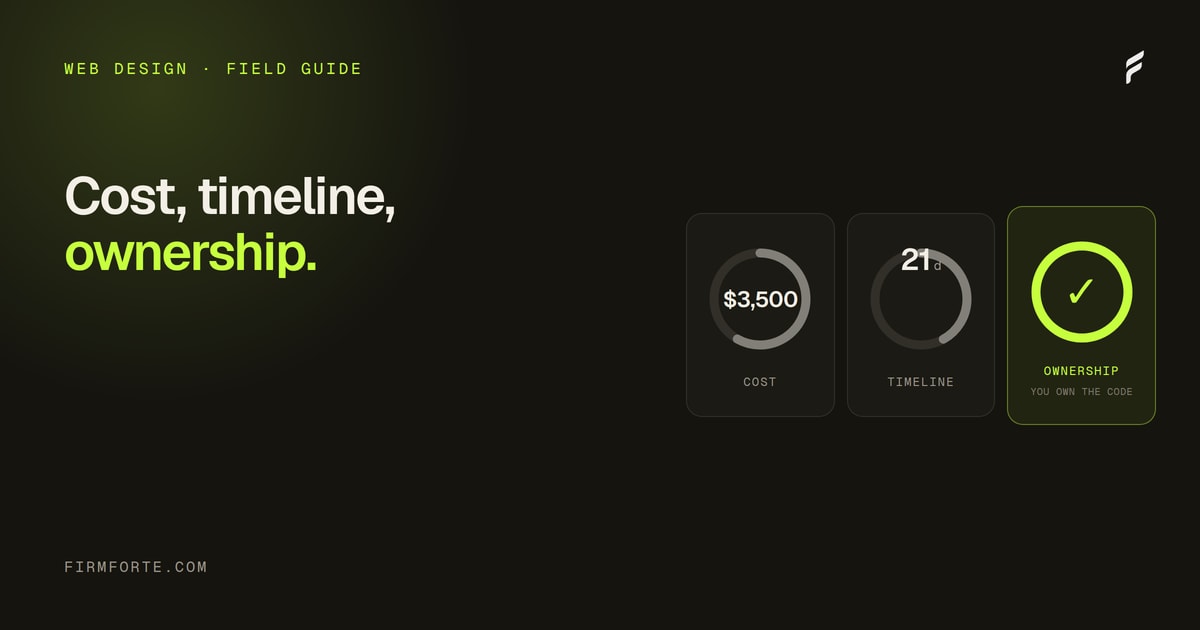
A targeted fix is far cheaper than a rebuild. At FirmForte, a focused Audit and Fix, schema, content, and technical corrections on an existing site, is $1,500 one-time; a full custom rebuild, our Launch tier, is $3,500 flat for a five-page site with AEO architecture built in, delivered in 21 days, with the code and domain yours to keep. The published industry range for a rebuild runs much wider, $1,500 to $50,000 and up, mostly reflecting account-team overhead rather than design quality.
The point of the gap is that if a fix solves your problem, you save the difference, so the diagnosis is worth getting right. Paying $3,500 to rebuild a site whose real issue was thin content and no schema wastes most of that money; paying $1,500 to patch a site whose foundation is genuinely broken wastes all of it, because the underlying trap remains. Match the spend to the actual problem. The full picture of what a law firm site should cost and contain is in the guide to law firm website design, cost, and ownership.
What if you're not sure it's worth fixing at all?
Then judge the site against what it needs to do, not against how it looks. A law firm site needs a handful of pages that each do a real job, a strong homepage, a page per practice area, an honest bio, an easy contact page, plus the technical foundation to be found, which we break down in the five pages every solo law firm website needs. If your site has those and they're just weak, that's fixable. If it's missing them structurally or can't support them, that leans toward a rebuild.
Either way, the decision should come from a clear read of what's wrong and what it would cost to fix versus replace, not from an agency's default or a vague sense that the site "looks dated." Looks are usually the cheapest thing to fix; the problems that actually cost you cases are content, machine-readability, and ownership. To get that honest read on your own site, and a straight answer on whether you need a fix or a rebuild, run the free review, and the build itself, scoped to the pages that earn their place, is our web design service.
Questions we get about this
-
Do I need a full website redesign or just fixes?
Fixes, in most cases. If the complaint is that the site looks generic, doesn't convert, or isn't ranking, the causes are usually copy, photography, structure, and technical hygiene — all changeable on the existing site. A rebuild is genuinely needed when the platform prevents you from editing what you need to edit, when the information architecture can't hold the pages you need, or when mobile is broken at a level styling can't reach. Diagnose before you decide.
-
What are the signs a law firm site only needs a patch?
It loads acceptably, works on a phone, and you can edit the pages and the head yourself — but the copy is generic, the photos are stock, or the schema is missing. Those are content and configuration problems, and none require a rebuild. If you can list what's wrong and each item is something a person could change on the current site this week, patch. Firms usually know the answer and want a rebuild anyway because it feels decisive.
-
When does a law firm website genuinely need a rebuild?
When the platform is the constraint. If you can't edit the head, can't control structured data, can't serve content without JavaScript, or can't get out of a proprietary system, no amount of patching reaches the problem. The other genuine case is a structure that can't hold what you now need — a five-page brochure site for a firm that now needs practice-area depth. Rebuild for a structural reason, not for a cosmetic one.
-
What's the most common mistake on this decision?
Rebuilding to avoid a content problem. A new site carrying the same generic headline, the same stock photography, and the same copy nobody rewrote fixes nothing at several times the cost — and it also resets whatever history the old pages had accumulated. The related mistake is patching a genuinely broken platform for years, spending more in increments than a rebuild would have cost. Both come from deciding on feel rather than on what's actually blocking you.