
The short answer
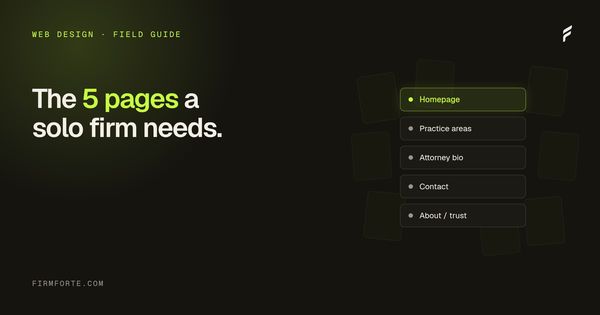
Five pages carry almost all the weight on a solo or small firm site: the homepage, one page per practice area, an attorney bio, an about page, and a contact page. Everything else is usually there to justify a price rather than to bring in cases. Five or six pages that each do a job beat twenty that don't, and they're far easier to keep current.
A solo law firm website needs five pages that do real work: a strong homepage, a page for each practice area, an honest attorney bio, an about page, and a contact page that makes calling easy. That's it. Everything beyond those is usually there to make a build look bigger, not to bring in cases. Five or six pages that each do their job beat twenty thin ones every time, and they cost less to build and maintain.
Here are the five that matter, what each one has to accomplish, and the pages you can safely skip.
What are the five pages every solo firm site actually needs?
The homepage, the practice-area pages, the attorney bio, the about page, and the contact page. Each has a distinct job: the homepage builds trust fast, the practice-area pages convert searchers into calls, the bio proves a real credentialed human is behind the work, the about page tells your story, and the contact page removes every obstacle to reaching you. Under all five sits the technical foundation that lets engines find them.
Notice what this list is organized around: jobs, not sections. A page earns its place by doing something specific for a visitor or an engine. If you can't say what a page is for in one sentence, it probably shouldn't exist. That single test cuts most law firm sites down to the pages that actually move a client from stranger to signed, and it's the frame for everything below.
1. The homepage
Your homepage has seconds to convince a stressed visitor they're in the right place, so it has to establish, fast, what you do, who you help, why you're credible, and how to reach you. It's not a place for a long history or a stock-photo hero with a vague tagline; it's a trust-and-routing page that sends visitors to the practice area they came for.
The specific elements that build that trust in the first screen, real proof, a clear statement of what you do, an obvious way to call, are mapped in the five homepage elements that build trust. Get the homepage right and it does two jobs at once: reassures the human and routes them deeper. Get it wrong and even good practice-area pages never get seen.
2. A page for each practice area
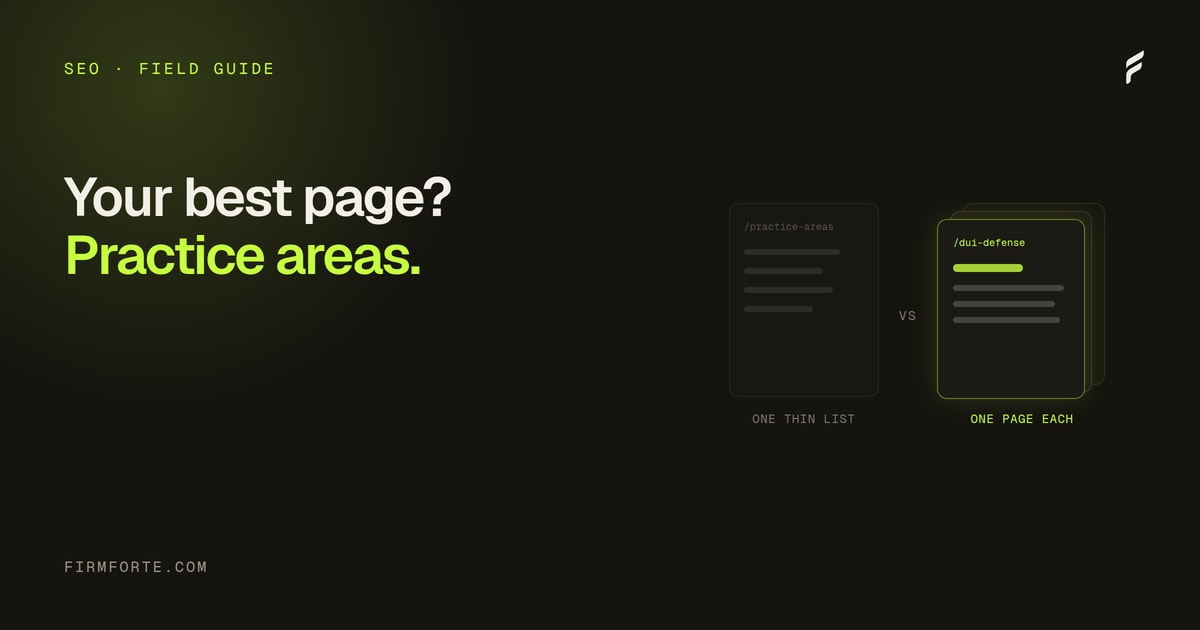
These are your money pages, one per service you actually want cases in, each going deep on that matter. They catch the high-intent searcher ("[practice area] lawyer near me") at the moment they're ready to hire, and they map one-to-one onto a paying matter. A firm that does three things needs three strong practice-area pages, not one thin "Practice Areas" list.
This is where a small firm's SEO actually converts, and it's worth building each page as if it's the only thing you do: the specific process, what to expect, the local detail, the questions clients ask, answered up top. The full case for why these outperform every other page type, and how to build one, is in why practice-area pages are the highest-ROI page a firm builds. If you build nothing else well, build these.
3. The attorney bio
The bio is where a nervous client decides whether they want you in their corner, and where your authority lives. It should read like a real, credentialed person, with genuine background, bar admissions, and experience, not a résumé and not a wall of adjectives. For a solo firm, the named lawyer is the most credible entity you have, so the bio does real work for both clients and engines.
It's also the single highest-return authority signal you own, because named, credentialed authorship is exactly what search and AI engines reward. A strong bio, marked up so machines can read the credentials, ties your content to a real expert. Make it human enough to reassure a client and specific enough to prove expertise. Both audiences are reading it.
4. The about page
The about page carries the story the homepage doesn't have room for: why the firm exists, how you work, what makes you a fit for the client reading it. It's a trust page more than a conversion page, and for a solo or small firm it's where personality and values do work that a list of services can't. Kept honest and specific, it turns a considering visitor into a confident one.
Keep it real. The about pages that work tell a genuine story and take a position; the ones that don't recite generic mission-statement filler that could describe any firm. A client choosing a lawyer for something that matters wants to feel they know who they're hiring, and the about page is where that happens. One good about page beats a scattered set of "our values," "our approach," and "our history" pages that say the same thing three times.
5. The contact page
The contact page has one job: make reaching you as easy as possible. A visible phone number that's clickable on mobile, a short form, your address and hours, and no friction between wanting to call and calling. For a law firm, where the visitor is often anxious and ready to act, a clumsy contact page quietly loses clients your other pages worked to win.
It's also where your NAP, name, address, and phone, needs to be exactly consistent with your Google Business Profile and everywhere else you're listed, because inconsistency there weakens your local ranking. Keep it simple and complete: easy to call, easy to find, consistent with the rest of the web. This page rarely gets attention and quietly matters more than most.
What are the 15 pages you probably don't need?
The bloat that pads a build without bringing cases. The usual suspects: a separate landing page for every nearby town you'd take a client from, a blog nobody maintains with no named author, generic "resources" pages, a page each for "our values," "our mission," and "our approach," an awards or logos page, thin one-paragraph service pages splitting hairs between near-identical terms, and a news section that stopped updating two years ago.
Most of these actively hurt. Manufactured location pages read as thin, duplicative content and can drag your whole site down, which is why we stopped building them, covered in the design fundamentals and in our broader work. An abandoned blog signals neglect. Splitting one real practice area across five thin pages dilutes the one strong page you should have built. The instinct that "more pages means more coverage" is usually backwards; each weak page is a small liability, and a lean site of strong pages outranks and out-converts a sprawling one of weak ones.
Why does fewer, better pages win?
Because depth ranks and thinness gets ignored, and because a small site is one you can actually keep excellent. Search engines reward pages that answer a query thoroughly, so one deep practice-area page beats three shallow ones on the same topic. And a five-page site is one a solo firm can keep current, accurate, and sharp, where a twenty-page site rots into stale corners nobody maintains.
So resist the upsell to a bigger site. The right number of pages is the number that each do a real job, usually five or six for a solo firm, and every page beyond that should have to justify its existence against the one-sentence test. This is part of the larger question of what a law firm site should cost and contain, which we cover in the full guide to law firm website design, cost, and ownership, alongside the conversion fundamentals in the five design mistakes that kill conversion on lawyer websites. To see whether your site has the pages that matter and none of the ones that don't, run the free review, and every site we build is scoped to the pages that earn their place through our web design service.
Questions we get about this
-
How many pages does a solo law firm website need?
Five or six, done properly, is enough for most solo and small firms. The homepage, a page for each practice area you actually want, an attorney bio, an about page, and a contact page cover the jobs a site has to do — establish what you practice, prove a real person is behind it, and make getting in touch easy. Adding pages past that dilutes attention and creates maintenance nobody does. Build the fifth page well before you build a sixth.
-
What pages does a law firm website not need?
Legal glossaries, generic "resources" sections, news pages nobody updates, and a separate page for every phrase you might rank for. They exist mostly to make a build look larger, and each one is a page that will go stale and quietly undermine the impression that the firm is active. If you can't say what job a page does and who it's for, it doesn't need to exist. Fewer, current pages beat more, abandoned ones.
-
What should a law firm attorney bio page include?
Where the attorney is licensed, how long they've practiced, what they actually handle, and something a nervous client can connect with — written as prose rather than as a résumé. It should also be verifiable: the bar admission, any publications, speaking, or association memberships, ideally linked out. The bio is where the firm becomes a person, and it's the page an engine uses to confirm a real, credentialed human exists behind the firm. A bio that reads like a list of credentials does neither job well.
-
Do fewer pages hurt law firm SEO?
No, provided the pages you keep are substantive and cover what you want to be found for. Search rewards depth on a topic rather than page count, so one thorough practice-area page outperforms four thin ones splitting the same subject. What does hurt is having no page at all for something you want cases in. Add pages when there's a real question or practice area to serve, not to hit a number.