
The short answer
Personal injury AEO differs on urgency and competition: the searches happen in a crisis, often on a phone, and the market is the most contested in legal. That rewards six specific page types, schema that describes the firm and its attorneys precisely, and entity signals tied to the places and courts you actually work. Ship them in order, because the later ones don't matter while the earlier ones are missing.
Most agencies running AEO for law firms run one playbook across every practice area. Schema markup deployed across the site. FAQ pages added to every practice area. Question-format H1s. Robots.txt opened for the AI crawlers. Executed reasonably well, that playbook does what it's supposed to do.
It just underdelivers for personal injury, and not because of the execution. It underdelivers because it treats a PI firm as a generic law firm. The citation landscape in PI is shaped by signals that aren't on the generic checklist at all: the queries are almost entirely commercial, the entity graph reaches into insurers and medical providers, and the statute detail that makes a page quotable is state-specific in ways general legal content never has to handle.
Here's what's actually different about PI-specific AEO, the six page types most firms are missing, and the schema corrections that matter most.
Why personal injury AEO works differently
Five differences shape why generic legal AEO underperforms for PI firms.
One: PI queries are almost entirely commercial. Most legal practice areas have an education layer (estate planning has "what is a living trust", family law has "what is mediation"). PI doesn't really have one. "How much is my whiplash case worth", "do I need a lawyer for a fender bender", "what is the average settlement for a herniated disc": these are all commercial-intent queries from people who plan to hire someone. There's almost no top-of-funnel education content with low commercial intent. The entire question landscape is buyer-stage.
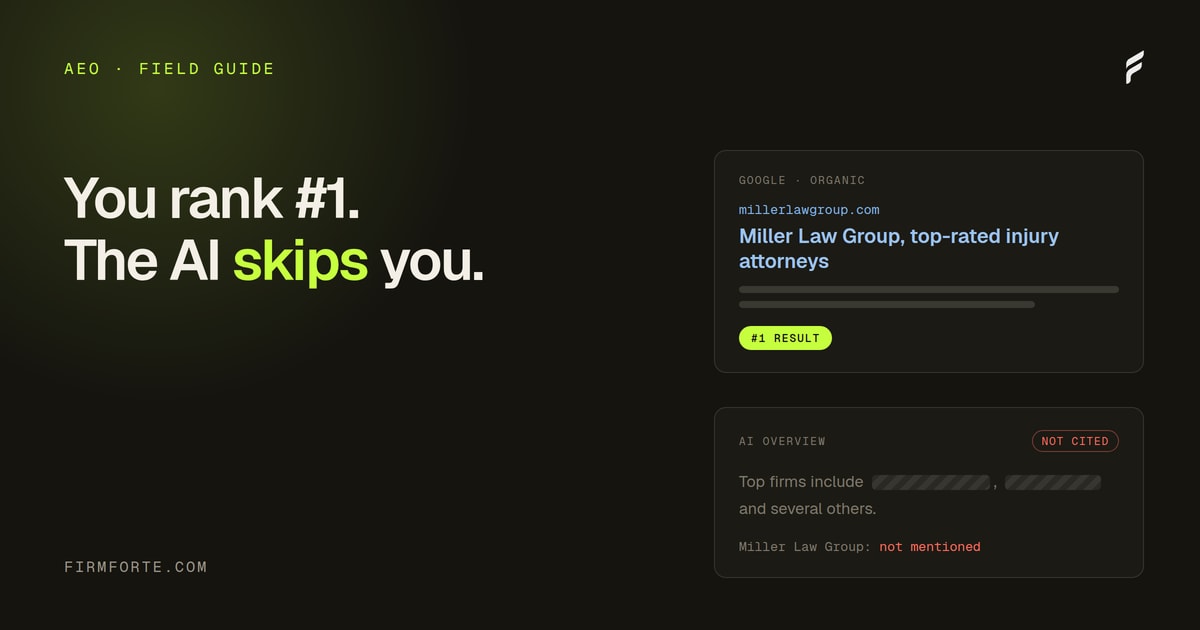
That changes what AI engines reward. In a category with mixed intent, the engine often cites educational sources over law firm sources. In PI, it cites law firms, but only law firms whose content matches the commercial-intent shape of the question.
The broader logic of intent-matching is in AEO vs SEO for law firms. The PI-specific implication: write every page assuming the reader is two months away from signing a fee agreement, not two years away from needing one.
Two: the entity graph includes non-firm entities most practice areas don't touch. In family law, the entity graph is mostly firms, attorneys, courts, and statutes. In PI, the graph also includes insurance carriers, medical providers, accident locations, and vehicle types. A page about "suing State Farm after a Phoenix car accident" reinforces State Farm as an entity in the engine's graph, and the engine starts recognizing the firm as a source for State-Farm-related queries even when the query doesn't name State Farm.
Most law firm sites don't write content that names insurance carriers, intersections, or medical specialties. PI firms that do build entity adjacency the firm without that content can't match. The general entity logic is in entities SEO for law firms; the PI-specific application is just the same rules applied to a richer graph.
Three: state-specific statute citation matters more. The PI statute of limitations varies from 1 year (Kentucky, Tennessee, Louisiana) to 6 years (Maine, North Dakota). Comparative negligence rules vary state to state. Caps on non-economic damages vary. PIP rules, no-fault rules, dram shop laws, dog bite liability all vary.
A PI page that cites Arizona Revised Statutes 12-542 (two-year statute) reads as authoritative on Arizona PI law. A PI page that says "you have a limited time to file" reads as vague generic content. AI engines cite the first one. The schema-types reference covers the FAQPage Answer rule for citing statutes by section number; for PI sites, that rule isn't optional.
Four: settlement and verdict data is uniquely citation-worthy. AI engines cite specific numbers more readily than generalities. A page that says "$1.4M settlement for a herniated disc in a rear-end collision in Maricopa County" gets cited. A page that says "we recover substantial settlements for our clients" doesn't. Most other practice areas have less of this data, or the data is harder to share (family law settlements are usually confidential, criminal defense outcomes are tracked as plea bargains and dismissals, estate planning doesn't have line-item dollar amounts the same way). PI is unusually rich in citable numerical outcomes, and most PI firms underuse them.
The mechanics of how anonymized result data becomes a citation surface are in the same family as named-attorney citation: specificity compounds into authority. The E-E-A-T guide covers the broader case.
Five: the asker might not be the victim. Defense attorneys, insurance adjusters, and other plaintiff attorneys also ask AI engines questions about PI cases. The shapes of their questions overlap heavily with victim questions, but the citation patterns are slightly different. They're more likely to cite the answer in a court filing or a settlement negotiation, which produces second-order entity reinforcement back to the firm. A PI firm whose answers are good enough to be quoted by opposing counsel ends up cited more by AI engines too.
The six page types every PI firm needs
Generic AEO advice ships practice area pages, attorney bios, and an FAQ. PI-specific AEO ships six page types that compound differently.
Six PI page types, one citation surface
The PI firm one entity
Generic AEO ships a practice page, some bios, and an FAQ. A PI firm needs six page types that each answer a question a buyer actually types.
Accident-type
Car, truck, motorcycle, slip-and-fall. Who's liable, the state SoL, the insurance picture.
Injury-type
TBI, herniated disc, wrongful death. Queried on their own, without naming the crash.
State-statute
Arizona's SoL, comparative negligence, damage caps. Answers the exact factual queries engines field constantly.
Case-worth
Honest ranges plus the variables that move them. Often the only honest content in the category.
Insurance-carrier
Suing State Farm in Arizona. Names the carrier, files the firm next to it.
Settlement result
One page per result, with the real facts and the real recovery number.
1. Accident-type pages. One page per accident type, written as a complete reference. Car accidents, truck accidents, motorcycle accidents, pedestrian accidents, bicycle accidents, slip and fall, dog bite, premises liability, product defects. Each page covers: who's typically liable, the statute of limitations in your state, the insurance landscape (especially first-party vs third-party), the medical-evidence requirements, and what victims typically recover. Six to nine pages of dense reference content, each one a citation surface for the engines.
2. Injury-type pages. One page per injury class. Traumatic brain injury, spinal cord injury, herniated disc, soft tissue, burns, amputations, scarring, wrongful death. These pages are queried independently of accident type. People search "average settlement for a herniated disc" without specifying the accident that caused it. Most PI firms don't have these pages, which leaves the entire injury-keyed citation surface to legal directories and content mills.
3. State-specific statute pages. A dedicated reference page for each major rule in your state. Statute of limitations. Comparative negligence rule. Damages caps. Recovery from uninsured motorists. Pre-suit notice requirements for cases against municipalities. These are the highest-citation pages on most PI sites once they exist, because they answer the exact factual queries AI engines field constantly.
4. Case-worth pages. One page per (accident type + injury) combination that produces real volume. "How much is a car accident neck injury case worth in Arizona." "Average settlement for a motorcycle accident with a TBI in Maricopa County." These pages have to be honest. Overpromising on settlement ranges damages credibility and produces citations the firm has to walk back in consultations. Honest ranges with the variables that move them (liability clarity, insurance limits, treatment duration, comparative fault) get cited because they're the only honest content in the category.
5. Insurance company pages. One page per major carrier in your market. Suing State Farm in Arizona. How to handle a Geico claim after a rear-end collision. Allstate bad faith claims. These pages do two things: they capture queries that name a carrier directly, and they reinforce the carriers as entities in the firm's graph. A PI firm with pages on the eight largest carriers in its state reads as a recognized counterparty to those carriers, not as a generic firm.
6. Settlement and verdict result pages. Anonymized case results with the actual facts, the actual injury, the actual recovery, and the actual variables that moved the case. Most PI firms list these as bullet points on a "results" page. The citation play is dedicating a page per result with two or three paragraphs of context. Done at scale (twenty to forty result pages), this is one of the most effective citation surfaces in the entire AEO playbook for PI. The architecture pattern that makes this work without diluting the rest of the site is the same one covered in how to design a law firm knowledge hub.
The schema layer specific to PI
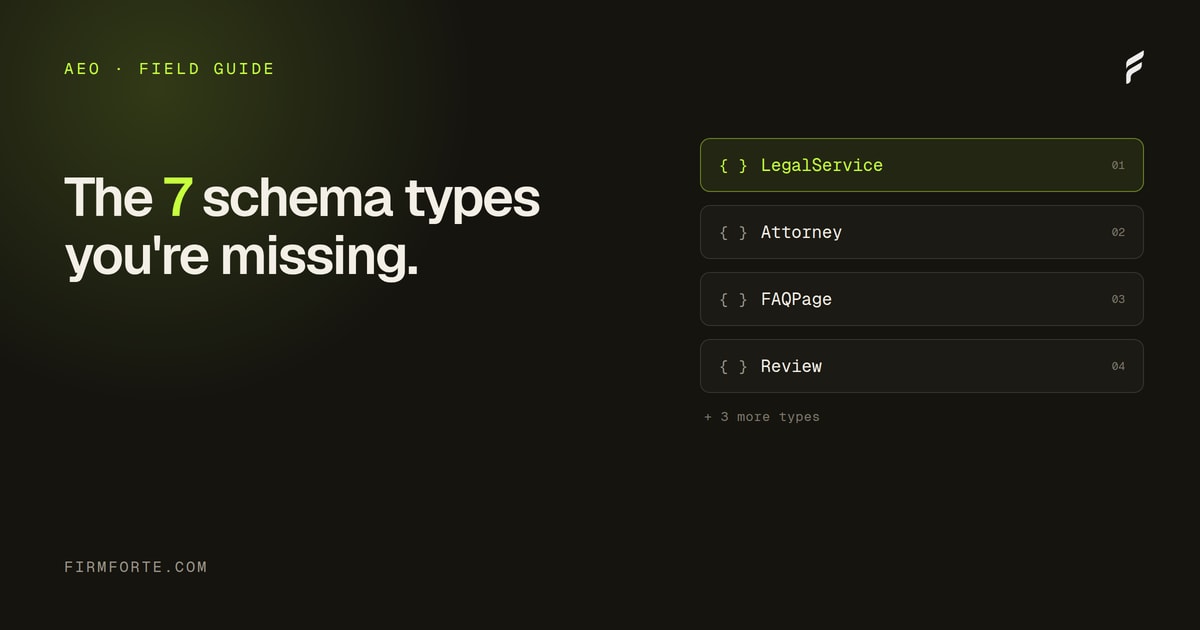
The seven schema types we recommend for all law firm sites still apply. PI adds two specific corrections.
First, the LegalService block's knowsAbout array should name the PI subtypes the firm actually handles, not "Personal Injury Law" as a generic catch-all. Car accidents, truck accidents, motorcycle accidents, premises liability, products liability, medical malpractice, wrongful death, mass torts. Each subtype the firm handles becomes a recognized topic the firm is associated with.
Second, Service blocks per accident type, each linked back to the firm's @id. We covered the general Service pattern in the schema-types post. For PI specifically, eight to ten Service blocks (one per accident type) compounding back to the firm reads to AI engines as a firm with real breadth in the practice area, not as a firm that's claiming breadth in marketing copy.
Service blocks also unlock something the generic playbook doesn't catch: AI engines extract serviceType more aggressively when the type is granular ("Motorcycle Accident Legal Representation") than when it's generic ("Personal Injury Law"). Granular Service blocks produce more citations per page than generic ones.
Entity reinforcement that's PI-specific
Off-site work follows the same logic as the general off-site SEO playbook, with three additions that matter disproportionately for PI.
One: bar association involvement specifically in the PI section. State bar PI sections, the American Association for Justice, state trial lawyer associations. These create third-party reinforcement specifically in the PI entity space, which compounds faster than generic legal third-party signals.
Two: medical provider relationships, declared on the site. A PI firm that lists the orthopedic surgeons, chiropractors, and pain management providers it commonly works with, without crossing the ethical line of recommending specific providers, reinforces medical-entity adjacency. Done carefully (no quid pro quo, no specific endorsements), this is one of the highest-ROI off-site signals available to PI firms.
Three: case-result publishing in jury verdict databases. Most states have a jury verdict reporting service. Submitting case results to those databases creates third-party records that AI engines cross-reference when verifying a firm's experience. A PI firm with twenty entries in the state jury verdict database reads to AI engines as a firm with twenty real cases.
The order to ship in
If you're running PI AEO and want to move from generic to PI-specific, ship the corrections in this order.
Week one: expand LegalService knowsAbout. Ship Service blocks on every accident-type page. Audit FAQ Answer text for statute citations and add the citations where missing.
Weeks two and three: state-specific statute pages and any missing accident-type pages.
Weeks four through six: injury-type pages. Each one is two or three days of research and writing.
Weeks seven through twelve: case-worth pages and the first ten to fifteen settlement result pages.
Months four through six: insurance company pages and the off-site PI-specific reinforcement program.
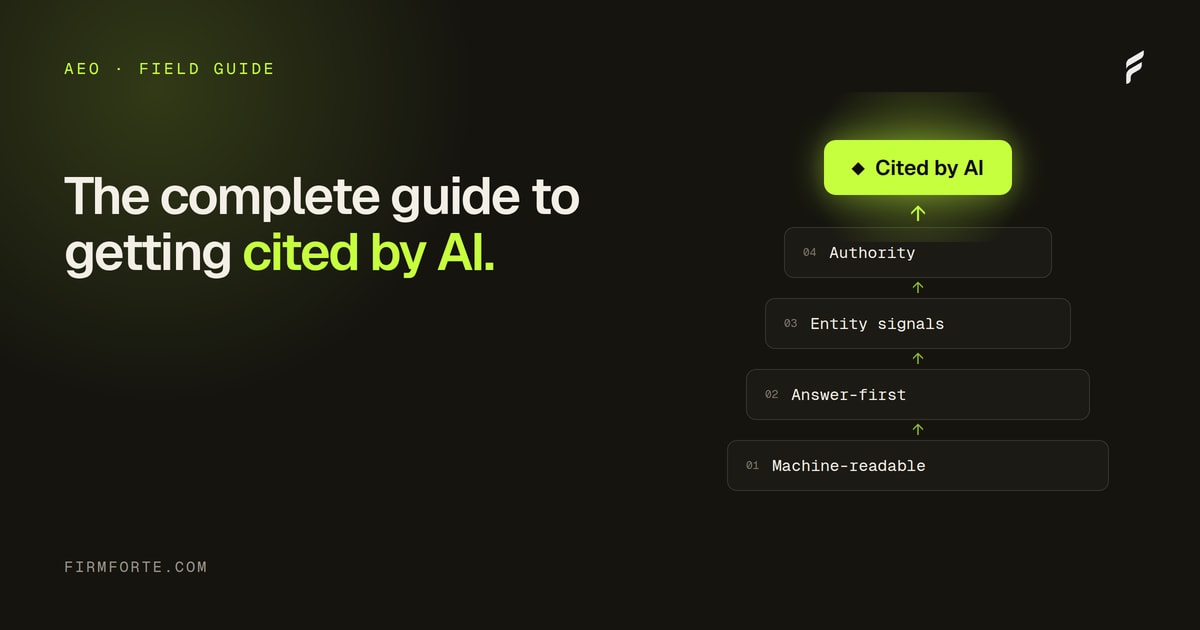
Order matters more than speed here. Each layer gives the next one something to reinforce: the schema tells an engine what the firm covers, the case-type pages give it something specific to quote, and the off-site work gives it corroboration from somewhere other than your own site. Shipping them out of order means doing the same work for less.
Send us your URL
The audit above takes us about 48 hours per site for a PI firm. Send us your URL and your three target metros. We'll run the PI-specific audit, hand back a structural report showing what's in place, what's broken, and what's missing, and come back with a real quote for what it would take to fix it. It's the same PI-specific work that runs inside our AEO for law firms service. Free, no card required, no expectation that you hire us afterward.
Questions we get about this
-
How is AEO different for personal injury firms?
The searches happen under pressure, usually on a phone, often within days of an accident — so the answer has to be immediate and the path to a call short. It's also the most competitive space in legal marketing, which means the baseline is higher: everyone has content, so being extractable and corroborated matters more than having pages at all. The upside is that the questions are predictable and finite, which makes them coverable. Depth on the specific questions beats breadth across the practice area.
-
What pages does a personal injury firm need for AI visibility?
One per accident type you take, pages answering the questions people ask in the first week, a page on how fees work, attorney bios that verify, a location page for each office, and results or case pages where your state's rules permit them. Each should answer its question in the first sentence rather than opening with an introduction to the firm. That set covers the searches that actually precede a call. Adding page types past that has diminishing returns compared with improving these.
-
What schema matters most for a personal injury firm?
LegalService for the firm with the practice areas named, Person for each attorney with a sameAs pointing at bar records and any press, and LocalBusiness for each office. Referenced back to one root rather than shipped in isolation, so the engine reads one firm rather than several fragments. Schema won't produce citations by itself — it makes the facts unambiguous to whatever reads them. Get it right once and it stops being a project.
-
Where should a personal injury firm start?
Confirm AI crawlers can reach the site, then fix the name-address-phone footprint, then rewrite the two or three highest-value pages to answer their question in the first sentence. That order matters: formatting answers is wasted while a crawler is blocked, and inconsistent entity data undermines everything built on top of it. Only after those three does content volume become the constraint. Most firms start at the last step and wonder why it didn't work.