

The short answer
Disability claimants are researching a government process, not shopping for a lawyer — they search for what the SSA requires, why they were denied, and what an appeal involves, often long before they consider representation. That makes the informational layer the whole strategy: answer the process questions first, convert locally second. The bare practice term itself is dominated by national advertisers and is genuinely hard to win.
Most law firm SEO advice assumes your market is local. For a Social Security Disability firm, that assumption is only half right. Yes, your clients live near you, and yes, you want to show up when someone in your city looks for help. But the searches that bring the most people to disability content aren't local at all. They're questions about a federal program, and the answers are the same in every state.
That's the opening most disability firms miss. The bare term, the "disability lawyer near me" search, is crowded and expensive and mostly won by whoever's buying the ads. The questions underneath it are wide open, and they're where people in a genuinely hard spot are actually spending their search time. Here's how to win that layer, and then turn it into local clients.
Why Social Security Disability is different from every other practice area
Social Security Disability is a federal program. The Social Security Administration runs SSDI and SSI under one national rulebook. The application process, the evidence standard, the appeal stages, the way benefits get calculated, none of it changes when you cross a state line. A claimant in Ohio and a claimant in Arizona are moving through the exact same system.
That has a direct consequence for search. In a practice area like personal injury or estate planning, the answer to a legal question genuinely depends on where you live, because the statutes differ state to state. In disability, the highest-volume procedural questions have one correct answer nationwide. "Why do disability claims get denied the first time" is the same answer in Dallas as it is in Detroit.
This is unusual, and it's an advantage if you use it. A page that answers a federal procedural question well can rank and get cited far beyond your metro, because it's just as true for everyone. You're not competing on local statute nuance. You're competing on whether your explanation is clear, complete, and trustworthy. That's a fight a good firm can win.
The questions disability claimants actually search
People apply for disability when they're out of work, out of income, and often scared. Their searches reflect that. They're not searching for a lawyer first. They're searching to understand what's happening to them. The volume clusters into a handful of themes.
Timelines. How long the initial decision takes, how long a hearing takes to get scheduled, how long the whole process runs from application to a decision. People stuck waiting search these constantly, because the wait is the hardest part of their year.
Denials. Why claims get denied, what to do after a denial, whether a denial means the case is over. Most initial claims are decided in ways applicants don't expect, and a denial letter sends people straight to search. This is some of the highest-intent traffic in the entire practice area, because someone who just got denied needs help now.
The appeal stages. What reconsideration is, what a hearing in front of an administrative law judge involves, what happens if the hearing doesn't go their way. The appeals process has distinct stages with their own rules, and each stage is its own set of searches.
SSDI versus SSI. The two programs get confused constantly. One is tied to your work history and the payroll taxes you've paid in; the other is need-based for people with limited income and resources. Some people qualify for one, some for both. "What's the difference between SSDI and SSI" is a foundational question a lot of applicants have before they understand which door they're walking through.
How the lawyer gets paid. This one matters more than firms realize. Disability representation runs on a specific fee structure: it's contingent, the fee is capped by federal rules, and it's generally paid out of past-due benefits rather than out of the client's pocket up front. People who are broke and afraid of legal bills are searching to find out whether they can even afford help. When your page answers that honestly and generally, without inventing numbers, you remove the exact fear that was stopping them from calling. Describe the structure accurately, point them to confirm specifics for their situation, and let the reassurance do the work.
Build the informational layer first
The strategic move is to build a real knowledge base around those questions before you worry about ranking for the money terms. Each of the themes above becomes a cluster of answer-first pages, written for the person in the hard spot, not for a search algorithm.
Answer-first means the page opens by answering the question in plain language, in the first paragraph, the way you'd answer a client across your desk. Then it expands: the detail, the exceptions, the what-to-do-next. Search engines and AI answer engines both reward this structure because it matches how people actually read a page they're anxious about. They want the answer, then the reasons. The general case for building an interlinked knowledge base instead of a scattered blog is in build a knowledge base, not a blog, and it applies with unusual force here, because your topics are stable federal procedure that won't go out of date next year.
Pair the explainers with a genuine FAQ built from the real questions claimants ask, phrased the way they phrase them. An FAQ page written to be quoted, with each answer complete enough to stand on its own, is one of the most citable assets a disability firm can own. The mechanics of writing one that answer engines actually pull from are covered in how to write a law firm FAQ page that gets cited. Schema markup helps here too, but keep it in perspective: structured data is hygiene and rich-result eligibility, not a trick that forces a citation. It makes a good page eligible for more. It doesn't make a thin page rank.
One honest note on scope. Because the procedure is federal, your explainers should stay federal. Don't dress up a national timeline as a local fact or imply your city has a special process it doesn't. The credibility of this whole strategy rests on the content being accurate, and claimants and the engines both punish pages that overreach.
Then convert locally
The informational layer builds reach and trust. It doesn't sign clients by itself. The conversion happens locally, because a claimant who finally decides to get help wants a real person in a reachable place. So the second half of the strategy is making sure every one of those informational pages has a clear path to your firm, and that your local presence is solid.
That starts with your Google Business Profile. Fully filled out, correct practice categories, real hours, a steady trickle of reviews from actual clients gathered in a bar-compliant way. When someone in your area moves from reading about denials to looking for a lawyer, the profile is often what they see first, and a strong one wins the click.
On the site itself, the intake path has to be obvious and low-friction. A claimant who's been waiting on the government for months has very little patience left. A visible phone number, a short and humane contact form, and copy that meets them where they are, not a wall of hype. For what a serious local practice-area page needs to do once the traffic arrives, see practice area pages for law firm SEO. The informational pages feed the practice-area and location pages; those pages convert.
One thing to be clear about: FirmForte doesn't build AI intake bots or chat widgets, and you don't need one to do this well. A clear form, a real phone number, and a fast human callback beat a chatbot for people in a stressful situation. The technology that matters here is content and local signals, not a robot on your homepage.
The honest part: the bare term is hard
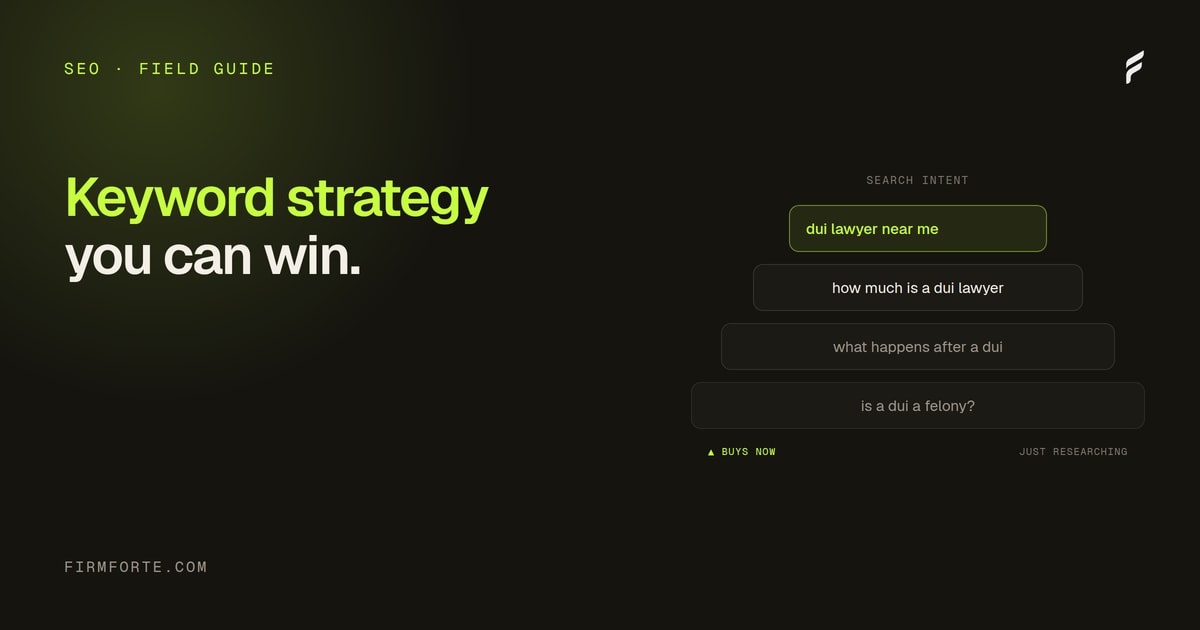
Ranking on "disability lawyer" or "disability attorney [city]" is genuinely difficult. Those terms are dominated by national lead-generation sites, directories, and firms with large ad budgets. If your whole plan is to fight for that one phrase, you'll spend a long time and a lot of money for slow returns, and no one can honestly promise you a top spot on it.
The questions are the opening precisely because everyone else is crowding the money term and skipping the informational layer. A firm that owns the answers to the timeline, denial, appeal, and program questions builds authority the ad-buyers never touch, gets in front of claimants earlier, and earns the trust that makes the eventual "who do I call" decision easier. It's a slower, sturdier route to the same clients, and it compounds instead of resetting every time you pause the ad spend. For how to think about which questions to target when you're a smaller firm without a huge team, keyword strategy for solo law firms walks through the prioritization.
None of this is a guarantee. SEO doesn't come with one, and any firm promising you rankings is selling something. What it is, is a strategy matched to how disability search actually works: a federal program, the same questions everywhere, a wide-open informational layer, and a local conversion at the end.
If you want to see where your firm already shows up for the questions your future clients are searching, and where the gaps are, send us your URL for a free review. In about 48 hours we'll send back a plain report on what's working, what's missing, and what it would take to own the layer the ad-buyers skip.
Questions we get about this
-
How is SEO different for Social Security Disability firms?
The searches are about the process rather than about lawyers. People want to know what qualifies, why a claim was denied, what a hearing involves, and how long it takes — and many are researching for months before they conclude they need representation. That means the pages that earn the client are informational ones that answer a government-process question, not practice-area pages selling a service. Converting comes second, after you've been useful.
-
What do Social Security Disability claimants actually search?
Denial reasons, listing requirements, timelines, what a hearing is like, whether a specific condition qualifies, and what happens to benefits in various circumstances — practical questions about a bureaucratic process. They use the SSA's own vocabulary sometimes and plain language other times, so cover both. These queries have real volume and far less competition than the term "disability lawyer". They're also where you can demonstrate that you know the process cold.
-
Can a small disability firm compete for the main practice term?
Honestly, rarely. The bare term is dominated by large national advertisers with budgets a local firm can't match, and treating it as the goal is how firms spend a year getting nowhere. The winnable ground is the specific process questions and the local variants tied to your hearing office and region. Compete where the competition isn't, and let the head term be something you might reach eventually rather than the target.
-
Where does local search fit for a disability practice?
It converts the traffic the informational layer earns. Someone who read your explanation of why claims get denied and then decides they need help will search locally or look you up by name — and that's where your Google Business Profile, reviews, and location signals do their work. Build the informational content first because it's what brings people in, then make sure the local footprint is clean so the conversion doesn't leak. The two halves fail separately if either is missing.