
The short answer
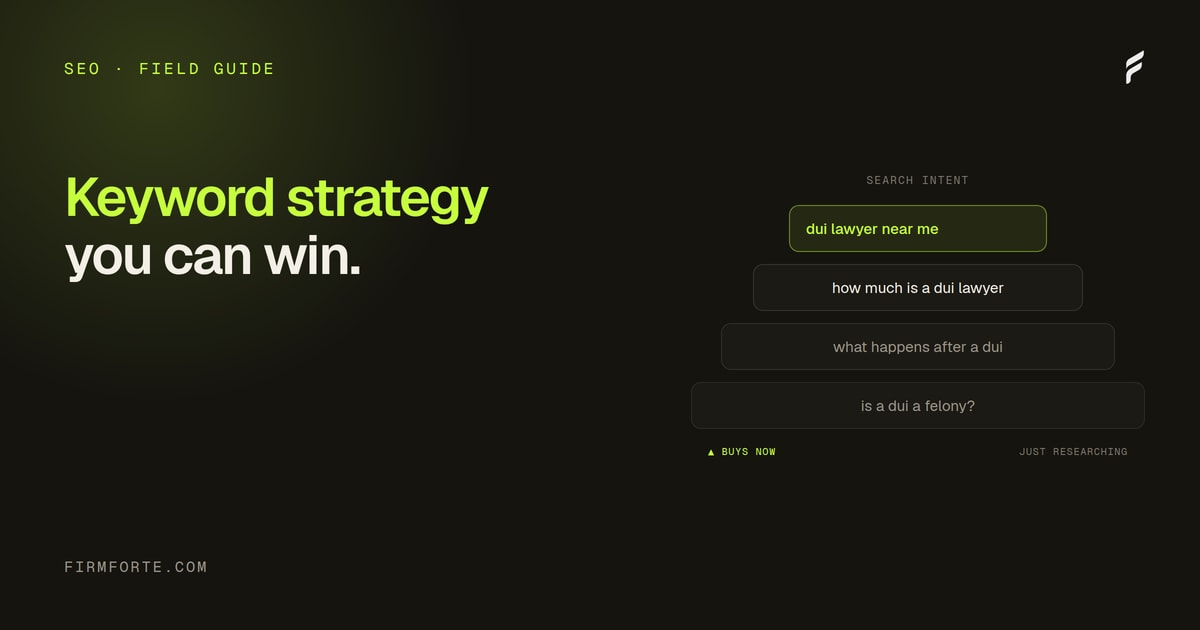
Traffic and DUI searches happen right after the stop or the arrest, on a phone, for the exact violation — "speeding ticket lawyer [county]," "first DUI [state]." So the firm that wins is the one that shows up locally for the specific charge, loads fast, and answers the real first question honestly: do I even need a lawyer for this? DUI adds fear and criminal stakes; a speeding ticket is a cost-and-points calculation. Same search bar, two different jobs.
Traffic and DUI defense is the practice area where the marketing funnel collapses into a single moment: someone just got pulled over or arrested, they're sitting in their car or at home that night, and they reach for their phone and search the exact thing that happened to them. There's no research phase, no shortlist built over weeks. There's a violation, a county, and a scared or annoyed driver typing it into Google. The firm that shows up, loads fast, and answers the real question gets the call. Everyone else is invisible at the one moment that matters.
Here's what that moment demands — and the part most "traffic lawyer marketing" advice misses, which is that traffic tickets and DUIs are two different jobs wearing one search bar.
Who searches for a traffic or DUI lawyer, and when?
People in the hours right after a stop, on a phone, searching the specific violation rather than a category. Nobody types "traffic attorney" and browses. They type "reckless driving [county]," "CDL speeding ticket [state]," "first DUI penalties," or "do I need a lawyer for a speeding ticket" — a precise, local, high-intent search made under mild panic or real fear. The decision gets made fast, and it gets made on the phone that took the search.
That shapes everything. The page has to name the violation and the jurisdiction in the first line, load in a hurry on mobile, and put a number where a thumb can reach it. Anything that adds a step — a slow hero image, a form before an answer, a generic "we handle all traffic matters" headline — loses the driver to the firm that just answered the question. This is the exact "someone gets a ticket and reaches for their phone" moment we built a Maryland traffic firm's whole site around, documented in the Waranch Knowledge Hub case study, where daily search clicks tripled once the content matched how people actually search after a stop.
Traffic tickets and DUIs are two different jobs
They start with the same kind of search and then split hard. A speeding or red-light ticket is, for most people, a cost-and-points calculation: how much is the fine, will it hit my insurance, will it put points on my license, and is a lawyer even worth it? The emotional register is irritation, not dread, and the client is price-sensitive and often leaning toward just paying. A DUI is a criminal charge. The register is fear, the stakes are a license, a job, maybe jail, and the decision is slower and far more serious.
That difference should shape the whole message. For traffic tickets, the most persuasive thing you can do is answer "do I actually need you?" honestly — because the driver is already asking it, and a firm that tells the truth earns the cases that genuinely need a lawyer. For DUIs, the lead is reassurance and availability, the same way criminal defense marketing works, because a DUI is criminal defense and carries the same urgency, the same 2am searches, and the same advertising limits on promising outcomes. Market them as one blurry thing and you under-serve both. Separate them and each message gets sharper.
What actually wins these clients?
Three things, all local and all built for speed: owning the map pack for your counties, ranking for violation-specific searches, and a mobile page that answers before it asks. For a decision made in hours on a phone, being visible and instantly useful is most of the battle.
The map pack is the foundation, because "DUI lawyer near me" and "traffic attorney [city]" surface three local results first, and being one of them is most of the win. That runs on a well-kept Google Business Profile and steady reviews, laid out in the Google Business Profile guide from setup to map pack. On top of that sits the content layer — a page for each violation that matters, in each county you serve — which is the part that compounds. Traffic and DUI are unusually geographic: the rules, fines, and point systems change by state, and often the court changes by county, so a firm that builds real local depth can out-rank bigger generalists on the exact searches that convert.
Try this yourself
Search your own money query
[violation and your county] — what shows up, and is your firm one of the first three results or the first real answer?
Opening a link sends the prompt to that company, the same as typing it there yourself. Nothing is sent to us.
The content that ranks for traffic and DUI
Violation-specific, penalty-specific, place-specific answers — the questions a driver types in the hours after a stop. Lead with the direct answer, then the detail, because there's zero patience for throat-clearing here.
The winning set looks like this, and it's the part most firms never build because it's more work than a single "Traffic Violations" page:
- A page per common violation with the real penalties and points for your state — speeding, reckless driving, driving on a suspended or expired license, no insurance.
- The honest "do I need a lawyer for [violation]?" answer for each, including when the answer is no.
- "Will this raise my insurance?" and "how many points is [violation]?" — the two questions behind most of the searches.
- First-DUI content: what actually happens, the process from here, and the plain-language next steps, written for someone frightened and new to this.
- The high-stakes drivers competitors ignore: CDL holders, security-clearance and government jobs, provisional or out-of-state licenses — they have the most to lose and search the hardest.
- County-level pages where the court and process genuinely differ, not thin copies with the city name swapped.
That last point matters: this is answer-first content built from genuine local demand, not spun location pages. The approach is the same one in keyword strategy for solo law firms — win the specific, less-contested searches your clients actually make instead of fighting for the head term "traffic lawyer." A driver searching "security clearance speeding ticket" or "second DUI [county]" isn't comparison shopping; they're looking for the firm that clearly handles exactly their situation.
Where the DUI side needs extra care
Because a DUI is a criminal matter, the rules tighten. No promising or implying outcomes, no misleading comparisons, and the same confidentiality limits that apply to any criminal case — the advertising standard is ABA Model Rule 7.1 and your state's version of it. Reassurance has to come from being clear, available, and competent, not from suggesting a result you can't guarantee.
Availability matters more on the DUI side, too. Arrests happen at night and on weekends, and a firm that can't be reached in that window loses the client to one that can — the reachability problem we cover in the criminal defense piece applies directly. A traffic ticket can wait until Monday; a DUI arrest often can't.
Reviews and trust, the compliant way
Reviews do double duty here: they help decide the map pack and they deliver fast credibility to a driver choosing in a hurry. Gather them the compliant way, which matters for the DUI side especially, since these are sensitive matters and the bar rules on testimonials and confidentiality still apply — all covered in a bar-compliant review strategy for law firms. A review that says the attorney explained the points situation clearly and was easy to reach is valuable without disclosing anything about the charge.
Build the local visibility, split your message between the cost-and-points driver and the frightened DUI client, answer the violation-specific searches honestly, and back it with genuine reviews, and you become the firm that's there when someone searches the ticket in their hand. To see whether you show up for those searches in your counties, run the free review, and the ongoing local and content work lives in our SEO service.
Questions we get about this
-
Do I even need a lawyer for a speeding ticket?
Often not for a single minor ticket, and saying so plainly is the most persuasive marketing a traffic firm has. It changes once points threaten your license, your insurance jumps, you hold a CDL or a security clearance, or the stop was a misdemeanor rather than an infraction. A firm that answers this question honestly on the page — instead of implying everyone needs representation — earns the trust that wins the cases that do need a lawyer. If the stakes touch your license or your job, talk to a lawyer before you just pay the fine, because paying is a guilty plea.
-
How do traffic and DUI clients search for a lawyer?
By the exact violation and place, on a phone, within hours of the stop — "reckless driving [county]," "DUI lawyer near me," "points for [violation] in [state]." The intent is high and the window is short, so the page has to load fast, say the violation and the jurisdiction in the first line, and put a working number where a thumb can reach it. DUI searches carry more fear and more deliberation than a speeding ticket, but both start the same way: a specific charge typed into a phone.
-
What content works for a traffic or DUI firm?
Plain, violation-specific answers tied to your state and county: what a given charge costs, how many points it carries, whether it raises insurance, what a first DUI actually involves, and the honest "is it worth hiring a lawyer" question for each one. These beat a generic "Traffic Violations" page because they match exactly what a worried driver types. Add the high-stakes angles your competitors skip — CDL holders, security-clearance jobs, provisional and out-of-state licenses — since those drivers have the most to lose and search the hardest.
-
Is DUI marketing different from traffic-ticket marketing?
Yes, enough to treat them as two jobs. A traffic ticket is largely a transactional, cost-and-points decision, often high-volume and price-sensitive. A DUI is a criminal charge with real fear attached, a longer decision, and tighter advertising rules — no outcome promises, and the same confidentiality and testimonial limits that govern criminal defense. The visibility playbook overlaps, but the DUI message leads with reassurance and 24/7 reachability, while the traffic message leads with a clear answer on whether hiring you is even worth it.