

The short answer
Work it backwards from your own numbers rather than from a percentage someone quoted: what a signed matter is worth to you, how many you want, and what share of inquiries you actually close. That gives you a defensible ceiling on cost per signed matter, and the budget follows from it. Most solo attorneys never set a formal budget at all, which is how the number ends up being whatever the last agency proposed.
Ask a solo attorney what their marketing budget is and the honest answer is usually a number someone else picked. Figures published by Constellation Marketing put it at roughly 14% of solo attorneys and about a third of small firms setting a formal marketing budget at all.
That statistic explains a lot of what we see. A firm without its own number can't tell whether a quote is high, can't tell when to stop funding something that isn't working, and has no basis for the conversation except how the proposal felt. The vendor's number becomes the number by default.
Working out your own takes an afternoon and some figures you already have.
Start from case economics, not a percentage
The common advice is to spend some percentage of revenue. It's a fine sanity check and a bad starting point, because it ignores the two things that actually determine what you can afford: what a matter is worth to you, and how many more you could handle.
A bankruptcy practice signing many modest matters and a commercial practice signing few large ones can have identical revenue and completely different answers. So work forward from four numbers instead.
- Average value of a signed matter. Your own figure, over the last year or two, for the kind of work you want more of. Not your best matter, and not the number you'd like it to be.
- How many more matters you actually want. Capacity is a real constraint. A budget that produces more inquiries than you can answer well makes things worse, not better.
- Your close rate on inquiries. What share of people who contact you become clients. Most firms guess this and guess high; it's worth counting for a month.
- What you're willing to pay per signed matter. Some share of matter value, chosen by you. This is the number that turns the other three into a budget.
Those give you a ceiling: if you'll pay up to a certain amount per signed matter, and you close a known share of inquiries, you can work out what an inquiry is worth and therefore what you can spend to generate them. It's arithmetic, and it's yours rather than a vendor's.
What the market rate is, for context
Your calculated number is what you can afford. The market rate is what things cost. Both matter, and they're not the same question.
Real ongoing marketing retainers for law firms commonly run $2,500 to $7,500 a month with the median near $3,500, per the 2026 pricing breakdowns collected in our piece on the median retainer. Solo practices in less competitive markets can find genuine help lower; firms in saturated practice areas and large metros spend considerably more. Our own published rates are $1,750 and $3,500 a month, with one-time options at $1,500 and $3,500, on the pricing page rather than behind a call.
If your calculated ceiling comes out far below the market rate for your practice area and city, that's genuinely useful information — and the honest response is to do the free foundational work yourself rather than to buy a cheap version of the paid work. Below a certain price there isn't enough time in the engagement for anyone to do anything, which is a different product sold under the same name.
The line items firms forget
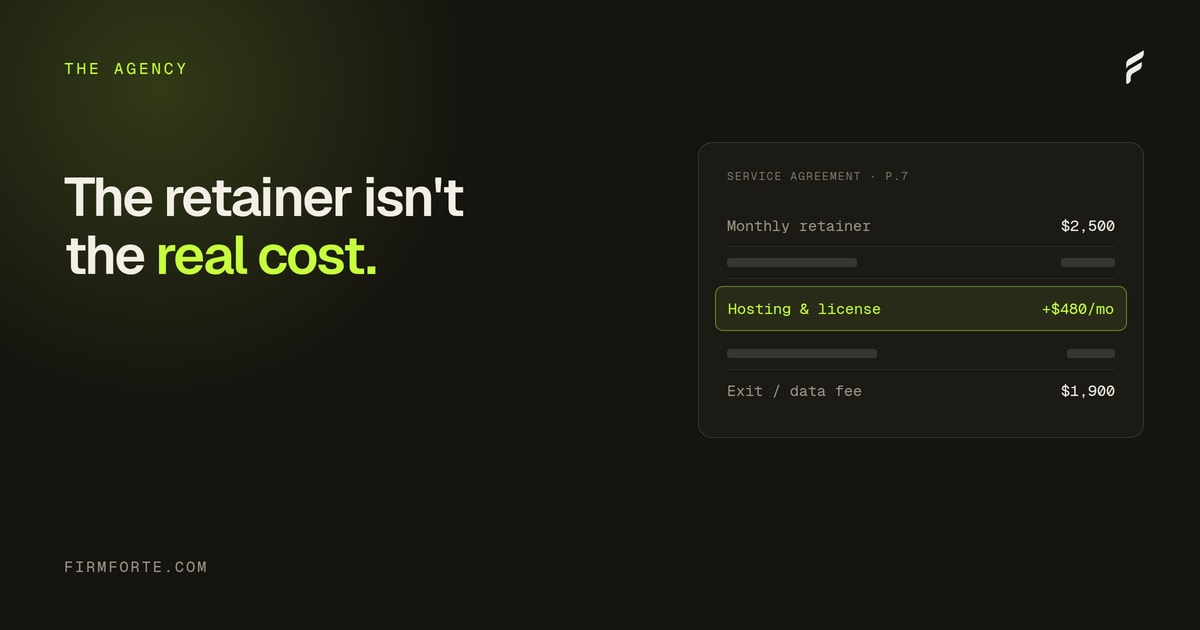
A budget built only from the retainer is wrong by a predictable margin. Four things routinely sit outside it:
- Ad management fees. A percentage fee sits on top of the ad budget rather than inside it, so a $3,000 ad spend can cost meaningfully more than $3,000. It also means the person advising you to increase spend earns more if you agree, which isn't dishonest but is worth naming.
- One-time build and fix costs. A rebuild, a migration, or a round of schema and technical work is capital rather than a monthly line, and it lands in the first quarter. What a new law firm site costs, how long it takes, and who ends up owning it is a separate decision from any monthly figure.
- Paid listings and tools. Directory profiles, call tracking, scheduling, analytics. Individually small, collectively not.
- Everything in the contract's appendices. Setup fees, content past an included limit, per-change charges, platform fees. The seven that show up most often are all disclosed somewhere written to be skimmed past.
Always compare the all-in number. Two quotes with the same monthly figure can differ by thousands a year once the extras arrive.
How to split it once you have a number
There's no correct ratio, but there is a sensible order.
Spend nothing first. The Google Business Profile, the name-address-phone consistency, and whether engines can read your site at all are free to fix and improve the return on everything you fund afterwards. Doing them first makes the rest cheaper, which is why they aren't really a budget question.
Then fund according to your runway, which is the same test as choosing between ads and organic: matters needed this quarter point at paid, a horizon of two or three quarters points at the compounding return of ongoing SEO for law firms. Splitting a small budget thinly across both is the reliable way to fund two things badly.
Hold something back for the one-time fixes the audit turns up. A budget fully committed to a monthly retainer has no room to fix a broken platform, and that's often the thing actually holding the site back.
How to know whether the number was right
Review it quarterly against the only figures that matter: signed matters, and what each cost all-in. Not impressions, not sessions, not rankings — those are steps on the way rather than results, and they can all improve while your caseload doesn't.
Ask every caller how they found you and write the answer down. Attribution for a firm your size is genuinely messy and no platform solves it, but a human answer recorded at intake captures what the referrer header lost.
Then be willing to act on it. A budget you never revisit isn't a budget, it's a subscription — and the whole point of setting your own number is being able to tell when it has stopped being the right one.
Questions we get about this
-
How much should a small law firm spend on marketing?
Enough that your cost per signed matter stays comfortably below what a matter is worth to you — which is a different number for every practice, so the percentage rules of thumb are close to useless. Work it from your own figures: average matter value, how many additional matters you want, and your close rate on inquiries. For context on the market, real ongoing retainers commonly run $2,500 to $7,500 a month with the median near $3,500. If your calculated ceiling is far below the market rate for your practice area, that's useful to know before you start rather than after.
-
Do most law firms have a marketing budget?
No — only around 14% of solo attorneys and about a third of small firms set a formal marketing budget, according to figures published by Constellation Marketing. That's the underlying reason so many firms end up spending whatever the last agency quoted: with no number of your own, the vendor's number becomes the number. Setting one takes an afternoon and changes how every subsequent conversation goes.
-
Should a law firm budget a percentage of revenue for marketing?
It's a reasonable sanity check and a poor starting point. Percentage rules ignore the two things that actually determine what you can afford — what a matter is worth and how many you can handle — and those vary enormously between a high-volume bankruptcy practice and a low-volume commercial one. Build the number from case economics, then check it against a percentage to see whether it's wildly out of line. If the two disagree badly, trust the case economics.
-
What should be in a law firm marketing budget?
The ongoing retainer or in-house time, any paid ad spend plus its management fee, one-time build or fix costs, and the tools and listings you pay for annually. Ad management fees are the line most often missed, because a percentage fee sits on top of the ad budget rather than inside it. Always work with the all-in number, since two quotes with the same monthly figure can differ by thousands once the extras land.