

The short answer
Nobody can guarantee a Google or AI ranking, because the position is the engine's decision and it changes without notice. What guarantees actually promise, once you read the wording, is usually a ranking on a term nobody searches, a position in a place you can't verify, or a refund clause with conditions that make it unreachable. An honest vendor guarantees the work and the reporting instead.
A salesperson tells your firm they'll guarantee first-page rankings. It's a good line. It answers the one question every managing partner actually has — will this work — with a flat yes, backed by what sounds like a promise. The trouble is that the promise can't mean what it sounds like it means, and the person saying it knows that. So the guarantee has to be something else. Either it's a word game, where "first-page rankings" has been quietly redefined into something achievable and worthless, or it's a contract trap, where the guarantee is real enough on paper but wired to a term you can't get out of. Usually it's both.
None of this makes SEO a scam. Ranking work is real, it compounds, and a good vendor earns its fee. But a guarantee is a specific claim, and it deserves to be read like a contract clause instead of heard like a reassurance. Here's what's underneath it.
Can anyone actually guarantee a Google or AI ranking?
No, and it's worth being precise about why. Nobody outside Google controls Google's ranking system. It's a machine that weighs hundreds of signals, retrains and reshuffles constantly, and personalizes results by location, device, and search history. Two people in the same city searching the same phrase can see different results. Google's own guidance tells you plainly that no one can guarantee placement, and that anyone who does should be treated with suspicion. The same is true, more so, for AI engines like ChatGPT, Google's AI answers, and Perplexity. What they surface is generated fresh, varies from session to session, and isn't a fixed list anyone can reserve a slot on.
So a vendor guaranteeing a ranking is guaranteeing an outcome produced by a system they don't operate and can't predict. That's not a promise about their work. It's a promise about someone else's algorithm. The only way to make that promise safely is to make sure the thing being guaranteed is either trivial to achieve or impossible to disprove. That's the game, and it's played in the wording.
The common tricks hiding inside the wording
Read the exact sentence, not the pitch. Almost every ranking guarantee survives by narrowing one of its words until the promise is easy to keep and useless to you.
Guaranteeing a phrase nobody searches. The classic move. They guarantee page one for a keyword — but not a keyword anyone types. Take a hypothetical: a personal injury firm in a mid-size city is promised first-page ranking for "compassionate catastrophic injury litigation counsel [city] free consultation." Ten words, near-zero search volume, no competition. Ranking it is almost automatic and drives no calls. The guarantee is technically met. Your phone doesn't ring. The terms that matter — the two- and three-word phrases your actual clients use — are conspicuously not in the guarantee.
Guaranteeing "a ranking," not a top spot. "First-page rankings" sometimes shrinks to "you will rank," meaning you'll appear somewhere in the results for some set of terms. Position 47 is a ranking. So is page nine. If the guarantee doesn't name a position and a specific, real-demand keyword, it isn't guaranteeing the thing you think you're buying.
Guaranteeing activity, not results. Watch for guarantees pinned to impressions, "visibility," rankings improving, or work delivered — twelve blog posts, a set number of backlinks, a monthly report. All of that is input and motion. None of it is a client. A guarantee that you'll get more impressions is a guarantee that a number in a dashboard goes up, which a vendor can influence without moving a single case to your door.
The traps that live in the contract, not the pitch
Some guarantees are real. That's where it gets more expensive, because a real guarantee is only as good as what happens when it's not met — and that's written in the parts of the contract nobody reads aloud.
The auto-renew trap. A twelve-month term with automatic renewal and a short cancellation window turns a guarantee into a lock. The guarantee gives you confidence to sign; the term keeps you paying whether or not the guarantee comes true. Miss the thirty-day notice window and you've re-upped for another year. The guarantee did its job — it got the signature — and the auto-renewal does the rest.
The clawback and the "guarantee" that's really a refund. Many ranking guarantees are refund or free-months promises: don't hit the target, get some money back or extra work. Read what triggers it. Often the target is one of the redefined ones above, or it's measured on a tool the vendor controls, or it excludes any month where you didn't approve every recommendation — which means the moment you push back, the guarantee voids. A guarantee you can only collect by never disagreeing isn't a guarantee. It's leverage.
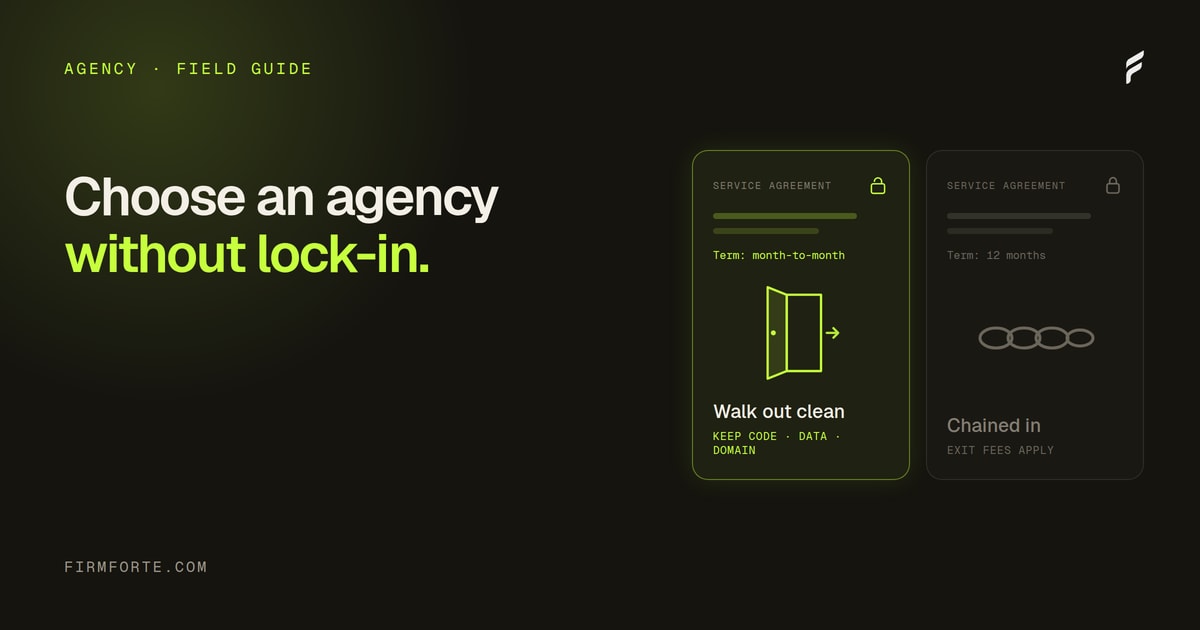
The ownership trap underneath it all. The quietest one. If the guarantee runs on a website you don't own, a Google Business Profile registered under the agency, or analytics you can't access, then leaving — even over a broken guarantee — means starting over. The promise is bolted to a platform you can't take with you. We wrote about that whole category in choosing a law firm marketing agency without lock-in, because it's the risk that outlasts any single campaign.
How to read the promise and what to ask
Slow the sentence down and make it specific. Four questions do most of the work.
Which exact keywords, and what do people search per month? Get the list in writing. Then check the phrases against a keyword tool, or ask the vendor to show the search volume. If the guaranteed terms have little or no real demand, the guarantee is decorative.
What position, and measured how? "First page" isn't a position. Ask for a named target and ask whose tool measures it, on whose location and login. A result that only shows up on the vendor's screen isn't a result.
What exactly happens if you miss it — and what voids it? Make them read the trigger and the exclusions out loud. If the remedy is more of the work that didn't work, or if it evaporates the moment you decline a recommendation, it isn't protecting you.
Can I leave, and what do I keep? The most important one. Ask about the term, the renewal, the notice window, and who owns the site, the profile, and the accounts. A guarantee attached to a contract you can't exit is a cost, not a comfort. For the full list to bring to a sales call, we keep a running one in questions to ask a legal marketing agency.
What an honest vendor guarantees instead
Plenty, actually. Just not the thing they don't control. An honest vendor guarantees their own work, because that's the only thing they can stand behind. That means a defined scope — what gets built, fixed, and published — on a stated cadence, not a vague "ongoing." It means reporting you can read, tied to metrics that mean something to a law firm: qualified inquiries, calls, real search terms moving, not vanity impressions. It means straight talk about what's working and what isn't. And it means you can leave — a term you can exit, accounts and a website you own, and no penalty for walking. That last one is the real guarantee, because a vendor confident in the work doesn't need to trap you into staying.
On the technical side, the honest version of "we'll help you show up" is about eligibility, not magic. Clean schema, fast pages, clear answer-first content, and a site an AI engine can actually read make you a candidate to be found and cited. They don't reserve you a spot, and no one can promise a specific engine will name your firm — that's a claim nobody can back. What good work does is stack the on-site signals in your favor and let the compounding happen. If someone tells you they can guarantee a citation or a placement, they're telling you they either don't understand the systems or they're counting on you not to.
So when you hear "guaranteed first-page rankings," don't argue with it. Read it. Ask which words, which position, measured how, and what it costs you to leave. The answers tell you everything the guarantee was built to obscure. If you want a second set of eyes before you sign, send us your URL for a free review — we'll give you a straight read on your site and what would actually move the needle, with no guarantees attached, because we're not going to sell you one nobody can keep.
Questions we get about this
-
Can anyone guarantee a Google ranking?
No. Ranking position is determined by the engine, depends on factors no agency controls, and changes without warning — including for reasons that have nothing to do with your site. Google has said explicitly that nobody can guarantee placement, and the same applies more strongly to AI citations, which vary between users asking the same question. A guarantee is therefore either meaningless or attached to a term chosen to be easy. Treat the offer itself as the disqualifying signal.
-
What tricks hide inside a ranking guarantee?
Guaranteeing a term nobody searches, so the promise is technically met and commercially worthless. Guaranteeing "a first-page ranking" without saying for what, or measuring from a location or device that flatters the result. Counting a map pack or ad placement as the ranking. And personalized results, which differ per user, so the vendor's screenshot and your search can genuinely disagree. Ask which exact term, measured how, from where, and by whom.
-
What should I ask a vendor offering a guarantee?
Which specific terms, what search volume they have, how position is measured and from what location, what happens if it isn't met, and what conditions attach to that remedy. The remedy is where these usually collapse: a refund that requires you to have stayed for twelve months, or free extra months rather than money back. Get the answers in writing before signing. A vendor who won't put the measurement method in the contract is telling you what the guarantee is worth.
-
What does an honest vendor guarantee instead?
The work, the cadence, and the reporting — what gets done each month, who does it, when you'll hear about it, and what you keep if you leave. Those are all things within the vendor's control, which is what makes them promisable. Outcomes in search are not, and saying so plainly is a better signal of competence than any guarantee. If you want something enforceable, put deliverables and ownership in the contract rather than a ranking.