
The short answer
Find every service that was being paid for on the agency's card, because those are what break first and they break silently. Hosting, the domain renewal, plugin and theme licenses, call tracking, and any analytics tools were often billed to them, not you. Then confirm you hold owner-level access to the domain, the site, Google Business Profile, Analytics, and Search Console, rather than the user-level access you were given. Verify each one by logging in yourself.
Leaving an agency is a decision. What follows is a project, and it's the part nobody plans for. The exit itself usually goes fine. Then six weeks pass and the site goes down, because hosting renewed on a card belonging to a company you no longer work with.
If you haven't given notice yet, read how to leave your law firm marketing agency cleanly first, because the order matters and some of this is much easier before the relationship ends. This post is for the firm that has already pulled the trigger.
Why does everything break weeks later instead of on day one?
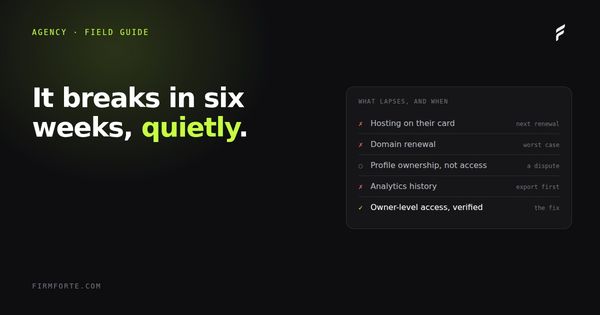
Because almost nothing your website depends on is billed monthly to you. It's billed annually to whoever set it up. Hosting, the domain, premium plugins, the SSL certificate on older setups, call tracking, rank tracking, an email service. Each one renews on its own date, on the agency's card, and each one fails quietly.
The failure mode is bad. A lapsed plugin license doesn't announce itself, it just stops receiving security updates. A lapsed domain doesn't redirect to an error page, it enters a redemption period where getting it back costs a few hundred dollars and some luck. By the time anyone notices, the thing that broke is a month old.
So the first month's work is almost entirely administrative, and it's worth doing properly once.
Week one: what has to happen immediately
Two jobs. Find the recurring payments, and confirm what you actually own.
On payments, the question to put in writing is specific: which services related to our website are currently billed to you rather than to us, and when does each one renew? That phrasing is harder to answer vaguely than "is everything paid up." Get the renewal dates, not just the list.
On ownership, the distinction that catches most firms is between access and ownership. You were probably given access, because access is what you need day to day. Ownership is what survives someone deciding to remove you. They look identical until the moment they don't.
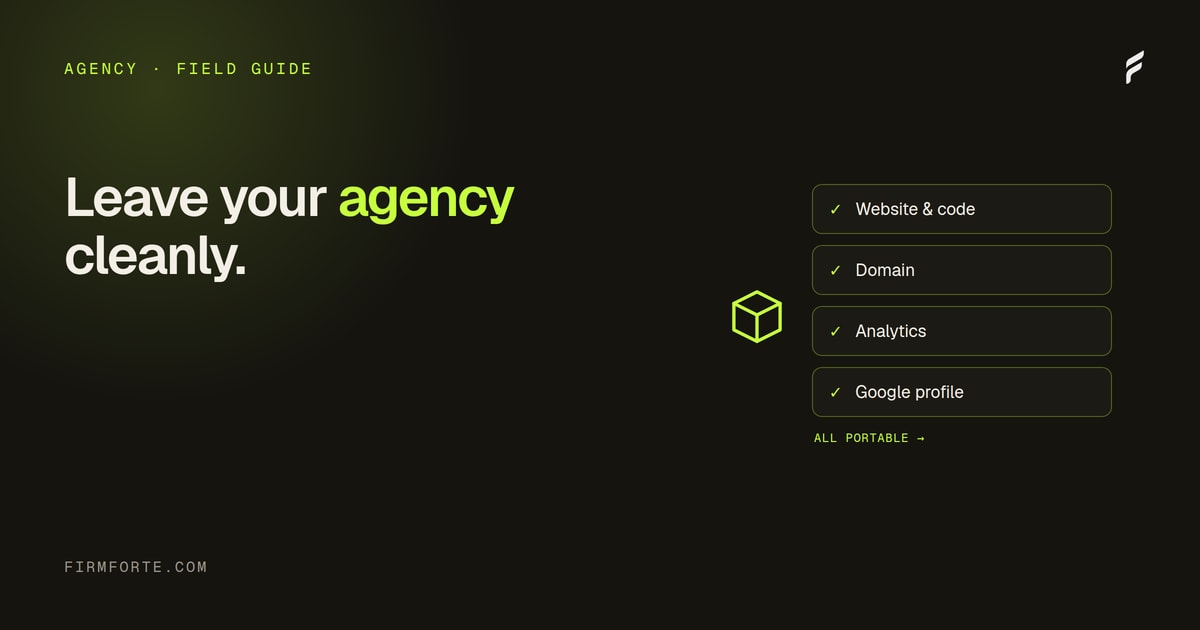
- Domain. Log into the registrar directly, not through the agency. Confirm the registrant is your firm and the renewal date is known.
- Hosting. Confirm the account is in your name and the card on file is yours.
- Google Business Profile. Open the user list. Confirm you are the owner, not a manager.
- Google Analytics. Confirm you have Administrator on the account, not just the property.
- Search Console. Confirm you are an owner, and that verification does not depend on a tag the agency controls.
- The site itself. Confirm an administrator login that isn't shared, and take a full export and file backup.
- Call tracking. Find out who owns any tracked number that appears publicly.
- Everything else recurring. Plugins, themes, email, schedulers, review tools.
Verify each of these by logging in yourself. Being told you have access is not the same as having it, and this is the week to find out which one you're holding.
Weeks two and three: the things that drift
The phone number deserves its own paragraph. If your public number was a tracking number the agency owned, losing it isn't just losing a line. That number is probably on your site, your Google Business Profile, your bar listing, Avvo, Justia, and a long tail of directories nobody remembers submitting to. Local search leans on those matching, and a number that disappears from one place but not thirty others fragments the whole signal. The mechanics of why that hurts are in call tracking numbers and NAP consistency.
If the number can't be ported, switch deliberately. Pick a date, change it everywhere in as short a window as you can manage, and keep the old one forwarding for as long as the agency will allow.
The second drift is content. Publishing usually stops the day the agency does, and nobody notices for a while because nothing visibly breaks. Pages age, facts go stale, and rankings soften over months rather than days. You don't need to maintain the old cadence in month one. You do need to know when the last thing was published, so the gap is a decision rather than an accident.
The third is tracking. If the agency installed analytics through their own tag manager container, your data can stop arriving the moment they clean up their account. Confirm the tracking on your site belongs to a container you control.
Try this yourself
Does the web still describe your firm the way you'd want?
What do you know about [firm name and city]? List the sources you used for each claim.
Opening a link sends the prompt to that company, the same as typing it there yourself. Nothing is sent to us.
Run that after the account cleanup rather than before. It surfaces the listings, directory entries, and old pages that are still describing you, some of which the agency created and none of which will update themselves. Treat anything wrong in the answer as a to-do list rather than a verdict.
Week four: get a baseline before you hire anyone
The temptation in month one is to replace the agency quickly, because the site feels unattended. Resist it for a few weeks if nothing is actually broken.
The reason is practical. Until you know your own numbers, you can't brief a new agency accurately and you can't judge what they change. Record where things stand now: non-branded organic clicks for the last three months, the pages getting impressions, the inquiries you received, and what was last published. Save it somewhere outside any tool an agency will later have access to.
That baseline is also the only defense against the oldest trick in the category, which is a new agency claiming credit for a recovery that was really just the previous work finishing its run. Search lags. Things that were done in your last three months with the old agency will still be landing in your first three months with the next one.
When you are ready to hire, choose on the exit rather than the pitch. The questions that sort the two apart are in the twelve questions to ask a legal marketing agency, and the contract terms worth refusing are in choosing an agency without getting locked in.
What if something is already broken?
Most of it is recoverable, and the order of urgency is not the order you'd guess.
A lapsed domain is the emergency. Registrars hold expired domains through a grace period and then a redemption period, and the cost and difficulty climb at each stage, so this is the one to handle the same day you discover it.
A site that's down is urgent but usually simple, because it's normally an unpaid hosting invoice rather than anything technical. A missing Google Business Profile owner is slow but survivable through Google's dispute process, so start it early precisely because it takes time. Lost analytics history is the one thing you genuinely cannot recover, which is the argument for exporting before you need to rather than after.
None of this is difficult work. It's just work that has an owner for the first time, and that owner is now you. If you want an outside read on what state the site is actually in before you hand it to anyone else, the free review covers it, and what we'd charge to take it on is posted on the pricing page.
Questions we get about this
-
What breaks first after a marketing agency leaves?
Anything on a recurring payment tied to the agency's card, which usually means hosting, the domain renewal, plugin or theme licenses, and call tracking. None of it fails on the day you part ways, which is what makes it dangerous. It fails whenever the next renewal falls due, often weeks or months later, and a lapsed domain renewal is the worst of them because recovery gets expensive fast. Find the renewal dates before you need them.
-
Can my old agency still control my Google Business Profile?
Yes, if they hold the primary ownership rather than a manager role, which is common when the agency created the profile. Being able to edit it is not the same as owning it, and owners can remove managers. Check the profile's user list and confirm your own account is the owner. If the agency is the owner, request a transfer while the relationship is still cordial, because the alternative is Google's dispute process and it is slow.
-
What happens to my call tracking number when I switch agencies?
If the agency owns the number, you can lose it, and that is a bigger problem than it sounds. That number may be published across your website, your Google Business Profile, directories, and years of citations, so losing it fragments the consistency that local search depends on. Ask whether the number can be ported to your own account. If it cannot, plan a deliberate switch back to your real line and update every listing rather than letting them drift out of sync.
-
Should I hire a new agency straight away?
Not in the first month, in most cases. Until you have owner-level access to everything and a baseline of your own numbers, you cannot brief anyone accurately or judge what they change. The exception is a site actively broken or a contract gap that leaves something unmanaged. Otherwise the month you spend securing accounts and recording where things stand is the month that makes the next relationship measurable.