
The short answer
Check the report against Search Console yourself, because that account is free, it is yours, and it is the one source the agency cannot shape. Split branded traffic from non-branded, look up whether the keywords being reported have any real search volume, and ask what each number would look like if the work stopped tomorrow. Reports that lead with impressions, ranking counts, and tasks completed are usually working around the numbers that matter.
For most firms paying a monthly retainer, the report is the entire relationship. You don't watch the work happen. You get a PDF, or a dashboard link, and a number that went up. Whether that number means anything is the whole question, and almost nobody is taught how to ask it.
This isn't an argument that agencies lie. Most don't. But every report is assembled by the people being judged by it, and there are numbers that flatter and numbers that inform. Knowing which is which takes about twenty minutes a month.
What does a misleading report look like?
It leads with the biggest number available and gets vaguer as it goes. Impressions in the headline, rankings in the middle, and inquiries either at the back or missing entirely. Nothing in it is false. The ordering is doing the work.
The clearest tell is that nothing ever goes wrong. Real search work has bad months: an algorithm update, a competitor outranking you, a page that decayed. A report that has shown steady improvement every month for a year is not describing search, it's describing a selection process. Ask what the worst number this month was. The answer, and the speed of it, is informative.
The second tell is that the work and the results are never connected. Twelve tasks on one page, a rising chart on the next, and no claim that one caused the other. That gap is deliberate and it protects the agency, because a connection you never explicitly made is a connection you can't be held to.
Which numbers are easiest to inflate?
Impressions. An impression means your site appeared somewhere in the results, including position 80 where nobody will ever see it. Impressions can climb for months while clicks stay at zero. They're the easiest number to grow and the least connected to getting a client.
Keyword counts. "You now rank for 400 keywords" sounds substantial until you look at which ones. Rankings for phrases nobody types are free to accumulate. So are rankings for your own firm's name, your attorneys' names, and long strings that happen to appear in your content.
Total traffic. Branded traffic, people who already knew your name and searched it, is traffic the marketing didn't create. If it's folded into one line with everything else, the chart can rise entirely on referrals and repeat clients while the work produces nothing.
Average position. An average across all your keywords moves when the mix changes, not only when your pages improve. Drop a few terms you were ranking badly for and the average improves without anything getting better.
Work delivered. Hours logged, posts published, "optimizations made." These measure effort, and effort is an input. You're paying for outcomes, and a list of tasks is a bill, not a result.
What should actually be in the report?
Five things, and most reports have room for all of them:
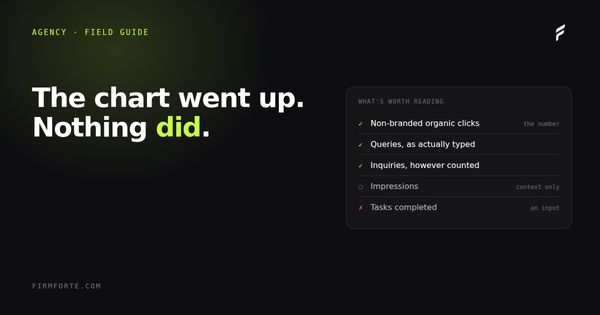
- Non-branded organic clicks, separated from branded. This is the closest thing to a single honest number for search work.
- The queries producing those clicks, not a curated keyword list. Real queries, as typed.
- What changed on the site, specifically, with URLs.
- Inquiries, however imperfectly counted, with the counting method stated.
- What didn't work, and what's being done about it.
Attribution for a small firm is genuinely difficult, and any agency claiming a clean line from a blog post to a signed case is overselling. That's covered properly in how to measure the ROI of your law firm's marketing. Difficulty is a reason to state the uncertainty, not a reason to skip the number.
How do you check it yourself?
Google Search Console is free, it takes minutes to verify if you aren't already in it, and it's the one source your agency can't shape. If you don't have access, that's the first thing to fix, and it should be your account with the agency added, not the reverse.
Once you're in, the single most useful action is filtering your firm's name out of the query list. What's left is people who found you without knowing you existed. That's what the retainer is supposed to produce.
- Open Search Console, set the date range to the last three months, and compare with the three before it.
- Filter out queries containing your firm name and any attorney names. Note the non-branded clicks.
- Check whether that number is rising, flat, or falling. Compare it to the report's headline.
- Take five keywords the report celebrates and look them up in any keyword tool. If they have no meaningful volume, they were free to win.
- Open the Pages report and confirm the pages the agency says it worked on are the pages getting impressions.
- Count the inquiries you actually received that month from your own inbox and phone log.
- Ask the agency, in writing, to connect one specific task from the report to one specific number in it.
That last step matters more than the six before it. A confident agency will answer it in a paragraph. An uncomfortable one will send a longer report next month.
Try this yourself
Are the keywords in your report worth winning?
I am a [practice area and city] attorney. List the ten search terms a potential client is most likely to type when they need my services, and mark which are commercially valuable and which are purely informational.
Opening a link sends the prompt to that company, the same as typing it there yourself. Nothing is sent to us.
Compare that list against the keywords in your report. Overlap means the work is aimed at people who might hire you. No overlap means it's aimed at whatever was easiest to rank for.
What if the report doesn't hold up?
Ask before you act. Some of what looks evasive is ordinary: a report template inherited from a bigger client, an account manager who doesn't understand the numbers either, or genuine early-stage work that hasn't produced results yet. Search takes months, and a flat six-month chart on a new site isn't proof of anything.
What isn't ordinary is a refusal to show you the raw account, or an explanation that gets less specific the more you press. If you can't get straight answers about your own data, the reporting problem is usually a symptom rather than the illness, and the questions worth asking next are in the twelve questions to ask a legal marketing agency.
If you get to the point of leaving, do it in the right order, because the sequence decides whether you keep your site and your rankings. That's laid out in how to leave your law firm marketing agency cleanly. And if you want an independent read on what's actually on your site before you decide anything, the free review gives you one, with our own terms posted on the pricing page.
Questions we get about this
-
How do I know if my law firm's marketing report is honest?
Compare it against Google Search Console, which is free and belongs to you rather than the agency. If the report's traffic and query numbers line up with what you see there, it is at least accurate. Honest and accurate are different things: a report can be entirely truthful and still be built from the friendliest numbers available. The test is whether it shows you anything that went badly, because a report with no bad news in it has usually been curated rather than compiled.
-
What should a monthly law firm marketing report include?
Non-branded organic clicks, the queries producing them, what was published or changed that month, and how many inquiries arrived. Rankings and impressions can appear, but as context rather than as the headline. The one thing that should never be missing is the connection between the work done and the result claimed. If you cannot draw a line from a task on the list to a number on the chart, the report is describing activity, not progress.
-
Why does my agency report rankings instead of leads?
Usually because rankings are easier to move and easier to present. There are legitimate reasons too: attribution for a small firm is genuinely messy, phone calls are hard to trace, and early SEO work produces ranking movement months before it produces cases. The problem is not that rankings appear, it is when they appear alone, month after month, with no attempt to tie them to inquiries. Ask for the connection once. How the agency reacts to being asked tells you more than the answer.
-
Can I check my agency's numbers myself without technical skill?
Yes, for the ones that matter most. Search Console shows clicks, impressions, average position, and the actual queries, and filtering your firm's name out of it takes about a minute. That single filter answers the most important question, which is whether new people are finding you or the same people are searching your name. Anything requiring a login you do not have is worth requesting in writing, and a refusal is itself a data point.