

The short answer
Fund ads first if you need matters this quarter and have the runway to keep paying; fund SEO first if you can wait six to twelve months and want the cost per case to fall over time. The honest answer for most small firms is neither exclusively — fix the free foundations, then put the discretionary money where your runway points. Ads stop the day you stop paying. SEO keeps working and can't be switched on when you need it.
This question usually gets answered by whoever is asking for the money. An agency that runs ad accounts will tell you ads; an SEO shop will tell you SEO. We sell neither ads nor ad management — our services are the site, the search work, and the profile behind it — so we have no position to defend here, and the answer can just be the answer.
Which is: it depends on three things about your firm, and none of them is a view about which channel is better.
The two channels solve different problems
Paid search buys attention now. You set a budget, your ad appears for the searches you've chosen, and people click. It works within days, it's measurable in a way organic never quite is, and it stops completely the day you stop paying. Nothing accumulates.
Organic search — the pages, the profile, the citations — buys attention later, and keeps buying it. It takes months to arrive, it can't be turned on when you need it, and it doesn't switch off when you stop investing. What accumulates is the reason your cost per case falls over time rather than staying flat.
Those aren't competing answers to one question. They're answers to two different questions: how do I get matters this quarter, and how do I stop paying this much per matter in three years. Which one you're actually asking is the whole decision.
The three things that decide it
Runway. If the practice needs signed matters inside ninety days to stay comfortable, that's an ads question, and no amount of content will change it. SEO cannot be accelerated by wanting it sooner. If you can carry six to twelve months on existing work and referrals, the money does more compounding in organic.
Practice area and urgency. Some matters are searched in a crisis and decided in an hour — a recent arrest, an accident, an emergency filing. Those reward being visible at the exact moment, which is what ads and the map pack do well. Others involve weeks of quiet reading before anyone contacts a lawyer, which is what content does well. An estate planning practice and a DUI practice are not making the same decision here, and it's a mistake to give them the same advice. Our criminal defense and estate planning pieces are the same argument at practice-area resolution.
Whether your intake can take it. Paid clicks arrive whether or not anyone answers. Every unanswered call is money already spent, so funding ads before intake is reliable is the most efficient way to waste a marketing budget. Organic is more forgiving of a slow response, because someone reading a page at 11pm didn't expect you to pick up. If you know your intake is patchy, that's an argument for fixing intake before funding either channel.
The thing to do before either, which costs nothing
There's a set of work that makes both channels cheaper, needs no budget, and is what we'd tell you to do before spending anything with anyone, including us.
- Check whether search and AI crawlers can actually read your site. If they can't, organic is impossible and your ad landing pages are probably weak too. Ten minutes with your robots.txt and a JavaScript-off page load answers it.
- Fix your name, address, and phone number so they're identical everywhere. Inconsistency undermines local visibility and quality score alike, and the format matters more than seems reasonable.
- Claim and complete your Google Business Profile properly. For local-intent searches it sits above everything you'd pay for, and most firms set theirs up once and never touched it again.
- Make your top practice-area pages answer the question in the first sentence. That improves organic and gives your ads somewhere worth landing.
None of that requires a decision about channels. All of it improves whichever one you fund next, which is why it's genuinely first rather than rhetorically first.
What ads actually cost in legal
Legal keywords are among the most expensive in Google Ads, for the obvious reason: a signed matter can be worth thousands or far more, so firms bid accordingly. The practical consequence for a small firm is that a budget too small to generate real click volume mostly generates noise — not enough data to tell a working campaign from a lucky week.
That's an argument for either committing properly or not starting, rather than for dabbling. It's also the argument for Local Service Ads as a different shape of paid: they bill per lead rather than per click, sit above the map pack, and carry the Google Screened badge, which is a third-party check a reader can see. They're not a substitute for organic, and they stop when you stop paying, but the economics are easier to reason about at a small budget.
Whichever paid route you take, judge it on cost per signed matter. Cost per click flatters the channel, cost per lead flatters it slightly less, and neither tells you whether the money worked. Attribution for a small firm is genuinely messy, so this needs someone recording where matters came from rather than a dashboard doing it for you.
What SEO actually costs, and when it shows
Real ongoing SEO work for a solo or small firm sits in the low four figures a month; the published market median is around $3,500, with most firms between $2,500 and $7,500, per the 2026 pricing breakdowns we've collected. What share of that you can actually justify is a separate calculation from your own case values, which we walk through in what a small law firm should budget for marketing. Our own retainers are $1,750 and $3,500 a month, published on the pricing page so you can compare rather than sit through a call to find out.
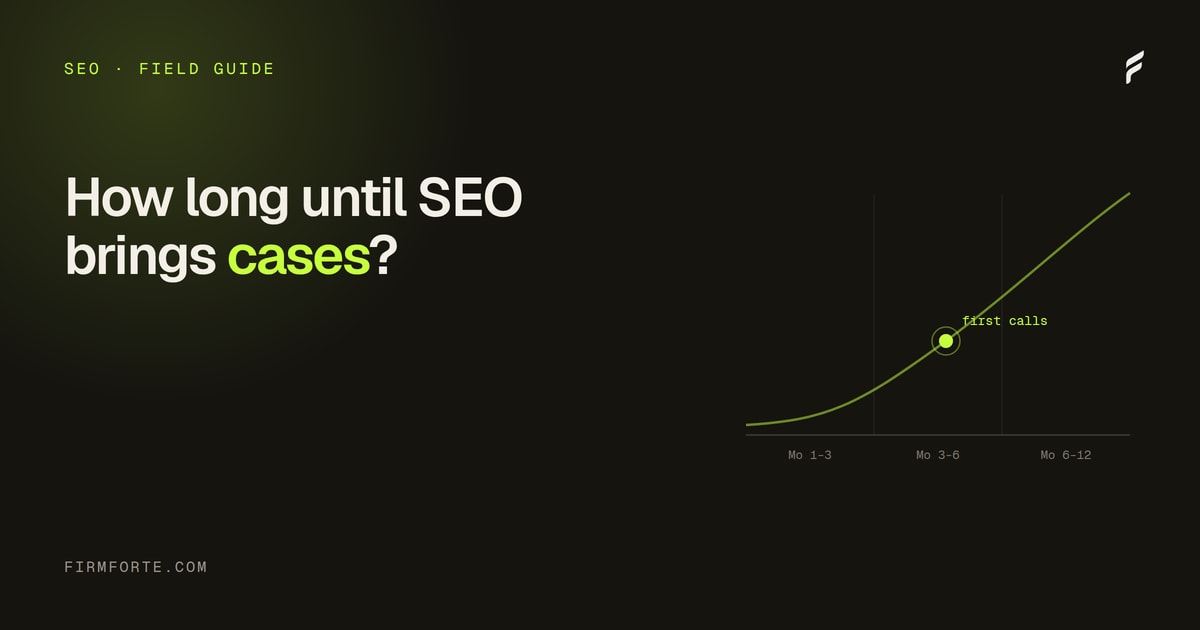
On timing: local improvements can show in weeks, competitive organic rankings usually take six to twelve months, and longer in saturated practice areas and large metros. That's the honest range, and anyone shortening it is either not competing for anything valuable or not telling you the truth.
So: which first?
If you need matters this quarter and can sustain the spend, fund ads, and run the free foundations alongside because they cost nothing. If you can wait two or three quarters, fund the organic work, because starting it later just moves the payoff later — the clock doesn't start until you do.
If the budget genuinely supports both, run both. They cover different parts of the same funnel, and the ad account tells you which queries convert, which is a free content brief for the organic side.
The one answer that reliably disappoints is splitting a small budget across both. A thin ad spend produces no usable data and a thin retainer produces no real work, and you end up having funded two things badly instead of one thing properly.
The version to be suspicious of
Be wary of anyone who answers this question without asking about your runway, your practice area, or your intake — because the answer genuinely depends on all three, and a vendor who skips them is answering from their own product catalog rather than your situation.
Be equally wary of the pitch that ads are a bridge to organic in a specified number of months. That's a real strategy and a reasonable plan; it just isn't a schedule anyone can commit to, for the same reason nobody can guarantee a ranking.
Questions we get about this
-
Should a law firm do PPC or SEO first?
Ads first if you need signed matters this quarter and can sustain the spend; SEO first if you can wait six to twelve months and want your cost per case to fall rather than stay flat. The deciding factor is runway, not which channel is better — they solve different problems. Before either, spend nothing and fix the free foundations: your Google Business Profile, your name-address-phone consistency, and whether engines can read your site at all. Those improve the performance of both channels, so doing them first makes whatever you fund next cheaper.
-
Is Google Ads worth it for a small law firm?
It can be, if you can afford enough sustained spend to gather data and your intake answers the phone. Legal keywords are among the most expensive in Google Ads because a signed matter is worth a great deal, so a budget too small to produce meaningful click volume mostly buys you noise. The other precondition is intake: paid clicks arrive whether or not anyone picks up, and an unanswered lead is money already spent. Judge it on cost per signed matter, not cost per click or cost per lead.
-
How long before SEO replaces the need for ads?
For most firms it doesn't replace ads so much as reduce how much you need them, and that shift usually starts somewhere in the six-to-twelve-month range. Local visibility moves fastest, competitive organic rankings take longest, and neither arrives on a schedule you can promise a client. The sensible plan is to run ads while the slower work matures and then reduce spend as organic and local carry more of the load. Firms that switch ads off the moment a ranking improves usually turn them back on.
-
Can a law firm run PPC and SEO at the same time?
Yes, and above a certain budget it's the right answer, because they cover different parts of the same funnel. Ads capture people ready now while organic and local build the visibility that keeps working between campaigns. Running both also tells you something useful: the queries that convert in your ad account are the ones worth building pages around. What doesn't work is splitting a budget too thin to do either properly, which is the common failure at the small end.